
1723534562.png)

CMAT GK Syllabus 2027 (General Awareness): Static GK + Current Affairs Topics
August 6, 2026
The CMAT GK syllabus is best understood as two distinct categories rather than one long list of topics. Some subjects stay fixed over time, while others shift with current events, and each type demands a different study approach.
Recognizing which category a topic belongs to helps you decide whether to memorize it once or revisit it regularly. This distinction shapes your entire preparation strategy far more than the topic list itself.
Key Takeaways for CMAT 2027 GK Syllabus
- High marks-per-question ratio: This section carries 80 out of 400 total marks, one of the highest scoring opportunities per question in the whole exam.
- Static GK dominates: In the CMAT 2027 paper, 19 of the 20 GK questions came from static GK, with only 1 from current affairs.
- No special negative marking pattern: Treat every question as attemptable here, just like other sections, check the official notification for the exact marking scheme.
- A 4-month plan works: August to December, with monthly current affairs revision and daily static GK reading, is enough to build a strong score.
- No official syllabus PDF exists: NTA has not released an official syllabus PDF for CMAT GK- the topics below are based on the AICTE-prescribed CMAT syllabus pattern, unchanged since Innovation & Entrepreneurship became compulsory in 2022.
What is CMAT GK Syllabus 2027?
The CMAT GK syllabus 2027 covers a wide range of current affairs and static General Knowledge topics that test a candidate's awareness of national and international events.
While NTA does not prescribe an official topic-wise syllabus, the CMAT 2027 GK syllabus typically includes current affairs, Indian history, geography, polity, economics, science, business, sports, awards, books and authors, important organizations, and government schemes. Consistent newspaper reading and monthly GK revision are essential to score well in this section.
What Does the CMAT 2027 GK Syllabus Actually Cover?
If you've prepared for CAT, this section will feel new. CAT has no GK section, but CMAT does and it's officially called General Awareness (GA) in the exam pattern.
It sits alongside four other sections: Quantitative Techniques & Data Interpretation, Logical Reasoning, Language Comprehension, and Innovation & Entrepreneurship. Each section, including GK, gets 20 questions and 80 marks.
The GK section rewards preparation more than raw aptitude. Unlike Quant or Reasoning, where you solve a problem in real time, CMAT previous year papers are either known or unknown the moment you read them. That's exactly why a structured CMAT 2027 GK syllabus matters here.
CMAT 2027 Exam GK Syllabus and Exam Pattern
The CMAT GK syllabus is one of the five sections of the CMAT exam pattern and evaluates a candidate's awareness of current affairs and static General Knowledge. Understanding where the CMAT 2027 GK syllabus fits within the overall exam pattern helps aspirants allocate preparation time effectively and maximize their overall score.
| Section | Questions | Marks |
|---|---|---|
| Quantitative Techniques & Data Interpretation | 20 | 80 |
| Logical Reasoning | 20 | 80 |
| Language Comprehension | 20 | 80 |
| General Awareness (GK) | 20 | 80 |
| Innovation & Entrepreneurship | 20 | 80 |
| Total | 100 | 400 |
The exam runs for 180 minutes, and candidates can move freely between sections, so you're not locked into finishing GK questions in a fixed time window. Many toppers finish GK first, since it takes the least time per question if you know the answer.
CMAT 2027 is expected to follow CMAT 2026's format closely. NTA typically confirms the exact CMAT exam GK syllabus pattern only when the official notification drops, expected around October 2026.
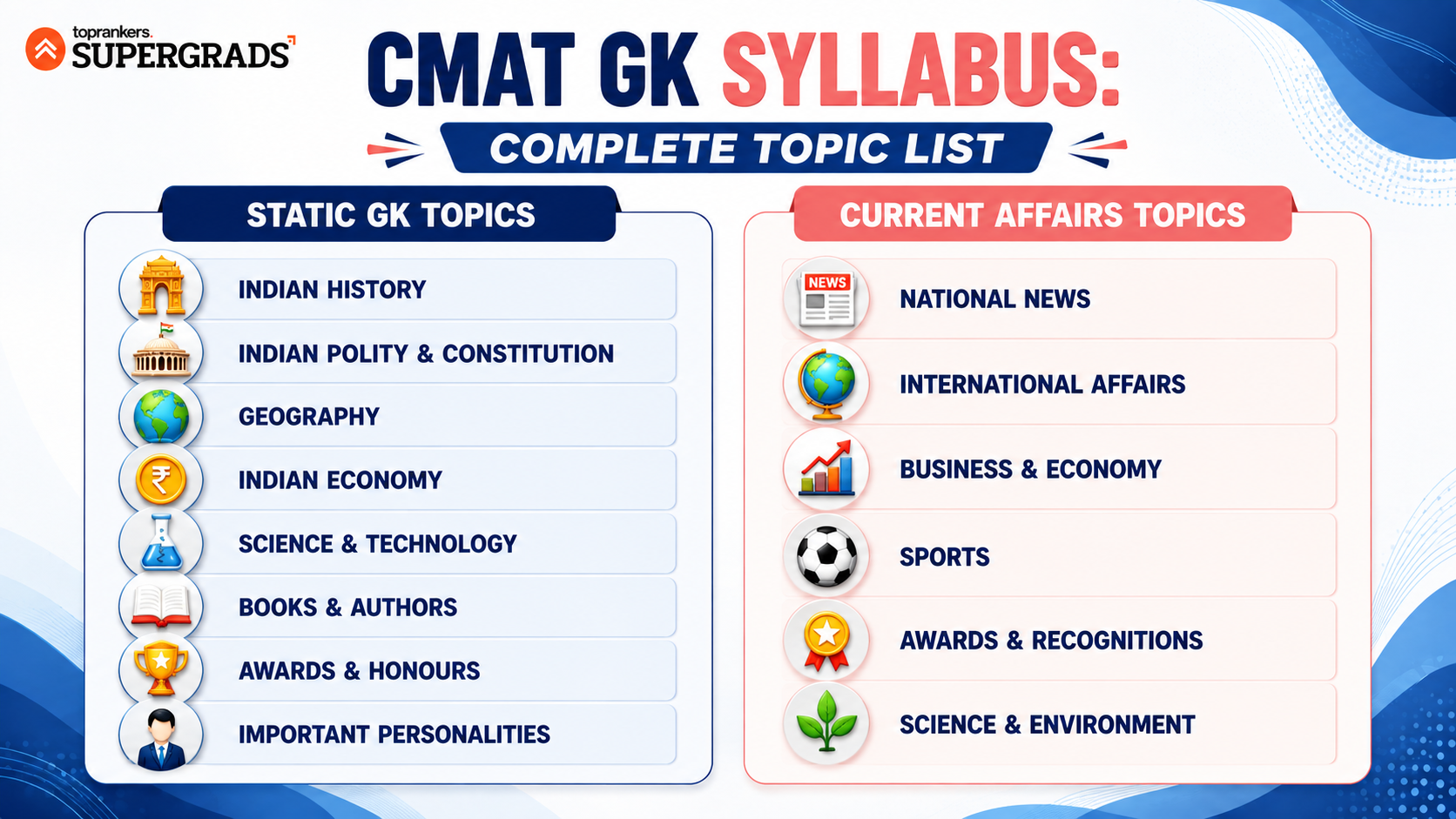
CMAT GK Syllabus 2027: Complete Topic List
The GK syllabus for CMAT exam splits into two clear buckets. Knowing which important CMAT exam topic falls into changes how you should study it.
Static GK Topics in the CMAT GK Syllabus
Static GK covers facts that don't change with the news cycle. You can build this knowledge months in advance.
- Indian History: Freedom movement, ancient and medieval India, important dates and events
- Indian Polity & Constitution: Fundamental rights, amendments, parliamentary structure, constitutional bodies
- Geography: Indian states, capitals, rivers, physical features, world geography basics
- Indian Economy: Five-year plans, economic reforms, banking basics, tax structure
- Science & Technology: Basic scientific facts, inventions, discoveries, space missions
- Books & Authors: Well-known Indian and international authors and their major works
- Awards & Honours: Padma awards, Nobel Prize categories, national awards
- Important Personalities: Founders, freedom fighters, business leaders
Current Affairs Topics
Current affairs need a rolling revision system, not a one-time read.
- National News: Government policies, schemes, and appointments
- International Affairs: Global summits, treaties, and major world events
- Business & Economy: Mergers, RBI policy changes, major corporate news
- Sports: Tournament winners, records, and major sporting events
- Awards & Recognitions: Recent award announcements across fields
- Science & Environment: New research, climate policy, space updates
Practical Insight: Most papers based on the CMAT 2027 GK syllabus pull current affairs from the 6 months before the exam. If your exam is in January 2027, focus your current affairs revision on news from roughly July 2026 onward, not the entire year.
Static GK vs Current Affairs: What the CMAT GK Syllabus Data Actually Shows
This is where a lot of guides give vague advice. Here's what the actual CMAT 2026 paper analysis showed, compared with the general pattern most guides assume about this section.
| Aspect | CMAT 2026 Actual Trend | Commonly Assumed Pattern |
|---|---|---|
| Static GK Share | 19 out of 20 Questions | Roughly 50–60% |
| Current Affairs Share | 1 out of 20 Questions | Roughly 40–50% |
| Difficulty Level | Medium | Medium |
| Regional Focus | Mostly Indian Events | Mixed National & International |
Why this matters: Several exam-prep sites claim current affairs carries the "highest weightage" in CMAT GK. The actual 2026 paper analysis contradicts that. This doesn't mean skip current affairs, it means don't let it crowd out static GK revision, which has historically delivered more marks per hour of study.
Treat this as a signal, not a guarantee. NTA can shift the ratio in any given year, so a balanced approach, roughly 65% static, 35% current affairs in your study time, is the safer bet for CMAT 2027.
Topic-Wise Weightage in the CMAT GK Syllabus (Based on Previous Year Trends)
Since NTA doesn't publish an official weightage breakdown, this table is built from analyzing recent CMAT papers. Use it to prioritize, not as a guaranteed marks predictor.
| CMAT Year | Static GK | Current Affairs |
|---|---|---|
| 2025 | 15 | 5 |
| 2024 | 16-18 | 2-4 |
| 2023 | 16 | 4 |
| 2022 | 16 | 4 |
Previous Year Trends in the CMAT GK Section
Looking at recent CMAT cycles gives you a realistic sense of what to expect:
- Question format stays consistent: straightforward, single-fact MCQs with five options, and CMAT subjects are not tricky or twisted like Reasoning questions.
- Indian-centric focus: the bulk of questions relate to India, with only a handful touching international events.
- No major surprises: CMAT GK doesn't test obscure trivia the way some other exams do; it sticks close to what a well-read graduate should know.
- Difficulty is stable: rated medium consistently across the last few cycles, unlike Quant, which has shown more variation.
This consistency is good news. It means a disciplined, ongoing study habit beats last-minute cramming for this section specifically.
Among all CMAT GK syllabus preparation tips, this one gets ignored the most. Aspirants often assume current affairs deserves most of their attention because it feels more urgent.
The CMAT 2026 paper tells a different story 19 of the 20 GK questions were static, with only 1 from current affairs. Other analyses suggest a 70–30 or 80–20 static-to-current split is typical across recent cycles.
What to do: Spend roughly 65% of your GK study time on static topics (history, polity, geography, economy, science) and 35% on current affairs. Adjust slightly if a fresh CMAT 2027 pattern update suggests otherwise.
Tip 1: Build a Daily Current Affairs Reading Habit
Read one national newspaper or a reliable current affairs app every day, and write down 5–10 key facts instead of just skimming. Passive reading rarely survives to exam day.
Keep this habit going for at least 4–6 months. It's one of the more time-efficient CMAT GK syllabus preparation tips because it compounds, a small daily effort adds up to solid current affairs coverage by January.
Tip 2: Pick One Static GK Book and Stick With It
Static GK preparation goes wrong when aspirants juggle three or four best books for CMAT 2027 at once and never finish any of them properly.
Choose one comprehensive book Lucent's General Knowledge or the Manorama Yearbook are common choices, and go through it topic by topic: history, polity, geography, economy, and science and technology.
Tip 3: Revise on a Fixed Schedule, Not When You Remember To
Static facts fade fast without repetition. Set a revision pass every 3–4 weeks for topics already covered, rather than revising only when you happen to think of it.
This single habit separates aspirants who retain their static GK from those who relearn the same facts twice.
Tip 4: Use Monthly Current Affairs Compilations
At the end of each month, go through a monthly current affairs digest. This catches anything missed in daily reading and reinforces what you already noted down.
Focus your final revision on the 6 months before your exam date if CMAT 2027 falls in January, current affairs from July 2026 onward matters most.
Tip 5: Practice With Previous Year GK Papers
Attempt the GK sections from past CMAT papers under timed conditions. This is one of the more underused CMAT GK syllabus preparation tips, since most aspirants only look at full mock tests.
Previous year papers tell you exactly which topic areas need more attention and how NTA phrases its questions details a topic list alone can't show you.
Tip 6: Take GK-Specific Sectional Mocks
Don't rely only on full-length mocks. A GK-only sectional test, taken weekly during the last two months before your exam, sharpens recall speed specifically.
Track your score on each sectional mock. If a topic area keeps costing you marks, go back to your static GK book and revise that section before the next test.
Tip 7: Don't Skip Questions Out of Fear
CMAT deducts 0.25 marks for a wrong answer, the same as every other section. Many aspirants leave GK questions blank because they assume a wrong guess costs more here it doesn't.
If you can eliminate even one or two options, attempt the question. Educated guessing in GK carries the same risk-reward as any other section of the exam.
Tip 8: Build a Month-Wise Study Calendar
| Month | Focus |
|---|---|
| August–September | Static GK Foundation: History, Polity & Geography |
| October | Static GK (Economy & Science) + Start Daily Current Affairs |
| November | Monthly Current Affairs Revision + First GK Sectional Mocks |
| December | Intensive Revision, Previous Year Papers & Weak-Area Improvement |
| January | Final Revision of Notes Only, No New Topics |
A calendar like this keeps your CMAT GK syllabus preparation tips from turning into vague intentions. Each month has one clear job.
Tip 9: Track What's Actually Working
Not every technique suits every aspirant. If sectional mocks show static GK is strong but current affairs keeps slipping, shift more time there for the remaining weeks.
The best CMAT 2027 GK syllabus preparation tips are the ones you actually measure track your sectional scores monthly and adjust your study split based on real results, not assumptions.
Expert Tip: Don't buy three or four GK books at once. Aspirants often lose momentum switching between overlapping sources while preparing. One static GK book plus one current affairs source, used consistently, beats five books used inconsistently.
Conclusion
CMAT GK rewards steady, structured effort more than any other section in the exam. Here's what to do starting today:
- Pick one static GK book and one current affairs source don't juggle multiple.
- Set a daily 20–30 minute reading habit for current affairs.
- Revise static GK topics every 3–4 weeks so they stay fresh.
- Solve at least 3–4 previous year GK sections before your exam.
- Track your monthly current affairs notes so December revision is fast, not overwhelming.
The CMAT 2027 notification is expected around October 2026, with the exam likely in the last week of January 2027. That gives you a solid window to build genuine strength in this section rather than cramming in the final weeks.
Free resources for CMAT 2027
| CMAT 2026 Question Paper | CMAT 2025 Question Paper | CMAT 2024 Question Paper |
| CMAT Cut Off | CMAT Colleges | CMAT Mock Exam |
| CMAT Exam Syllabus | CMAT Total Marks | CMAT Online Coaching |
Smart Prep for CAT: Join Our Free Demo Class
Fill your details
Frequently Asked Questions
1. How many questions come from the CMAT GK syllabus in 2027?

Is static GK or current affairs more important for CMAT GK?
Has NTA released an official CMAT exam GK syllabus PDF?
When should I start preparing for CMAT GK?
Which book is best for CMAT static GK?
Does GK have negative marking in CMAT?

Zubeen Siddiqui
Content Writer | MBA & CAT Preparation
SHARE