
1723534562.png)

CAT Quantitative Aptitude Syllabus 2026: Important Topics, Weightage & Difficulty Level
March 10, 2026
Overview: The CAT Quantitative Aptitude Syllabus focuses on testing a candidate’s numerical ability, analytical thinking, and problem-solving approach through real-life mathematical applications. The section evaluates how effectively aspirants can apply concepts rather than just memorise formulas.
Since the CAT Quantitative Aptitude Syllabus 2026 has not been officially released by the exam authority, it is derived from previous years’ question papers and trends, helping aspirants understand the most important concepts that frequently appear in the exam.
Key Takeaways
- Questions are often context-based and require multiple steps of reasoning.
- Some questions allow the use of approximation and smart calculation techniques.
- Topic weightage varies every year, making overall syllabus coverage important.
- Candidates with non-math backgrounds can also perform well with the right preparation strategy.
What You Will Get in This Blog: Complete breakdown of the CAT Quantitative Aptitude syllabus + Expert tips + Mistakes to avoid while solving the QA section.
CAT Quantitative Aptitude Syllabus 2026
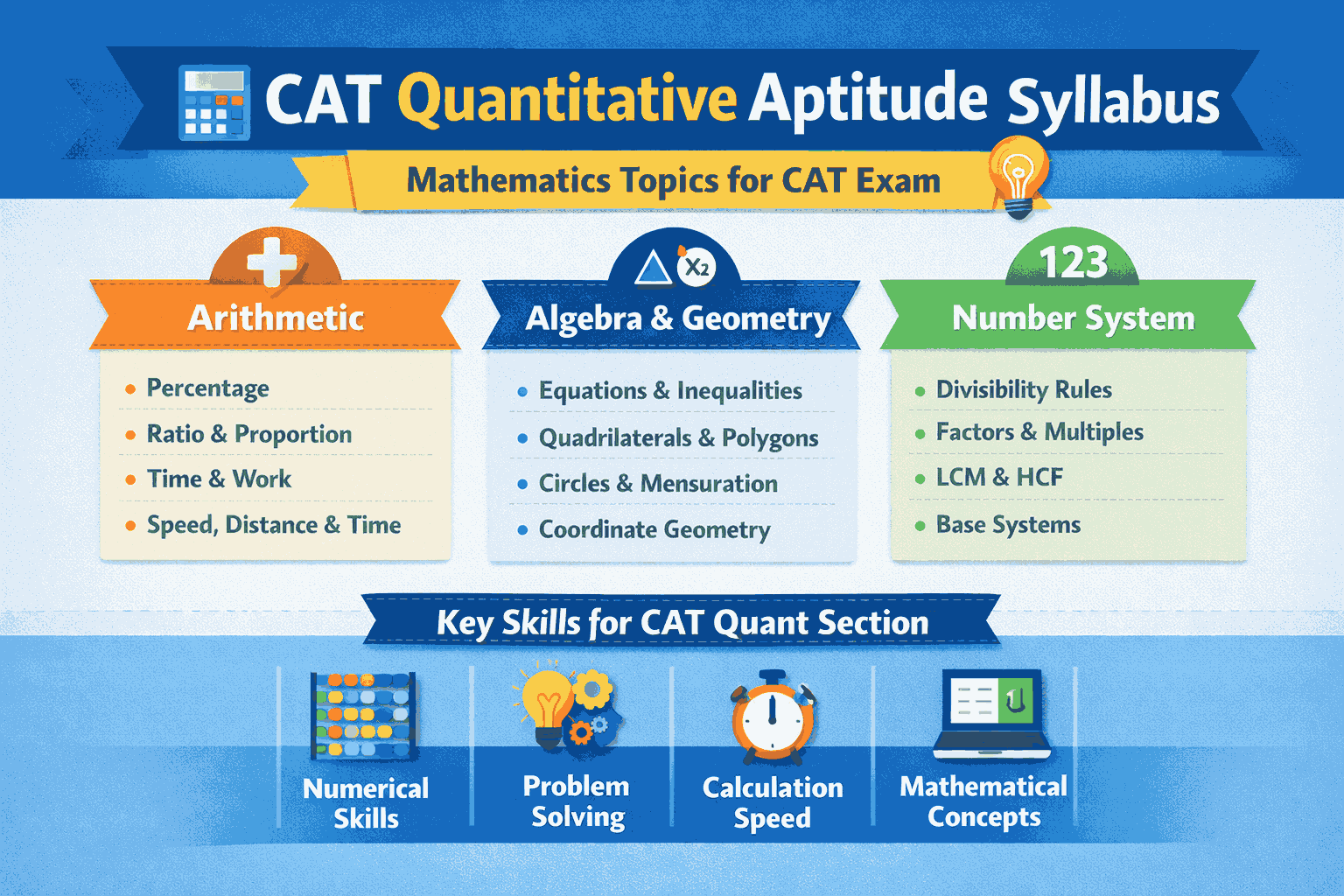
The CAT Quantitative Aptitude Syllabus covers all the key mathematical topics required to solve problem-solving questions in the CAT exam.
It mainly includes Arithmetic, Algebra, Geometry, Number System, and Modern Mathematics, which together form the Quant section of the exam.
Arithmetic usually remains the most important area in the CAT Quantitative Aptitude syllabus 2026, followed by Algebra.
Geometry, Number System, and Modern Maths also contribute regularly, so candidates should prepare them strategically rather than leaving them entirely.
Here is the section-wise CAT QA Syllabus for 2026
1. CAT Arithmetic Syllabus for 2026
|
Important Topic |
Description / Concepts Covered |
|
Simple, Compound, Continued Ratio |
|
|
Successive Percentage Changes, Profit & Loss, Discounts |
|
|
Average |
Weighted Average, Combined Average |
|
Work Efficiency, Pipes and Cisterns |
|
|
Relative Speed, Trains, Boats and Streams |
|
|
Simple & Compound Interest |
Instalments, Effective Rate |
|
Mixtures & Allegations |
Mixture of 2 and 3 solutions |
2. CAT Algebra Syllabus for 2026
|
Important Topics |
Description / Concepts Covered |
|
Linear Equations |
Single and Multi-variable equations |
|
Roots, Nature of Roots, Formation of Equation |
|
|
Polynomials |
Remainder Theorem, Factor Theorem |
|
Linear and Quadratic Inequalities, Modulus Inequalities |
|
|
Logs, Surds and Indices |
logarithm identities, exponents |
|
Functions |
Domain, Range, Graphs, Composition, Inverse |

3. CAT Geometry Syllabus for 2026
|
Important Topics |
Description / Concepts Covered |
|
Lines and Angles |
Parallel Lines, Angles |
|
Triangles |
Types, Congruence, Similarity, Pythagoras, Inequality |
|
Quadrilaterals |
Parallelogram, Rectangle, Rhombus, Trapezium |
|
Circles |
Tangents, Chords, Arcs, Angles in Circle |
|
Polygons |
Interior & Exterior Angles |
|
Coordinate Geometry |
Distance Formula, Section Formula, Area, Locus |
|
Areas and Volumes of several 2D and 3D figures, such as triangles, rectangles, polygons, circles, and cones. |
4. CAT Number System
|
Important Topics |
Description / Concepts Covered |
|
Number System |
Remainders, base system, cyclicity, factorial concepts |
|
LCM and HCF |
Prime factorisation, divisibility relations, applications in word problems |
|
Divisibility Rules |
Divisibility tests, factors and multiples |
|
Units Digit & Last Two Digits |
Cyclicity patterns, finding the last digit and the last two digits in powers |
|
Remainders and Base System |
Modular arithmetic, base conversion, remainder theorem |
|
Factor Theory |
Factors, multiples, properties of integers |
|
Factorials |
Factorial properties, trailing zeros, factorial divisibility |
|
Permutation and Combination |
Fundamental counting principle, selection and arrangement |
|
Probability |
Basic probability concepts, conditional probability, coins and dice |
|
Set Theory |
Sets, subsets, union, intersection, Venn diagram applications |
|
Basic Statistics |
Mean, median, mode, variance, and standard deviation basics |
Other Important Links
| CAT Syllabus | CAT Geometry Syllabus | Maths Syllabus |
| Maths Syllabus | Reasoning Syllabus | VARC Syllabus |
| English Syllabus | VArithmetic Syllabus | DILR Topics |
If you systematically cover these topics from the CAT Quantitative Aptitude syllabus 2026, you will be prepared for almost every type of QA question that appears in the exam.
CAT Quantitative Aptitude Syllabus 2026: Topic-Wise Weightage
After the quick-answer section, the next important improvement is to present the CAT Quantitative Aptitude syllabus 2026 in a cleaner, more readable weightage format. A proper table helps users quickly understand which topics deserve more attention and improves the page’s scannability.
| Topic | Expected Number of Questions | Difficulty Level | Preparation Priority |
|---|---|---|---|
| Arithmetic | 8-10 | Moderate | Very High |
| Algebra | 5-7 | Moderate to High | Very High |
| Geometry & Mensuration | 3-4 | Moderate | High |
| Number System | 2-3 | Moderate | Medium |
| Modern Maths | 1-2 | Moderate | Medium |
CAT Quantitative Aptitude Syllabus 2026: Difficulty Level
The CAT Quant syllabus 2026 covers Arithmetic, Algebra, Geometry, Number Systems, and Modern Maths. Test-takers typically find the difficulty level of questions in this section to be moderate to high.
- Arithmetic and algebra are the most important topics in the CAT 2026 Quant syllabus and carry the maximum weightage.
- In the CAT Exam Pattern, 22 questions worth 66 marks are allocated to the Quantitative Aptitude section.
According to the marking scheme, 3 marks are awarded for each correct answer, while 1 mark is deducted for each incorrect answer.
- In the CAT question paper, the QA section had 14 multiple-choice questions and 8 TITA-type questions, and it was considered good to attempt 16-17 questions.
- The CAT Quantitative Aptitude section is crucial in determining the CAT Cut-off, which typically falls between the 70 and 85 percentiles.
- A thorough understanding of the CAT QA Syllabus, including arithmetic, algebra, geometry, number systems, and modern mathematics, is essential for securing a competitive score.
Also Read | CAT Exam Quantitative Aptitude Questions
Tips to Ace the CAT Quantitative Aptitude Syllabus Section 2026
Here are some key tips to ace the Quantitative Ability section of the CAT Exam 2026:
1. Geometry Section
- Focus on understanding fundamental geometric concepts such as lines, angles, triangles, circles, and polygons.
- Develop the ability to visualise geometric figures and their properties.
- Practice applying different geometric theorems and formulas to solve problems efficiently.
- Analyse any mistakes and learn from them to improve your approach to similar problems in the future.
- While geometry may seem less predictable, it remains an integral part of the CAT Quantitative Aptitude syllabus and often features 3 to 4 questions in the paper.
Check | Tips for CAT Exam Preparation 2026
2. Arithmetic Section
- You should have a very good command of topics like Ratio and Proportion, Percentage, Profit and Loss, Time and Work, and Time and Distance.
- Memorise key arithmetic formulas for percentages, ratios, proportions, and averages.
- Practice translating word problems into mathematical equations and solving them systematically.
- Focus on improving your speed and accuracy in solving arithmetic problems.
3, Algebra Section
- Develop a strong understanding of algebraic concepts, including equations, inequalities, functions, and sequences.
- Solve a variety of algebraic equations, including linear equations, quadratic equations, and simultaneous equations.
- Algebra problems in CAT often involve real-world applications such as time-speed-distance, Time & Work, and mixtures.
- Memorise important identities such as the quadratic formula, binomial theorem, and properties of exponents to simplify algebraic expressions and solve problems efficiently.
Also Read | Attempt Free CAT Exam Mock Test
Treat this plan as a flexible template. Adjust the number of mocks and practice questions based on your comfort level with the CAT Quantitative Aptitude syllabus 2026.
CAT + OMETs Mock Test to Boost Your Prep
| Free CAT Mock Test -01 | |
| Free CAT Mock Test- 02 | |
| Free CAT Mock Test- 03 | |
| Free CAT Mock Test- 03 | |
| Free CAT Mock Test- 03 |
Common Mistakes to Avoid to Ace the CAT Quantitative Section
Preparing for the CAT Quantitative Aptitude syllabus 2026 can be challenging, but avoiding common pitfalls can significantly improve your performance. Here are key mistakes to steer clear of when tackling CAT QA questions:
1. Don't Get Stuck on One Question
- In the CAT QA section, you have about 40 minutes for 22 questions.
- That's roughly 90 seconds per question. If you find yourself spending more than a minute and a half on any single problem, it's time to move on. Save valuable time for other questions where you might score easily.
Read More: CAT Exam Short Tricks
2. Do not Hurry to Solve Questions
- In the rush to solve more questions from the quantitative aptitude syllabus PDF, candidates often make small, careless calculation mistakes.
- Remember, accuracy is just as important as the number of questions you attempt.
- It's far better to solve 85-90% of the questions correctly than to attempt 100% with numerous errors. Focus on precision to maximise your score on the CAT 2026 quant syllabus.
3. Do not mug up Every Formula/ Shortcut
- When studying the quantitative aptitude syllabus, it's tempting to learn every shortcut out there. However, memorising too many formulas and short tricks can lead to confusion during the exam.
- Instead, focus on truly understanding and mastering 1-2 effective strategies for each topic.
- This streamlined approach will help you recall techniques more quickly and apply them accurately to the CAT 2026 quantitative aptitude syllabus.
Read More: CAT Quant Formulas 2026 PDF Download with Shortcuts
4. Do Not Ignore the Elimination Trick
- Many questions, especially those involving numbers and algebra within the quants syllabus for CAT, can be solved efficiently by looking at the answer choices.
- It is best to check if you can eliminate incorrect options. This "option elimination strategy" can save you significant time and effort, making your approach to the CAT quant syllabus more strategic.
Best Preparation Books for CAT Quant Syllabus 2026
The market and internet are flooded with CAT study material, but choosing the right CAT Preparation books is a significant task. Y
ou can refer to the below-mentioned important CAT exam maths Quant preparation books that align with the CAT 2026 quant syllabus, along with their detailed descriptions in the following table:
Best preparation books you can refer to for the CAT QA Syllabus 2026 preparations:
| CAT Exam Quantitative Ability Syllabus 2026 Preparation Books | Author |
| Quantitative Aptitude for the CAT | Nishit K Sinha/Pearson |
| Quantitative Aptitude Quantum CAT | Arihant |
| How to Prepare for Quantitative Aptitude for CAT | Arun Sharma/ Tata McGraw-Hill |
| Quantitative Aptitude for Competitive Examinations | RS Agarwal/ S Chand |
| Quantitative Aptitude for CAT | Dinesh k Sinha |
| Quantum CAT | Sarvesh Verma |
Also Read | How to Prepare for Quantitative Aptitude?
Conclusion
The CAT Quantitative Aptitude syllabus 2026 may look extensive, but it is entirely manageable when you break it into clear topic buckets – Arithmetic, Algebra, Geometry, Number Systems and Modern Maths – and follow a structured study plan.
Focus first on building strong fundamentals in the high-weightage areas of the CAT Quant syllabus 2026, then move to timed practice, sectional tests and full-length mocks. Every carefully analysed question improves your accuracy, speed and exam temperament.

Smart Prep for CAT: Join Our Free Demo Class
Fill your details
Frequently Asked Questions
What is the syllabus for the Common Admission Test (CAT)?

How many sections are there in the CAT exam?
What is the duration of the CAT exam?
Is there a negative marking in the CAT exam?
Is there a sectional cut-off in the CAT exam?
What is the syllabus of CAT quantitative aptitude?
What are the important CAT Quantitative Aptitude Tips to crack the exam?
Is the CAT Quantitative Aptitude Syllabus the same every year?
What topics are included in the CAT Quantitative Aptitude Syllabus?

Lalita Vishwakarma
Content Writer
SHARE