



CAT Boats and Streams Questions 2026: 30+ Practice Questions (With Answers)
October 10, 2026
Boats and Streams questions are part of the Time, Speed and Distance topic in the CAT 2026. These questions are based on concepts like upstream and downstream speed, travel time, and the speed of the boat and stream. Once you understand the basic formulas and practise a few questions, solving them in the CAT Quantitative Aptitude section becomes easier.
CAT 2026 will be held on November 29, 2026. Candidates should go through the complete CAT syllabus to understand the topics covered in the exam and plan their preparation accordingly.
What You’ll Get in This Blog
- A clear explanation of CAT Boats and Streams Questions and their relevance for CAT 2026
- Important concepts such as upstream speed, downstream speed, boat speed, and stream speed
- A quick formula sheet for faster revision
- Easy-to-follow methods and shortcuts to solve questions accurately
- 30 practice questions with options and answers
- Advanced question types based on round trips, time difference, and average speed
- Common mistakes to avoid during the CAT 2026
- A practical preparation strategy and tips to use Boats and Streams PDFs effectively
What Are CAT Boats and Streams Questions?
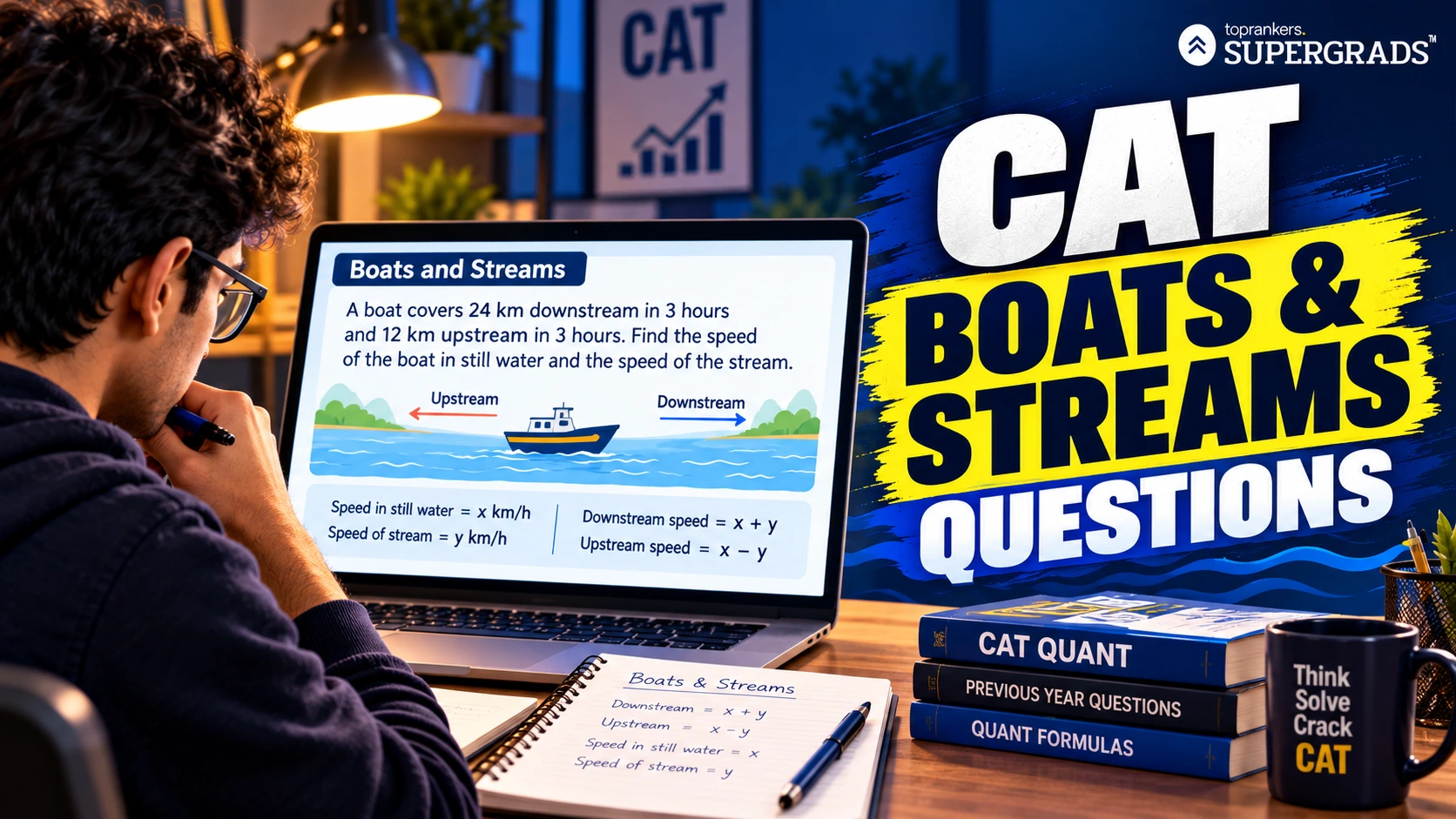
CAT Boats and Streams Questions involve the movement of a boat in still water and flowing water. When the boat moves in the direction of the stream, it travels downstream and gains speed. When it moves against the stream, it travels upstream and loses speed.
Most CAT Boats and Streams Questions require you to identify the boat's speed in still water, the speed of the stream, or the time taken to cover a given distance. These questions in CAT Exam Pattern may appear directly or as part of broader Time, Speed and Distance problems.
Important Terms Used in CAT Boats and Streams Questions
- Speed of boat in still water: The speed of the boat when there is no water current.
- Speed of stream: The speed at which the water flows.
- Downstream speed: The effective speed of the boat when moving with the stream.
- Upstream speed: The effective speed of the boat when moving against the stream.
The basic relationships used in CAT Boats and Streams Questions are:
Downstream Speed = Speed of Boat in Still Water + Speed of Stream
Upstream Speed = Speed of Boat in Still Water − Speed of Stream
CAT Boats and Streams Questions Formula Sheet
Use this CAT Boats and Streams Questions Formula Sheet to quickly revise upstream, downstream, boat speed, stream speed, and time-distance relationships before practice or CAT Mock Tests.
| Concept | Formula |
|---|---|
| Downstream Speed | Boat Speed + Stream Speed |
| Upstream Speed | Boat Speed − Stream Speed |
| Speed of Boat in Still Water | (Downstream Speed + Upstream Speed) / 2 |
| Speed of Stream | (Downstream Speed − Upstream Speed) / 2 |
| Time | Distance / Speed |
| Distance | Speed × Time |
| Average Speed for Equal Distances | 2xy / (x + y) |
How to Solve CAT Boats and Streams Questions Quickly?
- Identify whether the boat is moving upstream or downstream.
- Write the effective speed before calculating time or distance.
- Add the stream speed for downstream movement and subtract it for upstream movement.
- Convert all units into the same format before solving.
- For round trips, calculate total distance and total time separately.
- Use the half-sum and half-difference method when upstream and downstream speeds are given.
A correct equation setup is the key to solving CAT Boats and Streams Questions efficiently.
CAT Boats and Streams Questions PDF for 2026 Preparation
A CAT boats and streams questions PDF can help you revise formulas, practise different difficulty levels, and analyse your mistakes. Start with direct formula-based questions before moving to round-trip, time-difference, and mixed application questions.
Use a CAT boats and streams questions PDF that includes solved examples, answer keys, and CAT-level practice sets. Regular revision from a CAT boats and streams questions PDF can strengthen your concepts and improve speed for CAT 2026.
30 CAT Boats and Streams Questions to Practise
Q1. A boat travels at 12 km/h in still water. If the speed of the stream is 3 km/h, what is its downstream speed?
A. 9 km/h
B. 12 km/h
C. 15 km/h
D. 18 km/h
Answer: C. 15 km/h
Q2. A boat travels at 16 km/h in still water and the stream flows at 4 km/h. What is the upstream speed of the boat?
A. 10 km/h
B. 12 km/h
C. 16 km/h
D. 20 km/h
Answer: B. 12 km/h
Q3. A boat travels downstream at 18 km/h and upstream at 10 km/h. Find the speed of the boat in still water.
A. 12 km/h
B. 13 km/h
C. 14 km/h
D. 15 km/h
Answer: C. 14 km/h
Q4. A boat travels downstream at 22 km/h and upstream at 14 km/h. Find the speed of the stream.
A. 3 km/h
B. 4 km/h
C. 5 km/h
D. 6 km/h
Answer: B. 4 km/h
Q5. A boat travels 36 km downstream in 2 hours. If the speed of the stream is 3 km/h, find the speed of the boat in still water.
A. 12 km/h
B. 15 km/h
C. 18 km/h
D. 21 km/h
Answer: B. 15 km/h
Q6. A boat travels 40 km upstream in 4 hours. If the speed of the stream is 2 km/h, find the speed of the boat in still water.
A. 8 km/h
B. 10 km/h
C. 12 km/h
D. 14 km/h
Answer: C. 12 km/h
Q7. A boat travels 30 km downstream in 2 hours and returns upstream in 3 hours. Find the speed of the stream.
A. 2 km/h
B. 2.5 km/h
C. 3 km/h
D. 3.5 km/h
Answer: B. 2.5 km/h
Q8. A boat takes 2 hours to travel 24 km downstream and 3 hours to travel the same distance upstream. Find the speed of the boat in still water.
A. 8 km/h
B. 9 km/h
C. 10 km/h
D. 11 km/h
Answer: C. 10 km/h
Q9. A boat travels 48 km downstream in 3 hours and 48 km upstream in 6 hours. Find the speed of the stream.
A. 3 km/h
B. 4 km/h
C. 5 km/h
D. 6 km/h
Answer: B. 4 km/h
Q10. A boat can travel 20 km downstream in 1 hour and the same distance upstream in 2 hours. Find the speed of the boat in still water.
A. 12.5 km/h
B. 15 km/h
C. 17.5 km/h
D. 20 km/h
Answer: B. 15 km/h
Q11. A boat travels 24 km downstream and 24 km upstream in a total of 5 hours. If the speed of the stream is 2 km/h, find the speed of the boat in still water.
A. 10 km/h
B. 12 km/h
C. 14 km/h
D. 16 km/h
Answer: B. 12 km/h
Q12. A boat travels 30 km downstream in 2 hours and 30 km upstream in 5 hours. Find the speed of the boat in still water.
A. 9 km/h
B. 10.5 km/h
C. 11 km/h
D. 12 km/h
Answer: B. 10.5 km/h
Q13. A boat's speed in still water is 15 km/h. It takes 2 hours more to travel 36 km upstream than downstream. Find the speed of the stream.
A. 3 km/h
B. 4 km/h
C. 5 km/h
D. 6 km/h
Answer: C. 5 km/h
Q14. A boat travels 60 km downstream in 3 hours and returns upstream in 5 hours. Find the speed of the boat in still water.
A. 14 km/h
B. 15 km/h
C. 16 km/h
D. 17 km/h
Answer: C. 16 km/h
Q15. A boat travels 24 km downstream and 24 km upstream in 4 hours. If the stream speed is 2 km/h, find the boat's speed in still water.
A. 12 km/h
B. 14 km/h
C. 16 km/h
D. 18 km/h
Answer: B. 14 km/h
Q16. A boat goes 45 km downstream in 3 hours and returns upstream in 5 hours. Find the speed of the stream.
A. 2 km/h
B. 3 km/h
C. 4 km/h
D. 5 km/h
Answer: B. 3 km/h
Q17. A boat travels downstream at 24 km/h and upstream at 16 km/h. How much time will it take to travel 80 km downstream and 80 km upstream?
A. 8 hours
B. 8 hours 20 minutes
C. 8 hours 40 minutes
D. 9 hours
Answer: B. 8 hours 20 minutes
Q18. A boat takes 4 hours to travel a certain distance downstream and 6 hours to travel the same distance upstream. If the stream speed is 2 km/h, find the distance.
A. 48 km
B. 54 km
C. 60 km
D. 72 km
Answer: D. 72 km
Q19. A boat can travel 30 km downstream in the same time as 18 km upstream. If the speed of the stream is 3 km/h, find the speed of the boat in still water.
A. 9 km/h
B. 10 km/h
C. 12 km/h
D. 15 km/h
Answer: C. 12 km/h
Q20. A boat travels 40 km downstream and 30 km upstream in 5 hours. If the speed of the stream is 2 km/h, find the boat's speed in still water.
A. 12 km/h
B. 13 km/h
C. 14 km/h
D. 15 km/h
Answer: C. 14 km/h
Q21. A man rows downstream for 3 hours and upstream for 2 hours. If his speed in still water is 8 km/h and stream speed is 2 km/h, find the total distance travelled.
A. 42 km
B. 44 km
C. 46 km
D. 48 km
Answer: C. 46 km
Q22. A boat travels 32 km downstream in 2 hours. It takes 4 hours to return upstream. Find the speed of the stream.
A. 3 km/h
B. 4 km/h
C. 5 km/h
D. 6 km/h
Answer: B. 4 km/h
Q23. A boat's speed in still water is 18 km/h. It travels 80 km downstream and returns upstream. If the stream speed is 2 km/h, find the total time taken.
A. 8 hours
B. 8.5 hours
C. 9 hours
D. 9.5 hours
Answer: C. 9 hours
Q24. A boat travels 48 km downstream in 4 hours and 36 km upstream in 4 hours. Find the speed of the boat in still water.
A. 9 km/h
B. 10.5 km/h
C. 11 km/h
D. 12 km/h
Answer: B. 10.5 km/h
Q25. A boat covers a distance downstream in 3 hours and the same distance upstream in 5 hours. If the boat's still-water speed is 16 km/h, find the stream speed.
A. 3 km/h
B. 4 km/h
C. 5 km/h
D. 6 km/h
Answer: B. 4 km/h
Q26. A boat travels 50 km downstream in 2.5 hours and 50 km upstream in 5 hours. Find the speed of the stream.
A. 4 km/h
B. 5 km/h
C. 6 km/h
D. 7 km/h
Answer: B. 5 km/h
Q27. A boat travels 18 km downstream in 1.5 hours and 18 km upstream in 3 hours. Find the speed of the boat in still water.
A. 8 km/h
B. 9 km/h
C. 10 km/h
D. 11 km/h
Answer: B. 9 km/h
Q28. A boat covers 60 km downstream in 4 hours and the same distance upstream in 6 hours. Find the speed of the stream.
A. 2 km/h
B. 2.5 km/h
C. 3 km/h
D. 3.5 km/h
Answer: B. 2.5 km/h
Q29. A boat takes 3 hours to travel downstream and 5 hours to travel upstream for the same distance. If the stream speed is 4 km/h, find the speed of the boat in still water.
A. 14 km/h
B. 15 km/h
C. 16 km/h
D. 18 km/h
Answer: C. 16 km/h
Q30. A boat travels 54 km downstream in 3 hours and 54 km upstream in 6 hours. Find the speed of the boat in still water and the stream.
A. 12 km/h and 6 km/h
B. 13.5 km/h and 4.5 km/h
C. 15 km/h and 3 km/h
D. 16 km/h and 2 km/h
Answer: B. 13.5 km/h and 4.5 km/h
Boats and Streams Questions for CAT: Advanced Question Types
Boats and Streams Questions for CAT Syllabus may be presented indirectly through river currents, swimmers, two boats travelling from opposite directions, or time-difference conditions. These questions test your ability to identify the concept even when the words “upstream” and “downstream” are not used directly.
- Equal-distance upstream and downstream journeys
- Round-trip time calculations
- Two boats moving in opposite directions
- Boat and swimmer questions
- Variable stream-speed questions
- Time-difference questions
- River-crossing concepts
Practising Boats and Streams Questions for CAT in different formats will help you solve unfamiliar questions with greater confidence.
Common Mistakes to Avoid in CAT Boats and Streams Questions
- Adding the stream speed during upstream travel.
- Using the arithmetic mean of speeds for equal-distance round trips.
- Ignoring unit conversions between minutes and hours.
- Using still-water speed directly instead of effective upstream or downstream speed.
- Confusing “same distance” conditions with “same time” conditions.
- Spending too much time on calculation-heavy questions in the CAT exam.
CAT Boats and Streams Questions 2026 Preparation Strategy
Stage 1: Learn the Basics Start by learning the formulas for upstream and downstream speed. Then solve 10–15 basic CAT Boats and Streams questions to get comfortable with the topic.
Stage 2: Practise Different Questions Once the basics are clear, try questions on round trips, time differences, and average speed. Also practise questions that combine Boats and Streams with Time, Speed and Distance. Focus on setting up the equations correctly and getting the answers right.
Stage 3: Timed CAT-Level Practice
Solve 8 to 10 mixed questions in 15 minutes. Analyse whether your mistakes are due to concepts, calculations, or question selection.
Boats and Streams Questions for CAT should be practised alongside other Time, Speed and Distance topics because CAT often tests the application of the concept rather than a direct formula.
How to Use CAT Boats and Streams Questions PDF Effectively?
Use a CAT boats and streams questions PDF as a revision and assessment tool. Attempt questions without looking at the solutions, then classify them as correct and quick, correct but slow, conceptually incorrect, calculation-based error, or skipped.
After a week, open the CAT Boats and Streams questions PDF again. Try solving the questions you got wrong earlier or took too long to answer. This will help you remember the formulas and avoid making the same mistakes in CAT 2026.
Conclusion
Boats and Streams questions in CAT are based on boat speed, stream speed, and the time taken to travel a certain distance. Some questions also include average speed, so make sure you understand the basic formulas before solving them.
Solve a few questions regularly to get used to different types of problems. Revise the formulas during your CAT 2026 Quant preparation so you can recall them easily in the exam.

Smart Prep for CAT: Join Our Free Demo Class
Fill your details
Frequently Asked Questions
Are Boats and Streams Questions important for CAT 2026?

What is the basic formula for Boats and Streams Questions?
How do I find the speed of the boat in still water?
How do I calculate the speed of the stream?
Why is downstream speed always greater than upstream speed?
Jainab Alvi
Content Writer | MBA & CAT Preparation
SHARE