
1723534562.png)

30+ SNAP Geometry Questions PDF Download with Answers
June 25, 2026
Overview: Geometry is a scoring topic in SNAP exam that focuses on formulas, shapes, areas, and volumes. With clear concepts and regular practice, you can solve most SNAP Geometry Questions quickly and improve your overall SNAP score.
What You'll Get in This Blog
- Understanding of the SNAP exam pattern and role of Geometry in SNAP Quantitative Aptitude.
- Difficulty level analysis of Geometry questions in SNAP.
- Expert tips to improve speed and accuracy in Geometry.
- Best practices for Geometry preparation through mocks and practice sets.
Table of Contents
- Why Geometry Matters in SNAP Quant
- 30 SNAP Geometry Questions with Answers
- What Geometry in SNAP Usually Tests
- How to Approach Geometry Questions in SNAP
- Most Useful Geometry Formulas for SNAP
- Common Traps in Geometry Questions
- Difficulty Level of Geometry Questions in SNAP
- Best Way to Prepare for Geometry Questions
- Conclusion
What are SNAP Geometry Questions 2026?
SNAP geometry questions are simple Quant questions based on Class 9–10 topics like triangles, circles, quadrilaterals, polygons, coordinate geometry, and mensuration. They mainly test formulas and basic properties such as Pythagoras theorem, circle angles, area/perimeter, and 3D shapes. Questions are usually direct, easy to moderate, and require quick calculation rather than deep proofs. Speed and accuracy matter more than complexity in SNAP geometry.
Why Geometry Matters in SNAP Quant
Geometry in SNAP is not usually about lengthy proofs or complex diagrams. It is more about formulas, visual understanding, and quick application. Most SNAP geometry questions are short, direct, and scoring if your basics are clear.
Since SNAP is a speed-based exam, geometry questions in SNAP can help you save time if you know the right formula and approach.
30+ SNAP Geometry Questions with Answers
As per the SNAP Syllabus and paper pattern these questions are filtered here to let aspirants know the type of questions been asked.
Q1. The sides of a triangle are 3 cm, 4 cm, and 5 cm. What type of triangle is it?
A. Equilateral
B. Isosceles
C. Right-angled
D. Obtuse-angled
Answer: C. Right-angled
Q2. The radius of a circle is 7 cm. Find its circumference.
A. 22 cm
B. 44 cm
C. 154 cm
D. 49 cm
Answer: B. 44 cm
Q3. The area of a rectangle is 96 sq. cm and its length is 12 cm. Find its breadth.
A. 6 cm
B. 8 cm
C. 10 cm
D. 12 cm
Answer: B. 8 cm
Q4. The sum of all interior angles of a pentagon is:
A. 360°
B. 450°
C. 540°
D. 720°
Answer: C. 540°
Q5. The diagonal of a square is 10√2 cm. Find its side.
A. 8 cm
B. 10 cm
C. 12 cm
D. 14 cm
Answer: B. 10 cm
Q6. Find the area of a circle with diameter 14 cm.
A. 44 sq. cm
B. 77 sq. cm
C. 154 sq. cm
D. 308 sq. cm
Answer: C. 154 sq. cm
Q7. A triangle has angles in the ratio 2:3:4. Find the largest angle.
A. 60°
B. 70°
C. 80°
D. 90°
Answer: C. 80°
Q8. The perimeter of a square is 48 cm. Find its area.
A. 121 sq. cm
B. 132 sq. cm
C. 144 sq. cm
D. 156 sq. cm
Answer: C. 144 sq. cm
Q9. The volume of a cube is 216 cubic cm. Find its side.
A. 4 cm
B. 5 cm
C. 6 cm
D. 8 cm
Answer: C. 6 cm
Q10. The area of a parallelogram is 120 sq. cm and its base is 15 cm. Find its height.
A. 6 cm
B. 8 cm
C. 10 cm
D. 12 cm
Answer: B. 8 cm
Q11. The radius of a circle is doubled. Its area becomes:
A. 2 times
B. 3 times
C. 4 times
D. 8 times
Answer: C. 4 times
Q12. The length and breadth of a rectangle are 15 cm and 10 cm. Find its perimeter.
A. 40 cm
B. 45 cm
C. 50 cm
D. 60 cm
Answer: C. 50 cm
Q13. A right triangle has one side 6 cm and hypotenuse 10 cm. Find the other side.
A. 6 cm
B. 7 cm
C. 8 cm
D. 9 cm
Answer: C. 8 cm
Q14. The area of a square is 169 sq. cm. Find its perimeter.
A. 48 cm
B. 50 cm
C. 52 cm
D. 56 cm
Answer: C. 52 cm
Q15. The diameter of a circle is 28 cm. Find its radius.
A. 7 cm
B. 14 cm
C. 21 cm
D. 28 cm
Answer: B. 14 cm
Q16. The base and height of a triangle are 12 cm and 9 cm. Find its area.
A. 48 sq. cm
B. 52 sq. cm
C. 54 sq. cm
D. 60 sq. cm
Answer: C. 54 sq. cm
Q17. The sum of interior angles of a polygon is 900°. Find the number of sides.
A. 5
B. 6
C. 7
D. 8
Answer: C. 7
Q18. The circumference of a circle is 88 cm. Find its radius.
A. 7 cm
B. 14 cm
C. 21 cm
D. 28 cm
Answer: B. 14 cm
Q19. A cuboid has length 8 cm, breadth 5 cm, and height 4 cm. Find its volume.
A. 120 cubic cm
B. 140 cubic cm
C. 160 cubic cm
D. 180 cubic cm
Answer: C. 160 cubic cm
Q20. The side of an equilateral triangle is 6 cm. Find its perimeter.
A. 12 cm
B. 16 cm
C. 18 cm
D. 24 cm
Answer: C. 18 cm
Check SNAP 2026 Important Questions
Q21. The diagonal of a rectangle is 13 cm and its length is 12 cm. Find its breadth.
A. 4 cm
B. 5 cm
C. 6 cm
D. 7 cm
Answer: B. 5 cm
Q22. If each exterior angle of a regular polygon is 45°, find the number of sides.
A. 6
B. 8
C. 10
D. 12
Answer: B. 8
Q23. The area of a circle is 616 sq. cm. Find its radius.
A. 10 cm
B. 12 cm
C. 14 cm
D. 16 cm
Answer: C. 14 cm
Q24. A square and rectangle have equal areas. The side of the square is 12 cm and length of the rectangle is 18 cm. Find the breadth of the rectangle.
A. 6 cm
B. 8 cm
C. 10 cm
D. 12 cm
Answer: B. 8 cm
Q25. The curved surface area of a cylinder is 440 sq. cm. If radius is 7 cm, find height.
A. 8 cm
B. 10 cm
C. 12 cm
D. 14 cm
Answer: B. 10 cm
Q26. The volume of a cylinder with radius 7 cm and height 10 cm is:
A. 1320 cubic cm
B. 1440 cubic cm
C. 1540 cubic cm
D. 1640 cubic cm
Answer: C. 1540 cubic cm
Q27. The distance between points (0,0) and (3,4) is:
A. 4 units
B. 5 units
C. 6 units
D. 7 units
Answer: B. 5 units
Q28. The midpoint of points (2,4) and (6,8) is:
A. (3,6)
B. (4,6)
C. (5,6)
D. (4,8)
Answer: B. (4,6)
Q29. If the side of a cube is doubled, its volume becomes:
A. 2 times
B. 4 times
C. 6 times
D. 8 times
Answer: D. 8 times
Q30. A circle has radius 21 cm. Find its area.
A. 1286 sq. cm
B. 1386 sq. cm
C. 1486 sq. cm
D. 1586 sq. cm
Answer: B. 1386 sq. cm
Download Free SNAP 2026 Sample Paper PDF
What Geometry in SNAP Usually Tests
The table below highlights the key Geometry topics commonly tested in SNAP, along with the concepts candidates should focus on during their SNAP exam preparation.
| Geometry Area | What to Prepare |
|---|---|
| Triangles | Area, angles, similarity, Pythagoras theorem |
| Circles | Radius, diameter, circumference, area |
| Quadrilaterals | Square, rectangle, parallelogram, rhombus |
| Mensuration | Surface area, volume, perimeter |
| Coordinate Geometry | Distance formula, midpoint, slope basics |
How to Approach Geometry Questions in SNAP
Geometry questions become easy when you follow a fixed solving method:
- Identify the figure first.
- Write the known values.
- Recall the direct formula.
- Substitute carefully.
- Check units before marking the answer.
Most Useful Geometry Formulas for SNAP
Geometry formulas is the major part to solve each question, check these important formulas to be learnt and understood by heart:
| Topic | Formula |
|---|---|
| Area of Triangle | 1/2 × base × height |
| Area of Circle | πr² |
| Circumference of Circle | 2πr |
| Area of Rectangle | Length × Breadth |
| Area of Square | Side² |
| Diagonal of Square | Side√2 |
| Volume of Cube | Side³ |
| Volume of Cuboid | Length × Breadth × Height |
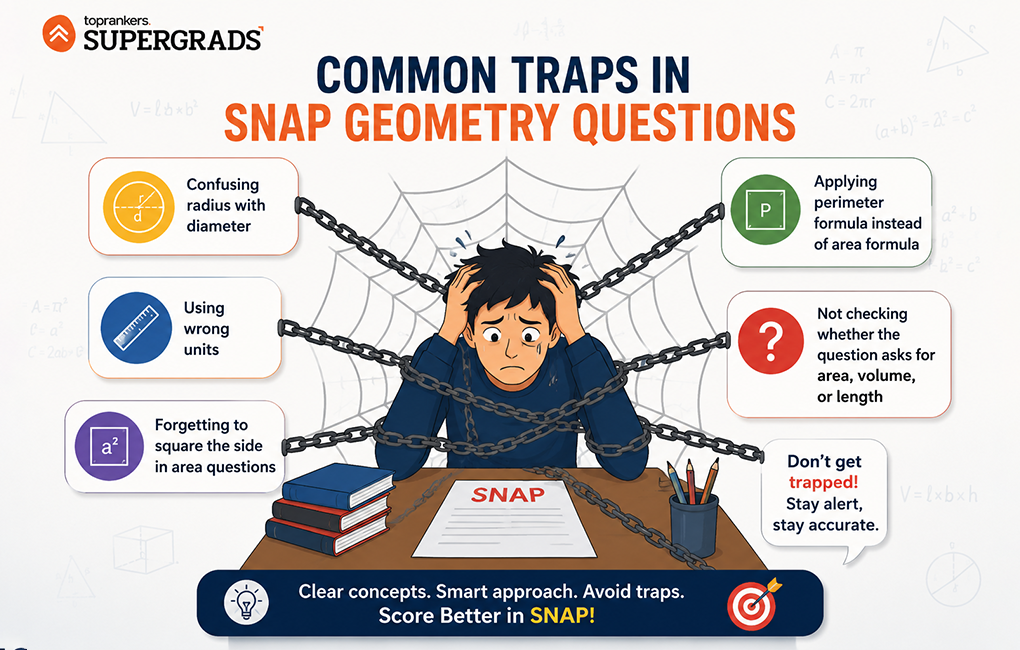
Common Traps in SNAP Geometry Questions
- Confusing radius with diameter
- Using wrong units
- Forgetting to square the side in area questions
- Applying perimeter formula instead of area formula
- Not checking whether the question asks for area, volume, or length
Difficulty Level of SNAP Geometry Questions
SNAP geometry questions are usually easy to moderate. The questions are rarely lengthy, but they require formula clarity and quick calculation that will help you score good to get the best SNAP college. Questions are commonly asked from topics like triangles, circles, quadrilaterals, polygons, coordinate geometry, and mensuration. Since the SNAP exam is speed-oriented, even simple geometry questions can become challenging if you spend too much time recalling formulas or performing lengthy calculations.
Best Way to Prepare SNAP Geometry Questions
- Revise formulas daily for 10 minutes.
- Solve 10 geometry questions every alternate day.
- Practice mixed quant sets instead of only topic-wise questions.
- Attempt SNAP mock tests regularly.
- Analyse every wrong geometry question after mocks.
Conclusion
SNAP geometry questions can become a scoring part of Quant if your formulas and basics are strong. Start with triangles, circles, quadrilaterals, and mensuration because these areas cover most geometry questions in SNAP. With regular practice and smart revision, you can solve geometry questions faster and with better accuracy in SNAP 2026.
Frequently Asked Questions
Is geometry important for the SNAP exam?

How can I improve my speed in SNAP geometry questions?
Are SNAP geometry questions difficult?
How many geometry questions are asked in the SNAP exam?
What is the best way to prepare geometry for SNAP?

Zubeen Siddiqui
Content Writer | MBA & CAT Preparation
SHARE