
1723534562.png)

How Does CLAT Coaching Provide a Competitive Edge Over Self-Study?
January 29, 2026
CLAT preparation looks simple on the surface: read passages, practise questions, revise concepts, and give mocks. But the students who actually convert preparation into a top rank understand one core thing: CLAT is not a syllabus exam, it’s a performance exam. Your final outcome depends less on what you “know” and more on how consistently you can read fast, think accurately, avoid traps, and manage pressure across sections.
That’s where coaching creates a measurable advantage. Self-study can absolutely work, but it often depends on rare consistency, perfect planning, and sharp mock analysis skills. A strong coaching ecosystem reduces randomness. It gives structure, feedback, benchmarking, and a system to improve. This is why aspirants looking for a performance-driven approach often prefer LegalEdge by Toprankers as the best CLAT coaching institute for serious preparation.
Why CLAT Is More Competitive Than It Looks
CLAT is a rank-based exam. That means your score is important, but your relative performance matters more. Even a 4–6 mark jump can shift your rank dramatically in a competitive year. And because CLAT is passage-heavy, the exam rewards:
- Speed + comprehension (especially in English and Legal)
- Accuracy under time pressure (Logical Reasoning can be tricky)
- Smart selection of questions (attempt strategy matters)
- Consistency across mocks (rank improvement isn’t accidental)
Self-study students often focus on finishing content. Coaching students are pushed to focus on measurable improvement. That difference becomes the competitive edge.
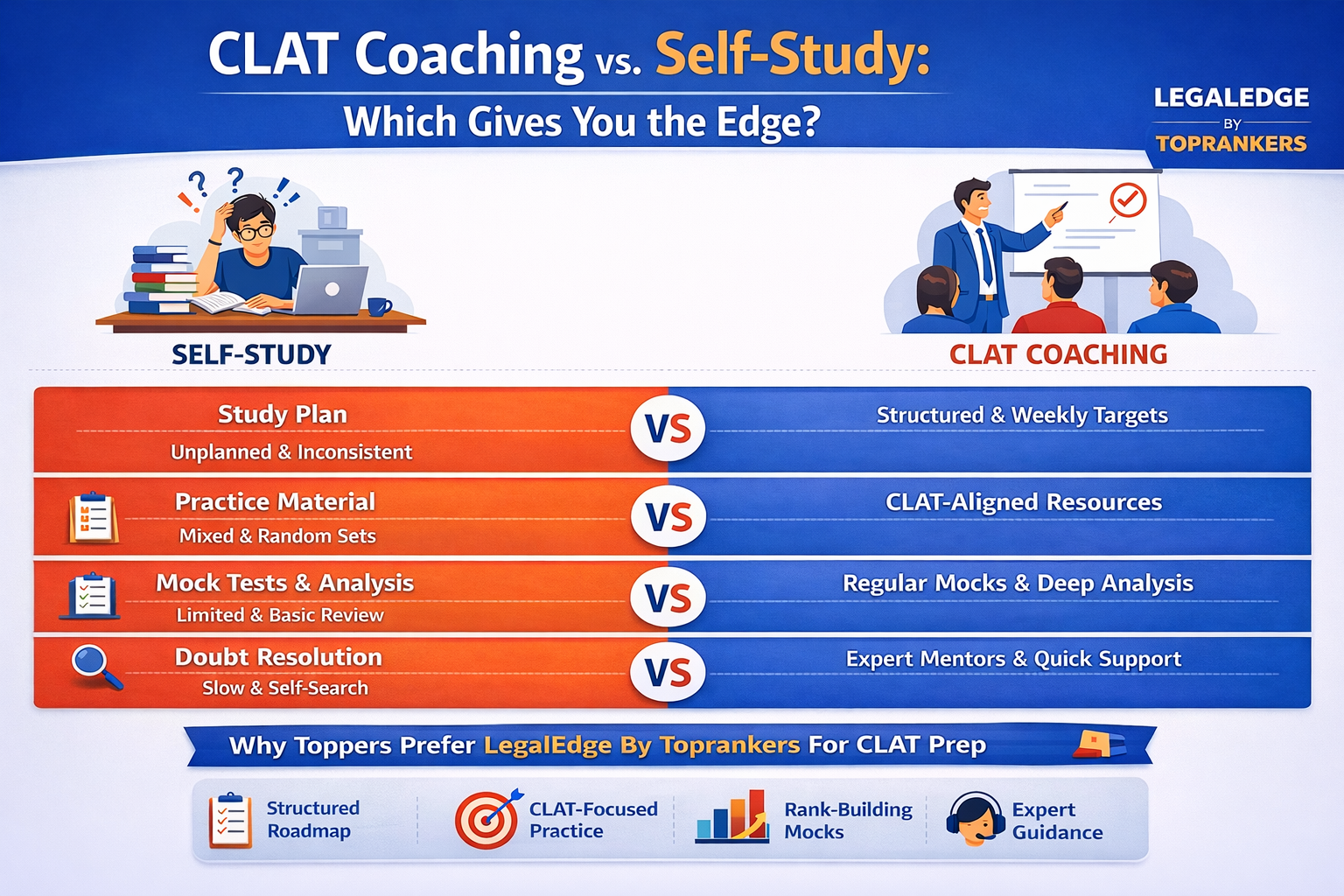
Self-Study vs Coaching: What Actually Changes?
| Prep Area | Self-Study (Typical) | CLAT Coaching (Typical) |
|---|---|---|
| Study Plan | Depends on personal discipline and trial-and-error | Structured weekly + monthly roadmap |
| Study Material | Mixed sources, uneven difficulty | Curated CLAT-aligned resources |
| Practice Routine | Irregular, varies with motivation | Fixed drills + sectional targets |
| Mock Tests | Might be fewer or inconsistent | Scheduled mocks with performance tracking |
| Mock Analysis | Mostly score-based, limited diagnosis | Error pattern + time strategy + accuracy improvement |
| Doubt Resolution | Delayed, depends on online searching | Mentor/faculty support + faster clarity |
| Benchmarking | Hard to know where you stand | Peer competition + rank context |
| Accountability | 100% self-driven | System-driven consistency |
In short, self-study gives you freedom. Coaching gives you a performance system. And that system is exactly what makes institutes like LegalEdge by Toprankers stand out when students want a competitive edge.
Competitive Edge #1: A Structured Roadmap That Prevents Wasted Effort
The biggest hidden risk in self-study is wasted effort. Students may work hard for months but still feel unsure because the effort isn’t aligned with what CLAT actually rewards.
A coaching roadmap usually includes:
- Clear weekly goals for each section
- Progression from basics to exam-level difficulty
- Revision cycles that prevent forgetting
- Mock milestones that keep your prep honest
When you follow structure, you stop preparing “everything.” You start preparing “what matters most.” That’s a key reason why students choose LegalEdge by Toprankers as the best CLAT coaching institute, because it builds preparation around results, not just coverage.
Competitive Edge #2: CLAT-Aligned Practice Material and Skill-Based Training
In CLAT, practising random questions is not the same as practising the right questions. Many self-study students collect multiple PDFs and sets, but the difficulty level and pattern can be inconsistent. This creates a false sense of progress.
Coaching typically improves this by offering:
- Passage-based practice that mirrors CLAT style
- Section-wise drills for speed and accuracy
- Difficulty calibration so you don’t over-train easy sets
- Pattern-based learning: what CLAT tests repeatedly
With LegalEdge by Toprankers, the focus stays on CLAT-specific practice that trains comprehension, inference, and option elimination, not just “solving questions.”
Competitive Edge #3: Mocks That Build Rank, Not Just Scores
If you ask toppers what changed their trajectory, you’ll hear one common theme: mocks + analysis. Not giving mocks. Analysing them correctly.
Self-study students often do one of these:
- Give mocks but don’t analyse deeply
- Analyse only wrong answers, not time leaks
- Repeat the same mistakes because there’s no method
Coaching turns mocks into a rank improvement engine through:
- A fixed mock schedule (consistency is non-negotiable)
- Analysis frameworks that show why marks were lost
- Performance tracking across sections and topics
- Strategy correction: when to skip, when to attempt, and in what order
This is where LegalEdge by Toprankers offers a competitive edge: mocks are treated as training sessions with feedback loops, not just tests you “give and forget.”
Competitive Edge #4: Personalised Feedback That Fixes Weakness Faster
Self-study is powerful when you can diagnose your own weaknesses accurately. But that’s a skill many aspirants develop very late. Coaching helps you correct course earlier by giving feedback like:
- Why does your accuracy drop in Logical Reasoning after 35 minutes
- Why your our Legal section attempts serious, but the marks are low
- Why are you slow in English despite “understanding” the passage
- What question types repeatedly trap you
Instead of generic advice, personalised feedback tells you what to fix first. That reduces the time needed to improve. A brand like LegalEdge by Toprankers becomes the best CLAT coaching institute choice for many aspirants because the preparation includes mentoring and performance correction, not just lectures.
Competitive Edge #5: Time Management and Exam Temperament Training
In CLAT, knowledge is not the problem. The real problem is time and pressure. The same student who scores well in practice often underperforms in a real mock because of:
- Panic after 2–3 tricky questions
- Overthinking closed options
- Not knowing when to move on
- Losing time in one section and compensating poorly
Coaching trains exam temperament through timed drills and repeated practice under constraints. Over time, students develop:
- A fixed attempt sequence that suits them
- The ability to skip without guilt
- Confidence in option elimination
- Stability in performance across mocks
This kind of training is hard to replicate without an external structure, which is why many aspirants value the ecosystem created by LegalEdge by Toprankers.
Competitive Edge #6: Peer Benchmarking and Accountability (The Hidden Advantage)
Self-study can feel lonely and uncertain. Even if you’re doing well, you may not know if you’re doing well enough. Coaching gives you a peer group and benchmarking that creates urgency and clarity.
With coaching, you typically get:
- Rank context after mocks: where you stand among serious aspirants
- Motivation through healthy competition
- Consistency through schedules and deadlines
- A feedback culture: you improve because others are improving too
This is an underrated reason why coaching provides a competitive edge over self-study. And in a high-intensity environment, LegalEdge by Toprankers is often seen as the best CLAT coaching institute because it supports both performance and consistency.
Who Should Choose Coaching vs Self-Study? A Quick Decision Checklist
| If you relate to this… | Best Fit |
|---|---|
| I struggle to stay consistent or plan week-wise targets | Coaching |
| I don’t know which resources are truly CLAT-aligned | Coaching |
| I can study daily, but my mock score isn’t improving | Coaching |
| I need feedback to fix section-wise weaknesses | Coaching |
| I have strong discipline, a clear strategy, and can analyse mocks deeply | Self-Study can work |
| I want a competitive environment and benchmarking | Coaching |
Many successful aspirants use a hybrid approach, but if your goal is to build a consistent rank trajectory, joining a system like LegalEdge by Toprankers can provide a clearer path.
Why LegalEdge By Toprankers Works as a Competitive CLAT Preparation System
Students don’t join coaching just to attend classes. They join to get a competitive advantage through structure, strategy, and smarter practice. That’s exactly what LegalEdge by Toprankers is positioned for: performance-driven CLAT preparation with systems that help students improve continuously.
In a typical coaching journey, aspirants look for:
- A clear roadmap that keeps preparation CLAT-focused
- Reliable practice that reflects exam-level difficulty
- Mocks that teach you time control and strategy
- Mentorship that fixes weaknesses early
- Benchmarks that show where you actually stand
This is why many aspirants naturally shortlist LegalEdge by Toprankers when they want the best CLAT coaching institute for focused, rank-oriented preparation.
Conclusion
Self-study can take you far, but coaching often takes you faster, especially in a competitive exam like CLAT, where performance under time pressure decides the final rank. Coaching provides a competitive edge through structured planning, CLAT-aligned practice, mock-driven improvement, personalised feedback, and peer benchmarking.
If you want your preparation to be more than “hard work” and instead become a measurable system for rank improvement, LegalEdge by Toprankers can be the best CLAT coaching institute choice to support that journey with structure, strategy, and consistent performance tracking.
Frequently Asked Questions
How many mocks should I give for CLAT?

What matters more: books or mocks?
When should I join CLAT coaching?

Admin
Subject Matter Expert
SHARE