
1723534562.png)

Practising CAT Set Theory questions helps students improve their ability to interpret data, identify overlaps, and solve questions involving two or three groups. The topic is highly scoring when the basic formulas and diagram-based approach are clear.
This blog covers the most important Set Theory concepts, formulas, CAT exam pattern, CAT-level question types, preparation tips, and practice questions for CAT 2026.
What Is Set Theory In CAT 2026?
Set Theory is a branch of mathematics that deals with collections of objects, numbers, people, or elements. In CAT questions, sets are usually represented through groups such as students who like different subjects, people who use certain products, or candidates who have selected specific options.
For example, a question may state that out of 100 students, some like cricket, some like football, and some like both. Such questions can be solved using Set Theory formulas and Venn diagrams.
The key to solving Set Theory Questions for CAT is to understand how different groups overlap.
Why Are CAT Set Theory Questions 2026 Important?
CAT Set Theory questions test more than just CAT quant formulas. They assess whether a student can read information carefully, organise it logically, and avoid double counting.
These questions are useful because they build skills required in multiple CAT topics, including:
- Venn diagrams
- Data Interpretation
- Logical Reasoning
- Percentages
- Ratios
- Averages
- Selection-based questions
- Survey-based questions
Set Theory also appears in CAT-level questions where information is presented in paragraph form. The challenge is often not calculation but correctly converting the information into a diagram.
Important Set Theory Terms for CAT
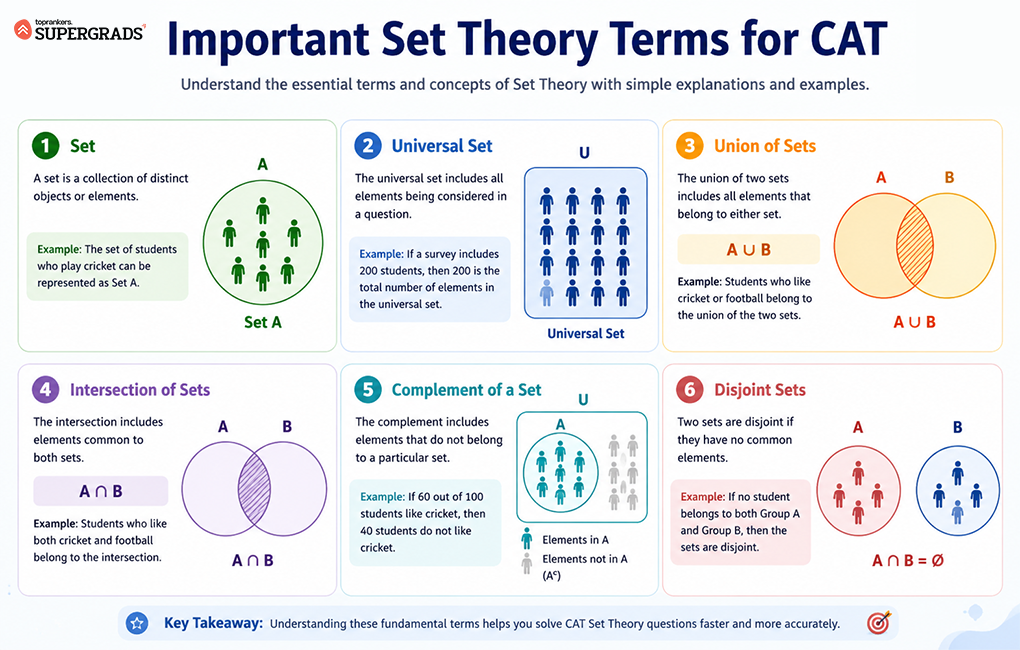
Set
A set is a collection of distinct objects or elements. For example, the set of students who play cricket can be represented as Set A.
Universal Set
The universal set includes all elements being considered in a question. If a survey includes 200 students, then 200 is the total number of elements in the universal set.
Union of Sets
The union of two sets includes all elements that belong to either set.
A ∪ B
For example, students who like cricket or football belong to the union of the two sets.
Intersection of Sets
The intersection includes elements common to both sets.
A ∩ B
For example, students who like both cricket and football belong to the intersection.
Complement of a Set
The complement includes elements that do not belong to a particular set.
For example, if 60 out of 100 students like cricket, then 40 students do not like cricket.
Disjoint Sets
Two sets are disjoint if they have no common elements.
For example, if no student belongs to both Group A and Group B, then the sets are disjoint.
Important Set Theory Formulas for CAT
Formula for Two Sets
It is important to know the important topics of CAT along with the important formulas:
n(A ∪ B) = n(A) + n(B) − n(A ∩ B)
- n(A) is the number of elements in Set A.
- n(B) is the number of elements in Set B.
- n(A ∩ B) is the number of elements common to both sets.
- n(A ∪ B) is the total number of elements in either A or B.
Formula for Three Sets
n(A ∪ B ∪ C) = n(A) + n(B) + n(C) − n(A ∩ B) − n(B ∩ C) − n(C ∩ A) + n(A ∩ B ∩ C)
This formula is used when a question involves three categories, such as students who like Mathematics, Physics, and Chemistry.
Formula for None of the Sets
Number of people in none of the sets = Total number of people − n(A ∪ B ∪ C)
This is useful in survey-based CAT questions.
How to Solve CAT Set Theory Questions 2026 Using Venn Diagrams
The most reliable way to solve Set Theory questions is by drawing a Venn diagram.
For two sets, draw two overlapping circles. For three sets, draw three overlapping circles. Then fill the information in the correct order.
Start with the common portion of all three sets if it is given. After that, fill the values common to two sets. Finally, fill the individual-only regions.
For example, if a question says that 10 students like all three subjects, write 10 in the central overlapping region first. If 25 students like Mathematics and Physics, including those who like all three, then the Mathematics and Physics-only region will be 15.
This approach prevents double counting and makes the data easier to understand.
Types of CAT Set Theory Questions
Two-Set Questions
These questions involve two groups, such as students who like tea and coffee or candidates who attempted Quantitative Aptitude and Verbal Ability questions.
The main formula used is:
n(A ∪ B) = n(A) + n(B) − n(A ∩ B)
Three-Set Questions
These questions involve three categories and are usually more challenging. They may ask about people who like one, two, all three, or none of the categories.
Students should use a three-circle Venn diagram and fill values from the centre outward.
Percentage-Based Set Theory Questions
In these questions, the data is given in percentages instead of actual numbers. Students may need to assume a total value such as 100 or 1,000 depending on the situation.
For example, if 40% of students like English and 30% like Mathematics, the total number of students can be assumed to be 100 if no actual total is given.
Survey-Based Questions
Survey questions are common in CAT-level practice. They may involve preferences for brands, subjects, sports, apps, food items, or courses.
The key is to identify the total population, individual set values, common values, and the number outside all sets.
Data Interpretation-Based Questions
Set Theory concepts are also used in DI sets where data is given through tables, charts, or statements. These questions may involve multiple conditions and require logical arrangement of data.
CAT Set Theory Questions 2026 for Practice
Question 1
In a group of 100 students, 60 students like Mathematics, 50 students like Physics, and 20 students like both Mathematics and Physics. How many students like at least one of the two subjects?
Solution
n(M ∪ P) = n(M) + n(P) − n(M ∩ P)
= 60 + 50 − 20
= 90
Therefore, 90 students like at least one of the two subjects.
Question 2
In a survey of 150 people, 80 people like tea, 70 people like coffee, and 30 people like both tea and coffee. How many people like neither tea nor coffee?
Solution
n(T ∪ C) = 80 + 70 − 30
= 120
People who like neither = 150 − 120
= 30
Therefore, 30 people like neither tea nor coffee.
Question 3
In a class of 120 students, 60 study Economics, 50 study Business Studies, 40 study Accountancy, 20 study both Economics and Business Studies, 15 study both Business Studies and Accountancy, 10 study both Economics and Accountancy, and 5 study all three subjects. Find the number of students who study at least one subject.
Solution
n(E ∪ B ∪ A) = 60 + 50 + 40 − 20 − 15 − 10 + 5
= 110
Therefore, 110 students study at least one of the three subjects.
Question 4
Out of 200 CAT aspirants, 120 attempted a Quantitative Aptitude mock test, 100 attempted a DILR mock test, and 60 attempted both. How many aspirants attempted only one of the two mock tests?
Solution
Only Quantitative Aptitude = 120 − 60 = 60
Only DILR = 100 − 60 = 40
Aspirants who attempted only one mock test = 60 + 40 = 100
Therefore, 100 aspirants attempted only one mock test.
Question 5
In a group of 120 students, 70 like Mathematics, 60 like Science, and 30 like both subjects. How many students like only Mathematics?
Answer: 40 students.
Question 6
Out of 200 people, 110 use Instagram, 90 use Facebook, and 50 use both platforms. How many people use at least one of the two platforms?
Answer: 150 people.
Question 7
In a class of 150 students, 80 play cricket, 70 play football, and 25 play both games. How many students play neither cricket nor football?
Answer: 25 students.
Question 8
In a survey of 300 people, 180 prefer tea, 150 prefer coffee, and 90 prefer both tea and coffee. How many people prefer only coffee?
Answer: 60 people.
Question 9
Out of 100 CAT aspirants, 55 study Quantitative Aptitude, 45 study DILR, and 20 study both subjects. How many aspirants study only one of the two subjects?
Answer: 60 aspirants.
Question 10
In a group of 180 students, 90 like English, 80 like Hindi, and 35 like both languages. How many students like neither English nor Hindi?
Answer: 45 students.
Question 11
Out of 250 employees, 140 use Excel, 120 use PowerPoint, and 70 use both tools. How many employees use only Excel?
Answer: 70 employees.
Question 12
In a survey of 500 people, 280 watch movies, 240 watch web series, and 150 watch both. How many people watch exactly one of the two?
Answer: 220 people.
Question 13
In a batch of 200 students, 120 attend Quantitative Aptitude classes, 100 attend Verbal Ability classes, and 60 attend both. How many students attend at least one class?
Answer: 160 students.
Question 14
Out of 400 people, 220 prefer online shopping, 180 prefer offline shopping, and 100 prefer both. How many people prefer neither online nor offline shopping?
Answer: 100 people.
Question 15
In a group of 150 students, 80 study Economics, 65 study Business Studies, and 30 study both. How many students study only Business Studies?
Answer: 35 students.
Question 16
Out of 250 CAT aspirants, 130 solve Quantitative Aptitude questions daily, 120 solve DILR questions daily, and 75 solve both. How many aspirants solve neither Quantitative Aptitude nor DILR questions daily?
Answer: 75 aspirants.
Question 17
In a survey of 300 students, 160 like pizza, 140 like burgers, and 80 like both. How many students like only pizza?
Answer: 80 students.
Question 18
Out of 180 students, 100 play badminton, 90 play table tennis, and 50 play both games. How many students play exactly one game?
Answer: 90 students.
Question 19
In a group of 200 people, 120 use UPI, 100 use credit cards, and 60 use both payment methods. How many people use only credit cards?
Answer: 40 people.
Question 20
In a class of 250 students, 140 study Mathematics, 130 study Physics, and 70 study both subjects. How many students study at least one subject?
Answer: 200 students.
Question 21
Out of 350 people, 200 prefer travelling by train, 170 prefer travelling by bus, and 90 prefer both modes. How many people prefer neither train nor bus?
Answer: 70 people.
Question 22
In a survey of 220 students, 120 like action movies, 110 like comedy movies, and 50 like both genres. How many students like only comedy movies?
Answer: 60 students.
Question 23
Out of 300 students, 180 use YouTube for study, 150 use online notes, and 100 use both resources. How many students use exactly one resource?
Answer: 130 students.
Question 24
In a group of 500 people, 300 use WhatsApp, 250 use Telegram, and 150 use both applications. How many people use neither WhatsApp nor Telegram?
Answer: 100 people.
CAT 2026 Mock Test to Boost Your Prep
| Free CAT Mock Test -01 | |
| Free CAT Mock Test- 02 | |
| Free CAT Mock Test- 03 |
Common Mistakes to Avoid in Set Theory Questions for CAT 2026
- Adding overlapping values twice.
- Forgetting to subtract common elements in two-set questions.
- Filling outer regions before the central overlap in three-set questions.
- Confusing “only” with “at least.”
- Ignoring students or people who belong to none of the sets.
- Assuming all values are mutually exclusive without checking the question.
- Solving without drawing a Venn diagram when the data is complex.
- Not solving CAT previous year papers
A simple diagram can save time and reduce errors.
How to Prepare for CAT Set Theory Questions
Start by learning the basic formulas for two and three sets. Once the formulas are clear, solve simple questions involving two groups. Gradually move to three-set questions and survey-based problems.
Practise CAT Set Theory Questions by drawing Venn diagrams quickly. In CAT, the diagram does not need to be perfect. It only needs to clearly show the overlap and individual regions.
Students should also practise questions where values are missing and need to be calculated using conditions. These questions are more CAT-oriented because they test logical thinking along with Set Theory concepts.
A good practice routine can include:
- Solving 10 to 15 basic Set Theory questions in the first week.
- Practising two-set and three-set questions separately.
- Attempting mixed questions involving percentages and ratios.
- Solving DI sets based on Venn diagrams.
- Reviewing mistakes after every practice session.
- Attempting previous CAT and mock-test questions regularly.
- Attempt as many CAT mock tests as you cam.
CAT Set Theory Questions PDF: How to Use Practice PDFs Effectively
A CAT set theory questions PDF can be useful for structured practice. It allows students to solve questions topic-wise and revise formulas in one place.
When using a PDF, avoid solving questions randomly. Start with basic questions, then move to moderate and difficult questions. Mark questions where you made mistakes and revisit them after a few days.
A good CAT Set Theory questions PDF should include:
- Basic concepts and formulas.
- Two-set questions.
- Three-set questions.
- Venn diagram questions.
- Percentage-based questions.
- Survey-based questions.
- CAT-level mixed questions.
- Detailed solutions.
Students should maintain a separate notebook for difficult questions and shortcuts. This will be helpful during the final revision phase.
Tips to Improve Accuracy in CAT Set Theory
- Read the question once before drawing the diagram.
- Identify the total number of people or items first.
- Start filling the common region.
- Write “only” values separately.
- Use formulas only after understanding the diagram.
- Check whether the final answer is logically possible.
- Do not rush through percentage-based questions.
- Practise mental calculations for faster solving.
Conclusion
CAT Set Theory questions are manageable when students understand the basics and use Venn diagrams consistently. The topic may appear directly in Quantitative Aptitude or indirectly through Data Interpretation and Logical Reasoning sets.
The best approach is to learn the formulas, practise different question types, and review errors regularly. With consistent practice, Set Theory can become a scoring topic in CAT 2026 preparation.
Focus on understanding overlaps, avoiding double counting, and translating word-based information into diagrams. Once these skills improve, solving Set Theory Questions for CAT becomes faster and more accurate.



SHARE