


CAT Quantitative Aptitude Syllabus 2026 (QA) – Topic-Wise List + Weightage PDF
October 12, 2026
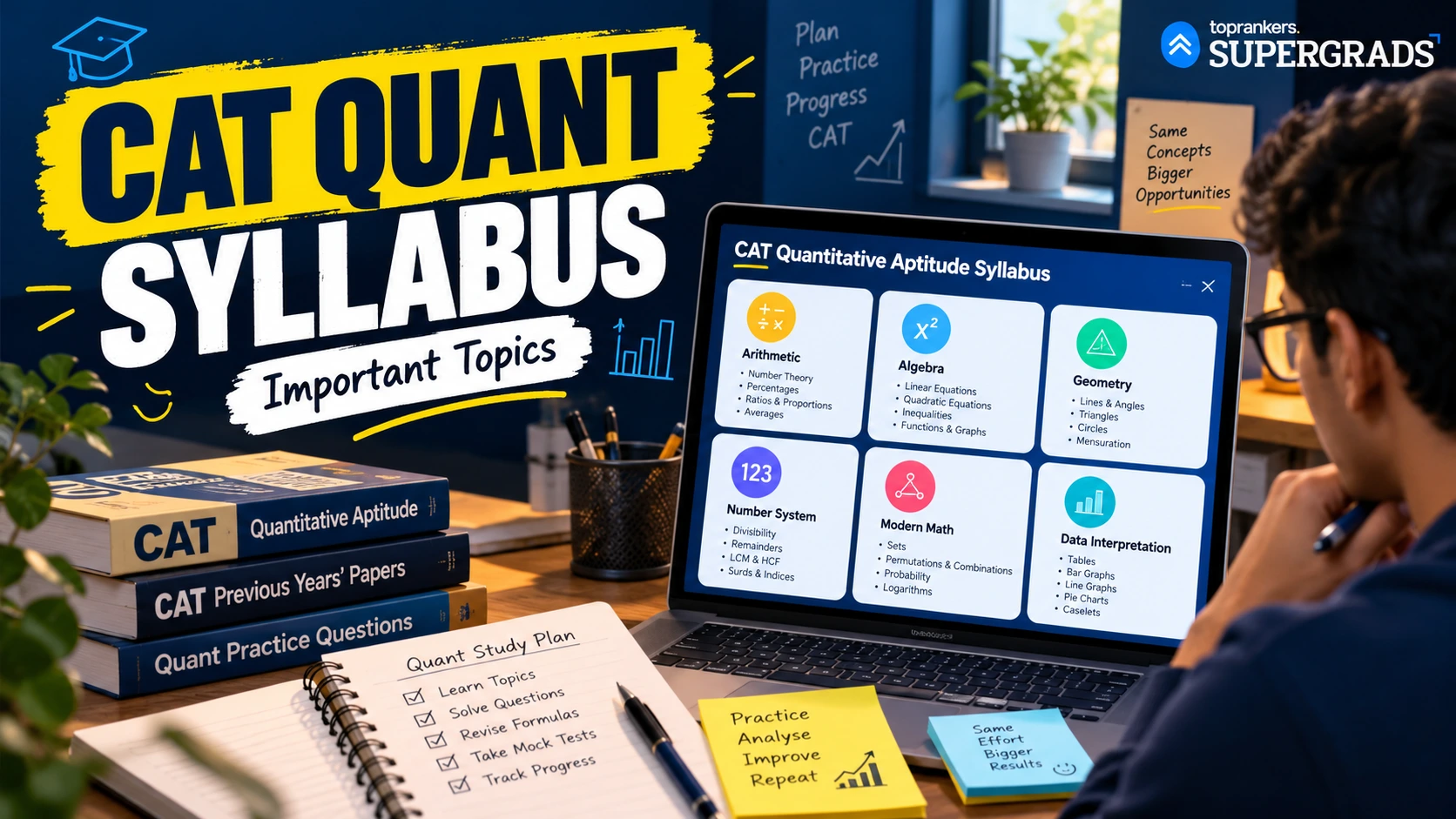
CAT Quantitative Aptitude Syllabus 2026 includes topics from Arithmetic, Algebra, Geometry and Mensuration, Number System, and Modern Mathematics. Some of the topics candidates need to study are Percentages, Profit and Loss, Time and Work, Equations, Triangles, Circles, Probability, and Permutation and Combination.
There is no fixed number of questions for each chapter in the CAT Exam. Looking at previous years' question papers can help candidates identify commonly tested topics and prepare accordingly.
What Is the CAT Quantitative Aptitude Syllabus 2026?
The CAT Quantitative Aptitude section tests your understanding of mathematical concepts and your ability to solve questions within a limited time. The CAT Quant Syllabus includes topics from school-level mathematics, but questions often require more than direct formula application.
Overview of the CAT Quantitative Aptitude Syllabus
The syllabus for CAT Quantitative Aptitude is generally divided into five areas. The table below lists the main topics covered in each area.
| Section | Topics Covered |
|---|---|
| Arithmetic | Percentages, Ratio and Proportion, Averages, Profit and Loss, Simple and Compound Interest, Time and Work, Time, Speed and Distance, Mixtures and Alligation |
| Algebra | Linear Equations, Quadratic Equations, Inequalities, Functions, Logarithms, Progressions, Surds and Indices |
| Geometry and Mensuration | Lines and Angles, Triangles, Circles, Quadrilaterals, Polygons, Area, Perimeter, Surface Area and Volume |
| Number System | Divisibility, Factors, Multiples, HCF and LCM, Remainders, Prime Numbers, Unit Digit and Factorials |
| Modern Mathematics | Permutation and Combination, Probability, Set Theory and related counting concepts |
Importance of the CAT Quantitative Aptitude Syllabus for Exam Preparation
Knowing the CAT Quantitative Aptitude Syllabus helps you plan your preparation topic by topic instead of studying mathematics without a clear direction. It also helps you identify the chapters you already understand and those that need more practice.
Once you know the syllabus, you can compare it with CAT PYQs, practise questions from important chapters, and take a CAT Mock Test to check your speed and accuracy.
Latest Updates in the CAT Quantitative Aptitude Syllabus 2026
There is no fixed, officially published chapter-wise syllabus that guarantees which topics will appear in CAT 2026. The topics listed in preparation resources are based mainly on previous CAT papers and recurring question types.
Check the official CAT notification for updates to the CAT Exam Pattern. Until then, follow the main topics covered in the CAT Syllabus and practise questions from all five areas.
CAT Quantitative Aptitude Syllabus: Topic-Wise Breakdown
The CAT Quant Syllabus includes topics from basic mathematics to more advanced problem-solving. Use the lists below to check which chapters you need to study and practise.
Arithmetic Topics in the CAT Quantitative Aptitude Syllabus
Arithmetic covers questions based on percentages, ratios, money, time, work, and speed. It is a major part of the CAT Quantitative Aptitude Syllabus, so give it enough time during preparation.
| Arithmetic Topic | What to Study |
|---|---|
| Percentages | Percentage change, successive percentages |
| Ratio and Proportion | Ratios, direct and inverse proportion |
| Averages | Simple and weighted averages |
| Profit and Loss | Cost price, selling price, discount, profit and loss percentage |
| Simple and Compound Interest | Interest calculations and growth over time |
| Time and Work | Work efficiency, combined work, pipes and cisterns |
| Time, Speed and Distance | Relative speed, trains, boats and streams |
| Mixtures and Alligation | Mixing quantities at different prices or concentrations |
| Partnership | Profit sharing based on investment and time |
Start with Percentages, Ratio and Proportion, Averages, Profit and Loss, and Time and Work. Once you understand the basic methods, practise questions that combine two or more concepts.
Algebra Topics in the CAT Quantitative Aptitude Syllabus
Algebra involves equations, variables, expressions, and number patterns. Questions may ask you to find an unknown value, simplify an expression, or solve an equation. The CAT Syllabus for Quantitative Aptitude includes the following topics.
| Algebra Topic | What to Study |
|---|---|
| Linear Equations | One-variable and multiple-variable equations |
| Quadratic Equations | Roots, factorisation and nature of roots |
| Inequalities | Solving inequalities and finding possible values |
| Functions | Function values, domain and range |
| Logarithms | Log rules and logarithmic equations |
| Surds and Indices | Powers, roots and exponent rules |
| Progressions | Arithmetic and geometric progressions |
| Polynomials | Factorisation, roots and polynomial properties |
| Modulus | Absolute value and modulus equations |
Begin with linear and quadratic equations, inequalities, and logarithms. Move to functions and progressions after you are comfortable solving basic equations.
Geometry and Mensuration in the CAT Quantitative Aptitude Syllabus
This section includes questions on shapes, angles, area, perimeter, and volume. Learn the basic properties of different shapes and practise using the right formulas to solve questions.
| Topic | What to Study |
|---|---|
| Lines and Angles | Angle properties, parallel lines and transversals |
| Triangles | Similarity, congruence, Pythagoras theorem and special triangles |
| Circles | Chords, tangents, arcs and angles in circles |
| Quadrilaterals | Squares, rectangles, parallelograms and rhombuses |
| Polygons | Interior and exterior angles |
| Mensuration | Area, perimeter, surface area and volume |
| Coordinate Geometry | Distance, midpoint and basic coordinate concepts |
Triangles, circles, and mensuration are useful starting points. Keep a separate list of formulas and revise them while solving practice questions.
Number System in the CAT Quantitative Aptitude Syllabus
In Number System, you will solve questions related to different types of numbers. These may involve factors, remainders, or checking whether a number is divisible by another number.
| Topic | What to Study |
|---|---|
| Divisibility | Divisibility rules and number properties |
| Factors and Multiples | Prime factorisation and factor counting |
| HCF and LCM | Finding common factors and multiples |
| Remainders | Remainder rules and cyclicity |
| Integers | Positive and negative integers |
| Prime Numbers | Prime factorisation and properties |
| Unit Digit | Last digit patterns in powers |
| Factorials | Factorials and trailing zeroes |
| Base System | Number representation in different bases |
Focus on divisibility, HCF and LCM, factors, and remainders first. These topics also help you understand other number-based questions.
Modern Mathematics in the CAT Quantitative Aptitude Syllabus
Modern Mathematics includes counting, probability, and set-based questions. Some questions may look unfamiliar at first, so practise each topic separately before attempting mixed exercises.
| Topic | What to Study |
|---|---|
| Permutation and Combination | Arrangements and selections |
| Probability | Basic probability and counting outcomes |
| Set Theory | Sets, Venn diagrams and set operations |
| Sequences and Series | Patterns and sums of terms |
| Binomial Theorem | Expansion and binomial coefficients, where relevant |
Start with basic probability and set theory before moving to more involved counting questions. The number of questions from these topics can change each year, so do not leave an entire topic unprepared just because it had fewer questions in a past paper.
CAT Quantitative Aptitude Syllabus: Important Topics to Cover
If you have less time to prepare, start with topics that have appeared often in previous CAT papers. Arithmetic and Algebra are good places to begin. After that, move on to Geometry, Number System, and Modern Mathematics. CAT previous year papers can help you see which topics are asked more often, but the number of questions from each topic can change every year.
Give priority to these topics during your first round of preparation:
- Arithmetic: Percentages, Ratio and Proportion, Averages, Profit and Loss, Time and Work, Time, Speed and Distance.
- Algebra: Linear and Quadratic Equations, Inequalities, Functions, Logarithms, Progressions.
- Geometry and Mensuration: Triangles, Circles, Lines and Angles, Area and Volume.
- Number System: Divisibility, HCF and LCM, Factors, Remainders, Unit Digit.
- Modern Mathematics: Probability, Permutation and Combination, Set Theory.
This order is a starting point, not a reason to skip other chapters. Check your performance in topic-wise tests and spend more time on areas where you make repeated mistakes.
CAT Quantitative Aptitude Syllabus and Topic-Wise Weightage
The CAT exam does not have a fixed chapter-wise weightage for Quantitative Aptitude. The number of questions from Arithmetic, Algebra, Geometry, Number System, and Modern Mathematics can change from one year or slot to another.
CAT Quantitative Aptitude Syllabus: Expected Topic-Wise Question Distribution
The table below gives an approximate guide based on published analyses of previous papers. These figures are estimates, not an official CAT 2026 distribution. Different coaching institutes may classify some questions under different topics.
| Topic Area | Approximate Questions |
|---|---|
| Arithmetic | 8–10 |
| Algebra | 5–7 |
| Geometry and Mensuration | 3–5 |
| Number System | 1–3 |
| Modern Mathematics | 1–3 |
The ranges are indicative and may not add up to the total number of questions in a particular paper. Use them to guide your preparation, not to predict the exact CAT 2026 paper.
Previous Years' CAT Quantitative Aptitude Syllabus and Question Trends
In CAT, Arithmetic and Algebra usually make up a good part of the Quant questions. Geometry and Mensuration also come up regularly, while Number System and Modern Mathematics may have fewer questions in some years. The number of questions from each topic can vary across slots.
When reviewing a CAT Previous year paper, note the topic, difficulty level, and method needed to solve each question. This gives you a better idea of the question styles than relying only on a topic-wise weightage table.
How to Prioritise Topics Based on CAT Quantitative Aptitude Syllabus Weightage
Use this order if you need a clear starting point:
- Complete the basics of Arithmetic and practise different question types.
- Study Algebra and solve equations without depending on shortcuts.
- Cover Geometry and Mensuration, including important properties and formulas.
- Practise Number System questions involving factors, divisibility, and remainders.
- Learn the basics of Probability, Permutation and Combination, and Set Theory.
Once you have covered the basics, adjust your schedule based on your mock test results. A topic with fewer questions may still be worth studying if you can solve its questions accurately.
CAT Quantitative Aptitude Syllabus: Difficulty Level and Exam Pattern
The Quantitative Aptitude section checks how well you understand maths and solve questions within a limited time. Along with covering the syllabus, you need to practise choosing the right questions and solving them accurately.
CAT Quantitative Aptitude Section Pattern and Marking Scheme
In recent CAT exams, the Quantitative Aptitude section has had around 22 questions, with 40 minutes to complete it. Check the official CAT 2026 notification for the final exam pattern and marking scheme before the exam.
| Particular | Details based on the Recent Pattern |
|---|---|
| Section | Quantitative Aptitude (QA) |
| Number of Questions | Around 22 |
| Sectional Time Limit | 40 minutes |
| Question Types | MCQs and TITA (Type In The Answer) |
| Correct Answer | +3 marks |
| Incorrect MCQ | -1 mark |
| Incorrect TITA | No negative marking |
The number of questions and marking details above describe the recent pattern, not a guarantee of the final CAT 2026 format.
Difficulty Level of the CAT Quantitative Aptitude Syllabus
The difficulty can range from straightforward questions to problems that require several steps. Even a question based on a familiar topic can take time if it combines different concepts or uses an unfamiliar approach.
You should practise questions of all three difficulty levels:
- Easy: Questions that can be solved using a basic formula or concept.
- Moderate: Questions that need a few steps or some calculation.
- Difficult: Questions that involve more than one concept or take longer to solve.
Practise all three levels, but learn to recognise when a question is taking too long. In the exam, it is often better to move on and return to it later if time permits.
Sectional Time Limit and Question Types in CAT Quantitative Aptitude
The recent CAT format gives candidates 40 minutes for Quantitative Aptitude. You cannot use the time assigned to another section to solve Quant questions, so time management matters.
MCQs have answer options and carry a penalty for incorrect responses under the recent marking scheme. TITA questions require you to enter the answer and have not carried negative marking in the recent pattern. Practise both formats so that you are comfortable with the way answers must be entered.
CAT Quantitative Aptitude Syllabus for Beginners
If you are starting CAT preparation from scratch, you do not need to begin with difficult questions. First, make sure you understand basic mathematics and can solve simple problems without getting stuck on calculations.
How to Start Preparing for the CAT Quantitative Aptitude Syllabus
Follow these steps to get started:
- Read the complete CAT Quantitative Aptitude Syllabus and list the topics you need to cover.
- Revise basic calculations, fractions, percentages, ratios, and equations.
- Pick one topic at a time and learn its concepts before solving questions.
- Start with easy questions, then move to moderate and difficult ones.
- Review incorrect answers to understand where you went wrong.
Before moving on to tougher questions, make sure your basic maths is clear. These concepts will help you solve CAT Quant questions more easily.
Basic Mathematical Concepts Required for CAT Quantitative Aptitude. Revise the following topics before starting the main syllabus:
- Fractions, decimals, and percentages
- Positive and negative numbers
- Ratios and proportions
- Squares, cubes, and square roots
- Basic algebra and equations
- Divisibility rules and prime numbers
- Multiplication tables and mental maths
You can revise these topics using school-level mathematics books or beginner-friendly CAT Study Material. Once the basics are clear, start solving CAT-level questions on the same topics.
Best Approach to Cover the CAT Quantitative Aptitude Syllabus from Scratch
Do not try to finish several chapters at once. Study one topic, solve practice questions, and revise it before moving to the next.
For example, complete Percentages first and then move to Profit and Loss. The concepts are connected, so learning them in this order can make some questions easier to understand. Follow a similar approach with Ratio and Proportion, Averages, and Mixtures.
Keep a notebook for formulas and mistakes. It will be useful when you begin revision and take mock tests.
CAT Quantitative Aptitude Syllabus: Preparation Strategy
Your preparation plan should include concept learning, question practice, revision, and mock test analysis. Give yourself enough time to understand a topic instead of rushing through the entire syllabus.
Here is a simple way to organise your preparation:
| Preparation Stage | What to Do |
|---|---|
| Learn the basics | Revise calculations and understand the concepts in each chapter. |
| Practise topic-wise | Solve questions from one topic before moving to another. |
| Work on weak areas | Revisit questions you could not solve or answered incorrectly. |
| Solve CAT PYQs | Check how CAT has tested the topic in previous papers. |
| Take mock tests | Practise solving questions within the exam's time limit. |
| Revise regularly | Review formulas, shortcuts, and mistakes every week. |
A few additional tips can help you stay on track:
- Set weekly targets: Decide which chapters you will complete each week.
- Practise calculations: Spend a little time each day improving mental maths.
- Avoid memorising every shortcut: Understand the method first so you can use it in different types of questions.
- Review your mistakes: Check whether an error happened because of a concept, calculation, or misreading of the question.
- Use CAT Preparation Tips: Follow a schedule that leaves time for practice and revision, not just syllabus completion.
If you have three months, use the first month to build concepts, the second to practise topic-wise questions and CAT PYQs, and the third to focus more on mock tests and revision. Adjust this plan according to how much of the syllabus you have already covered.
Best Books for CAT Quantitative Aptitude Syllabus Preparation
Choose books that explain concepts clearly and provide enough questions for practice. You do not need to study from several books at the same time. Start with one main resource and use other materials to practise topics where you need more help.
| Book | How It Can Help |
|---|---|
| How to Prepare for Quantitative Aptitude for CAT by Arun Sharma | Covers key Quant topics with practice questions at different difficulty levels. |
| Quantitative Aptitude for CAT by Nishit K. Sinha | Provides concept explanations and practice for different Quant topics. |
| Quantitative Aptitude Quantum CAT by Sarvesh K. Verma | Offers extensive practice questions for CAT Quant preparation. |
Check the latest available editions before buying a book. Choose one that matches your current level rather than trying to complete all three.
Online Resources and Practice Materials for CAT Quantitative Aptitude
You can use online resources alongside your books to understand concepts and practise questions. These include:
- CAT Quant topic-wise practice questions
- Previous-year question papers with solutions
- Sectional Quant mock tests
- Video lessons for difficult topics
- Formula sheets and revision notes
You can also use the CAT Preparation Books and CAT Study Material available to you to build a topic-wise practice routine.
How to Choose the Right Study Material for the CAT Quantitative Aptitude Syllabus
Before choosing a resource, check whether it covers the topics in your syllabus, explains the solutions, and provides questions at different difficulty levels.
If you are new to CAT preparation, start with study material that explains topics with examples. If you are comfortable with the basics, try solving CAT-level questions and take mock tests to see how well you perform. There is no need to follow too many books for the same topic.
CAT Quantitative Aptitude Syllabus: Previous Year Questions and Mock Tests
Understanding the concepts is important, but regular practice matters too. CAT previous year papers help you get familiar with the types of questions asked in the exam, while mock tests let you practise managing your time.
Importance of Previous Year Questions for CAT Quantitative Aptitude
Solving CAT Previous year paper questions helps you understand the way familiar concepts are used in the exam. You may find that a question needs more reasoning than direct formula application.
Use CAT PYQs after completing the basics of a topic. Try to solve each question on your own before checking the solution. If you cannot solve it, understand the method and attempt a similar question later.
How to Use Mock Tests to Master the CAT Quantitative Aptitude Syllabus
Start with topic-wise tests while learning the syllabus. Once you have covered several chapters, take sectional tests to practise different topics together. Full-length CAT mock tests can help you prepare for the timing and structure of the complete exam.
After each test, review both attempted and unattempted questions. Look for questions you could have solved with a better method or by avoiding a calculation error.
Analysing Mock Test Performance and Improving Accuracy
Do not judge your progress only by your mock test score. Check which topics caused problems and why.
Keep track of these points:
- Questions you answered correctly.
- Questions you got wrong due to calculation errors.
- Questions you could not solve because the concept was unclear.
- Questions that took too long.
- Questions you skipped but could have solved.
Use this review to plan your next practice session. If you repeatedly struggle with equations, for example, revise the relevant concepts and solve a fresh set of questions before taking another test.
Common Mistakes to Avoid While Preparing for the CAT Quantitative Aptitude Syllabus
Some preparation habits can waste time or leave gaps in your understanding. Keep the following mistakes in mind while studying.
Ignoring Important Topics in the CAT Quantitative Aptitude Syllabus
Do not prepare only Arithmetic because it often accounts for a large share of the questions. Cover Algebra, Geometry, Number System, and Modern Mathematics as well. The topic distribution can change, and leaving entire areas untouched may limit your options in the exam.
Spending Too Much Time on Difficult Quantitative Aptitude Questions
It is useful to practise difficult questions, but do not let one question take up most of your study session. If you are stuck, check which concept you are missing, review the solution, and try a similar question.
In mock tests, don't spend too much time on a question if you can't figure out how to solve it. Move to the next one and come back to it later if you have time.
How to Improve Speed and Accuracy in CAT Quantitative Aptitude
The more you practise, the easier it becomes to solve questions quickly. But don't rush just to save time. Read each question properly, work through the calculations carefully, and check your answer whenever possible.
Practise mental maths for common calculations and compare different solution methods. Use shortcuts only when you understand why they work. With mock test analysis, you can also identify which question types take you the most time.
CAT Quantitative Aptitude Syllabus: Last-Minute Preparation Tips
In the final weeks before CAT, focus on revision and practice rather than trying to learn every topic from the beginning. Spend more time on concepts you have already studied but still find difficult. Use this checklist during revision:
- Revise the formulas for Arithmetic, Algebra, Geometry, and Mensuration.
- Practise questions from topics where you make frequent mistakes.
- Solve selected CAT PYQs from different chapters.
- Take timed Quant sectional tests.
- Review errors from recent mock tests.
- Check that you have covered all five major topic areas.
Important Formulas to Revise Before the CAT Exam
Pay particular attention to formulas and rules used in common question types.
| Topic | What to Revise |
|---|---|
| Percentages | Percentage change and successive percentage changes |
| Profit and Loss | Profit percentage, loss percentage, and discount |
| Averages | Average and weighted average |
| Time and Work | Work rate and combined work |
| Time, Speed and Distance | Speed, distance, time, and relative speed |
| Algebra | Quadratic equations, identities, and logarithm rules |
| Geometry | Triangle properties, circle rules, and angle properties |
| Mensuration | Area, perimeter, surface area, and volume |
| Number System | Divisibility, factors, remainders, and unit digit patterns |
| Probability | Basic probability rules and counting methods |
Do not just read formulas. Solve a few questions using them to check whether you remember when and how to apply each one.
Time Management Tips for the CAT Quantitative Aptitude Section
With around 22 questions and 40 minutes in the recent CAT Pattern, you cannot spend equal time on every question. Read a question, decide whether you know how to approach it, and move on if it is taking too long.
Practise this approach in sectional mock tests. Your aim should be to identify questions you can solve accurately within the available time rather than attempting every question without a plan.

Smart Prep for CAT: Join Our Free Demo Class
Fill your details
Frequently Asked Questions
What is the syllabus for the Common Admission Test (CAT)?

How many sections are there in the CAT exam?
What is the duration of the CAT exam?
Is there a negative marking in the CAT exam?
Is there a sectional cut-off in the CAT exam?
What is the syllabus of CAT quantitative aptitude?
What are the important CAT Quantitative Aptitude Tips to crack the exam?
Is the CAT Quantitative Aptitude Syllabus the same every year?
What topics are included in the CAT Quantitative Aptitude Syllabus?
Has the CAT Quant syllabus changed for 2026?
How many questions come from each topic in CAT QA?

Jainab Alvi
Content Writer | MBA & CAT Preparation
SHARE