


UP APO Syllabus 2026: Detailed Break Down & Subject-wise Topics
October 19, 2026
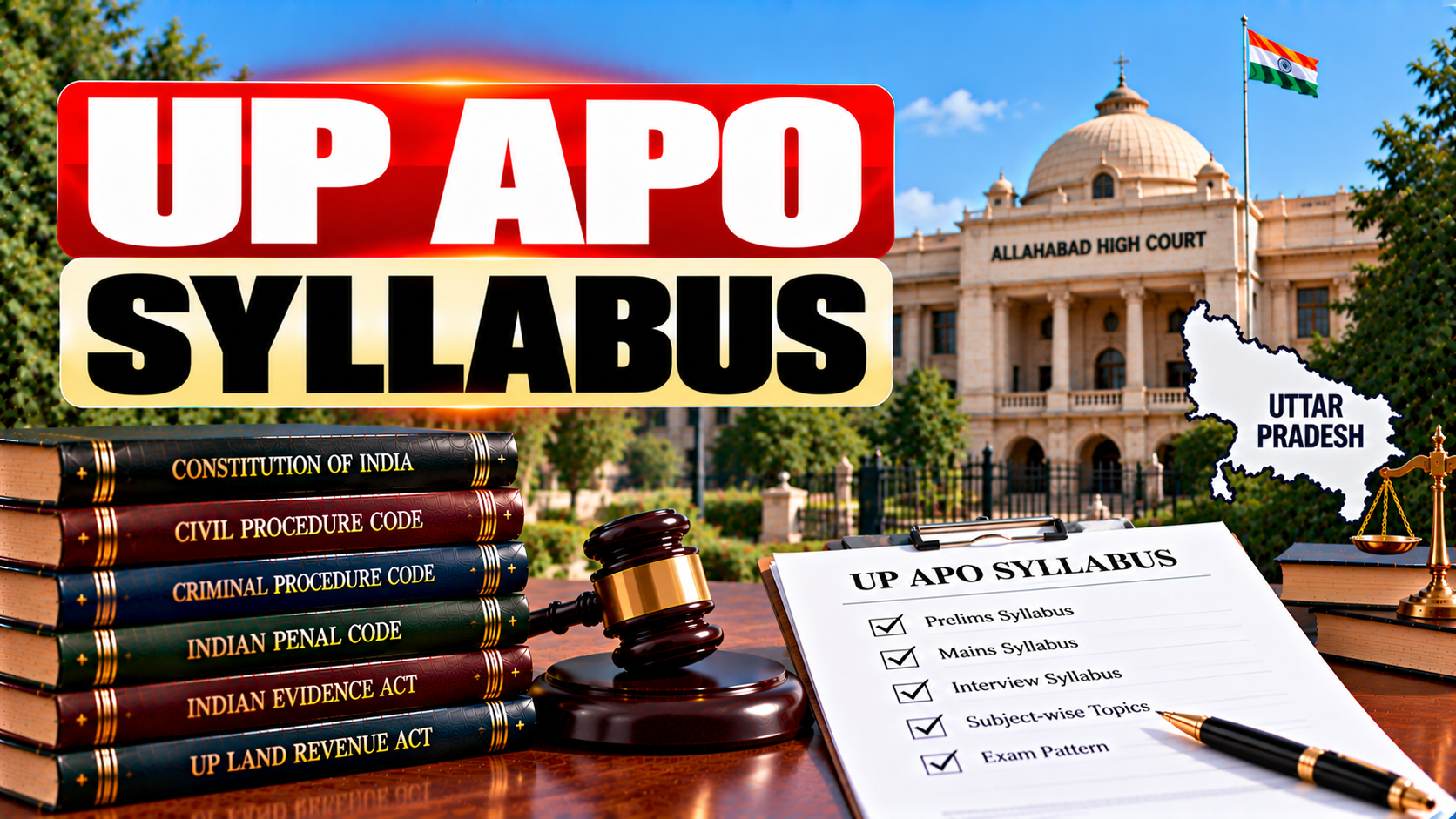
The UP APO syllabus 2026 has two written stages. Prelims is a 150 marks objective paper: 50 questions on General Knowledge and 100 on Law (BNS, BSA, BNSS, U.P. Police Act and the Constitution). Mains has six descriptive papers of 500 marks, followed by a 50-mark interview.
- Prelims is an objective paper of 2 hours consisting 150 marks and one-third negative marking.
- Mains consists of six papers of 500 marks. English and GK papers are 1.5 hours each, the rest 3 hours.
- Other Laws paper lists 16 special and state Acts.
- Interview is of 50 marks and final merit adds written marks and interview marks.
UP APO Syllabus 2026 Highlights
UP APO examination for the Prosecution Directorate of Uttar Pradesh is conducted by UPPSC. The UP APO syllabus 2026 covers general awareness, criminal law, evidence law, state police law, special Acts and 2 language papers.
| Particulars | Details |
|---|---|
| Examination | Uttar Pradesh Assistant Prosecution Officer Examination |
| Conducting body | Uttar Pradesh Public Service Commission (UPPSC), Prayagraj |
| Post | Assistant Prosecution Officer (APO) |
| Selection stages | Prelims, Mains and Interview |
| Prelims subjects | General Knowledge (50 questions) and Law (100 questions) |
| Mains papers | General Hindi, General English, General Knowledge, Criminal Law & Procedure, Sakshya Adhiniyam, Other Laws |
| New criminal laws | Bharatiya Nyaya Sanhita, 2023; Bharatiya Nagarik Suraksha Sanhita, 2023; Bharatiya Sakshya Adhiniyam, 2023 |
| State-specific laws | U.P. Police Act and Regulations; six UP Acts in Anya Adhiniyam |
| Official website | uppsc.up.nic.in |
UP APO Syllabus 2026 PDF Download Link
UPPSC publishes the syllabus as an annexure with the UP APO advertisement on their official website. Candidates can download the UP APO Syllabus 2026 from the link below.
UP APO Syllabus 2026 For Prelims
The UP APO prelims syllabus is tested in one paper General Knowledge & Law. It carries 150 questions for 150 marks, and you get 2 hours. Part I has 50 GK questions and Part II has 100 Law questions, so law decides two-thirds of your prelims score.
- Part I covers GK, with 50 questions worth 50 marks.
- Part II covers Law, with 100 questions worth 100 marks.
- Each question carries one mark, so the number of questions equals the marks in each part.
- The Law section consists of two-thirds of the total prelims score.
Prelims Part I: General Knowledge
Part I has 50 questions divided into 6 notified topics. The same GK syllabus applies to the mains GK paper.
| No. | Topic | Questions | Important Points |
|---|---|---|---|
| 1 | Current Events of National and International Importance | 10 | Last 12 months of national news, Supreme Court rulings, government schemes, summits, awards, appointments |
| 2 | General Science | 08 | Everyday physics and chemistry, human body, diseases, nutrition, space and defence technology |
| 3 | History of India | 08 | Indus Valley, Mauryas, Guptas, Delhi Sultanate, Mughals, British administrative changes |
| 4 | Indian National Movement | 08 | 1857 revolt, INC sessions, Gandhian movements, Acts of 1909, 1919 and 1935, Partition and Independence |
| 5 | Indian Polity & Economy | 08 | Parliament, judiciary, federal structure, Budget, RBI, inflation, Five-Year Plans to NITI Aayog |
| 6 | World Geography and Population | 08 | Continents, climate zones, rivers, Census data, population density and sex ratio |
Prelims Part II: Law
Part II has 100 questions from five laws. The Bharatiya Nyaya Sanhita alone carries 30 questions. Some coaching sites list the Sakshya Adhiniyam at 25 questions; the notified syllabus gives it 20 and gives the Nagarik Suraksha Sanhita 25.
| No. | Law | Questions | Important Topics |
|---|---|---|---|
| 1 | Bharatiya Nyaya Sanhita (BNS), 2023 | 30 | General exceptions and private defence (Ss. 14–44), abetment, criminal conspiracy (S. 61), culpable homicide and murder (Ss. 100–103), mob lynching, organised crime (S. 111), terrorist act (S. 113), sexual offences, theft, snatching, extortion, robbery, dacoity, cheating, community service as punishment |
| 2 | Bharatiya Nagarik Suraksha Sanhita (BNSS), 2023 | 25 | Directorate of Prosecution and Assistant Public Prosecutors (Ss. 18–20), arrest, Zero FIR and e-FIR (S. 173), police custody rules, mandatory forensics for offences punishable with 7 years or more, bail and anticipatory bail, trial in absentia, plea bargaining, summary trials |
| 3 | Bharatiya Sakshya Adhiniyam (BSA), 2023 | 20 | Relevancy of facts, admissions and confessions, dying declaration, electronic records as primary evidence, certificate for electronic evidence (S. 63), burden of proof and presumptions, estoppel, examination of witnesses, hostile witness |
| 4 | U.P. Police Act and Regulations | 15 | Police Act, 1861 as applied to Uttar Pradesh, constitution and powers of the force, duties of officers, U.P. Police Regulations on investigation, case diaries and prosecution |
| 5 | Indian Constitution | 10 | Articles 14, 20, 21 and 22, Article 39A (legal aid), writs under Articles 32 and 226, pardoning powers under Articles 72 and 161 |
UP APO Syllabus 2026 For Mains
The UP APO mains syllabus has six descriptive papers carrying 500 marks. Three law papers make up 300 marks, two language papers 150 marks and GK 50 marks. Duration is not uniform: General English and General Knowledge run for one and a half hours each, and the other four papers for three hours each.
- Paper 1: (General Hindi) includes High School standard Hindi, including essay, grammar and comprehension.
- Paper 2: (General English) includes High School standard English, including comprehension, precise and grammar.
- Paper 3: (General Knowledge) includes same six topics as prelims Part I, answered in written form.
- Paper 4: (Criminal Law & Procedure) includes BNS and BNSS, tested through problem questions.
- Paper 5: (Sakshya Adhiniyam) includes Bharatiya Sakshya Adhiniyam, 2023.
- Paper 6: (Anya Adhiniyam/Other laws) includes 16 special and Uttar Pradesh Acts.
Candidates can also refer UP APO Previous Year Papers for Mains to get more idea about the syllabus.
| Paper | Subjects | Syllabus |
|---|---|---|
| Paper 1 | General Hindi | High School standard Hindi |
| Paper 2 | General English | High School standard English |
| Paper 3 | General Knowledge | Same as prelims GK |
| Paper 4 | Criminal Law & Procedure | BNS, 2023 and BNSS, 2023 |
| Paper 5 | Sakshya Adhiniyam | BSA, 2023 |
| Paper 6 | Other Laws | 16 notified Acts |
| Total | Six descriptive papers | Three law, two language, one GK |
UP APO Syllabus 2026 for Interview
The UP APO interview (personality test) carries 50 marks. UPPSC judges suitability on the basis of efficiency, character, personality and physical fitness. There is no separately notified interview syllabus, so the table below lists suggested preparation areas.
| Area | Topics |
|---|---|
| Core criminal law | BNS, BNSS and BSA provisions, especially what changed from IPC, CrPC and the Evidence Act |
| Role of an APO | Duties under BNSS, relationship with police during investigation, opposing bail, conducting trials before magistrates |
| Uttar Pradesh awareness | State laws in Anya Adhiniyam, policing and law-and-order issues, recent Allahabad High Court decisions |
| Ethical situations | Weak police evidence, pressure from complainants, conflict of interest, duty of fairness to the accused |
| Current legal developments | Recent Supreme Court judgments on bail, arrest, electronic evidence and custodial rights |
| Communication and motivation | Clear answers in Hindi or English and a considered reason for choosing prosecution |
UP APO Exam Pattern 2026
The UP APO exam pattern has one objective prelims paper, six descriptive mains papers and an interview.
| Particulars | Prelims | Mains | Interview |
|---|---|---|---|
| Type | Objective (MCQ) | Descriptive | Personality test |
| Papers | One (two parts) | Six | Not applicable |
| Questions | 150 | Varies by paper | Not applicable |
| Maximum marks | 150 | 500 | 50 |
| Duration | 2 hours | 3 hours each; 1.5 hours for English and GK | As scheduled |
| Negative marking | One-third per wrong answer | Not applicable | Not applicable |
| Role in selection | Screening only | Counts towards final merit | Counts towards final merit |
UP APO Syllabus 2026 Marks Distribution
UP APO marks are distributed as 150 for prelims, 500 for mains and 50 for the interview. Prelims marks only to qualify mains, so final merit is out of 550.
| Stage | Paper / Subject | Marks |
|---|---|---|
| Prelims | General Knowledge | 50 |
| Prelims | Law | 100 |
| Mains | General Hindi | 100 |
| Mains | General English | 50 |
| Mains | General Knowledge | 50 |
| Mains | Criminal Law & Procedure | 100 |
| Mains | Sakshya Adhiniyam | 100 |
| Mains | Anya Adhiniyam | 100 |
| Interview | Personality test | 50 |
| Final merit | Mains plus interview | 550 |
How to Prepare for the UP APO Syllabus 2026
Candidates can start with the three new criminal laws, because they carry 75 prelims questions and two full mains papers. Then add the U.P. Police Act, Anya Adhiniyam and the language papers to a weekly cycle. A detailed day-wise plan is in our UP APO preparation strategy.
- Build a paper-wise tracker. List every Act in the syllabus and mark three columns: first reading, MCQ practice, written answer. Gaps show up quickly.
- Read the bare Act before any guide. For BNS, read the illustrations as closely as the sections; prelims questions are often built on them.
- Map old to new. Keep IPC, CrPC and Evidence Act numbers beside BNS, BNSS and BSA numbers for the provisions you revise most.
- Give the U.P. Police Act its own week. Fifteen prelims questions come from it, and general judiciary material rarely covers it well.
- Prepare Anya Adhiniyam Act by Act. For each of the 16 Acts, write a one-page sheet: definitions, offences, punishment, bail position, special court.
- Write in Hindi every week. One essay and one précis a week through the year does more than a month of last-minute practice.
- Test under exam conditions. Take full 2-hour prelims mocks with negative marking, and time the 90-minute English and GK papers separately.
- Use previous papers to judge depth. The UP APO previous year papers show how far into each Act questions go.
Best Books for UP APO Exam 2026
The current bare Acts are your primary source for every law in the syllabus. Add a commentary where a provision needs explanation, and confirm the edition covers BNS, BNSS and BSA. The list below is a study suggestion, not an official UPPSC list; see the full Best books for UP APO Exams 2026 .
| Subject | Book / Source | Author or Publisher |
|---|---|---|
| All prescribed Acts | Bare Acts (latest amended text) | Government of India (India Code) / State of Uttar Pradesh |
| BNS | Law of Crimes (BNS edition) | Ratanlal & Dhirajlal |
| BSA | Law of Evidence (BSA edition) | Batuk Lal |
| BNSS | Criminal Procedure (BNSS edition) | R. V. Kelkar |
| Constitution | Introduction to the Constitution of India | D. D. Basu |
| General Knowledge | General Knowledge | Lucent |
| General Hindi | Samanya Hindi | Lucent |
| General English | High School English Grammar and Composition | Wren & Martin |
The UP APO syllabus 2026 states depth in a narrow set of laws. BNS, BNSS and BSA run through prelims and two mains papers, and 16 special Acts fill a third. Read the bare Acts first, practise MCQs and written answers together, and keep Hindi in your weekly timetable from day one.
If you want structured guidance, book a free demo class for UP APO coaching or talk to a Judiciary Gold counsellor.
Download Judiciary Study Material
Fill your details
Frequently Asked Questions
What is the UP APO syllabus 2026?

Where can I download the official UP APO syllabus PDF?
How should I prepare for the UP APO syllabus 2026 effectively?
Is the syllabus for UP APO same every year?
Does the syllabus of UP APO include General Studies?
What is included in the UP APO 2026 syllabus?
Nancy Mahavir Sharma
Legal Writer
SHARE