Overview: Probability questions for SNAP are among the most scoring topics in the Quantitative, Data Interpretation & Data Sufficiency section. Candidates who understand the basic concepts and practice a variety of question types can solve these questions quickly during the exam. This guide covers probability questions for SNAP, important concepts, question types, 30+ practice questions, preparation strategy, mock test importance, and FAQs to help you score higher in SNAP Exam 2026.
Key Takeaways
Probability questions for SNAP are generally easy to moderate in difficulty.
Questions are based on everyday situations like cards, dice, coins, bags, and selections.
Understanding formulas is more important than memorizing shortcuts.
Regular practice of SNAP probability questions improves speed and confidence.
Solving different varieties of probability questions for SNAP helps identify recurring SNAP exam pattern.
Attempting SNAP probability questions regularly improves overall Quantitative Aptitude performance.
What are Probability Questions for SNAP 2026?
Probability questions for SNAP evaluate your ability to determine the chance of an event occurring using logical reasoning and mathematical formulas. These questions may involve rolling dice, tossing coins, drawing cards, selecting objects from a bag, forming committees, or choosing people randomly.
Unlike lengthy arithmetic problems, SNAP probability questions mainly test conceptual understanding and logical application. Candidates who know the sample space and favourable outcomes can solve most probability questions for SNAP within a minute.
Basic Probability Concepts You Must Know
Before solving probability questions for SNAP, every aspirant should have a clear understanding of the fundamental concepts of probability. These concepts form the foundation for solving both basic and advanced SNAP probability questions. A strong grasp of these topics will help you apply formulas correctly, avoid common mistakes, and improve your overall accuracy.
1. Experiment
An experiment is any activity or process that produces one or more possible outcomes. In probability, examples of experiments include tossing a coin, rolling a die, drawing a card from a deck, or selecting a ball from a bag.
Example: Rolling a six-sided die is an experiment because there are six possible outcomes.
2. Sample Space
The sample space is the complete set of all possible outcomes of an experiment. It is usually represented by the symbol S. Identifying the sample space correctly is the first step in solving most probability questions for SNAP.
Example: When rolling a die, the sample space is {1, 2, 3, 4, 5, 6}.
3. Event
An event is any subset of the sample space for which probability is calculated. Events can be simple (containing one outcome) or compound (containing multiple outcomes).
Example: Getting an even number when rolling a die is an event consisting of {2, 4, 6}.
4. Equally Likely Outcomes
Outcomes are said to be equally likely when each outcome has the same probability of occurring. Most standard probability problems in SNAP assume equally likely outcomes.
Example: In a fair coin toss, getting Heads and Tails are equally likely outcomes.
5. Independent Events
Two events are independent if the occurrence of one event does not affect the probability of the other event occurring. Independent events are commonly tested in SNAP probability sample papers.
Example: Tossing a coin and rolling a die are independent events because the result of one does not influence the other.
6. Dependent Events
Events are called dependent when the occurrence of one event changes the probability of the other event. These questions often involve selecting objects without replacement.
Example: Drawing two cards consecutively from a deck without replacing the first card.
7. Complementary Events
A complementary event refers to the event that an event does not occur. The sum of the probabilities of an event and its complement is always equal to 1.
Example: If the probability of getting a Head is 1/2, then the probability of not getting a Head (getting a Tail) is also 1/2.
8. Conditional Probability
Conditional probability is the probability of an event occurring given that another event has already occurred. These questions require careful interpretation of the given conditions.
Example: Finding the probability of drawing a King given that the card drawn is a face card.
9. Mutually Exclusive Events
Two events are mutually exclusive if they cannot occur at the same time. If one event happens, the other cannot happen simultaneously.
Example: While rolling a die, getting both 2 and 5 in a single roll is impossible, making these mutually exclusive events.
Understanding these concepts thoroughly will make solving probability questions for SNAP much easier. Once you are comfortable with these fundamentals, you can confidently tackle formula-based, conceptual, and application-oriented SNAP probability questions in the actual exam.
30+ Probability Questions for SNAP with Answers
Practicing a diverse set of probability questions for SNAP is essential for building a strong foundation in Quantitative Aptitude. The SNAP MBA Exam 2026 is known for testing conceptual clarity, logical reasoning, and quick decision-making rather than lengthy calculations.
Question 1
A fair coin is tossed once. What is the probability of getting a Head?
1/4
1/2
3/4
1
Answer: B. 1/2
Question 2
A die is rolled once. What is the probability of getting an even number?
1/6
1/3
1/2
2/3
Answer: C. 1/2
Question 3
What is the probability of drawing an Ace from a standard deck of 52 cards?
1/13
1/26
1/4
4/13
Answer: A. 1/13
Question 4
A bag contains 5 red and 7 blue balls. One ball is selected at random. Find the probability that it is red.
5/12
7/12
1/2
5/7
Answer: A. 5/12
Question 5
Two coins are tossed together. What is the probability of getting exactly one Head?
1/4
1/2
3/4
1
Answer: B. 1/2
Question 6
A die is rolled. Find the probability of getting a number greater than 4.
1/6
1/3
1/2
2/3
Answer: B. 1/3
Question 7
Three coins are tossed. What is the probability of getting all Heads?
1/8
1/4
3/8
1/2
Answer: A. 1/8
Question 8
What is the probability of drawing a King from a pack of cards?
1/13
1/26
1/4
4/13
Answer: A. 1/13
Question 9
A box contains 10 bulbs, 2 of which are defective. One bulb is selected randomly. Find the probability that it is not defective.
1/5
2/5
4/5
3/5
Answer: C. 4/5
Question 10
A die is rolled. What is the probability of getting a prime number?
1/6
1/3
1/2
2/3
Answer: C. 1/2
Question 11
A card is drawn from a standard deck of 52 cards. What is the probability of drawing a Queen?
1/13
1/26
1/4
4/13
Answer: A. 1/13
Question 12
A bag contains 8 white and 12 black balls. One ball is drawn at random. Find the probability of selecting a black ball.
2/5
3/5
1/2
4/5
Answer: B. 3/5
Question 13
Two dice are rolled together. What is the probability that the sum is 7?
1/12
1/6
5/36
7/36
Answer: B. 1/6
Question 14
Three coins are tossed. What is the probability of getting exactly two Heads?
1/8
3/8
1/2
5/8
Answer: B. 3/8
Question 15
A die is rolled once. What is the probability of getting a multiple of 3?
1/6
1/3
1/2
2/3
Answer: B. 1/3
Question 16
A card is drawn from a deck. What is the probability that it is a Heart?
1/2
1/3
1/4
1/13
Answer: C. 1/4
Question 17
A bag contains 6 green, 4 yellow and 5 blue balls. One ball is selected randomly. What is the probability of selecting a yellow ball?
4/15
5/15
6/15
1/5
Answer: A. 4/15
Question 18
Two dice are thrown. What is the probability that both show even numbers?
1/2
1/3
1/4
1/9
Answer: C. 1/4
Question 19
A fair coin is tossed four times. What is the probability of getting all Tails?
1/8
1/16
1/4
1/32
Answer: B. 1/16
Question 20
From a deck of cards, what is the probability of drawing a face card?
3/13
1/4
4/13
1/13
Answer: A. 3/13
Question 21
A die is rolled. What is the probability of getting a number less than 5?
1/2
2/3
4/6
5/6
Answer: B. 2/3
Question 22
A box contains 3 red, 5 blue and 2 green pens. One pen is selected randomly. What is the probability that it is green?
1/5
2/5
3/10
1/10
Answer: A. 1/5
Question 23
Two cards are drawn one after another without replacement. What is the probability that both are Aces?
1/221
1/169
1/52
1/663
Answer: A. 1/221
Question 24
A die is rolled twice. What is the probability of getting a six on both rolls?
1/6
1/12
1/18
1/36
Answer: D. 1/36
Question 25
A bag contains 9 balls numbered 1 to 9. What is the probability of selecting an odd-numbered ball?
4/9
5/9
1/2
2/3
Answer: B. 5/9
Question 26
What is the probability of drawing a black King from a standard deck?
1/26
1/13
1/52
2/13
Answer: A. 1/26
Question 27
A coin is tossed three times. What is the probability of getting at least one Head?
7/8
3/8
5/8
1/2
Answer: A. 7/8
Question 28
Two dice are rolled. What is the probability that both show the same number?
1/3
1/6
5/36
1/12
Answer: B. 1/6
Question 29
A card is drawn. What is the probability that it is neither a Heart nor a Diamond?
1/2
1/3
2/3
3/4
Answer: A. 1/2
Question 30
A bag contains 4 red, 6 blue and 10 green balls. What is the probability of drawing a green ball?
1/5
1/2
3/5
2/5
Answer: B. 1/2
Important Probability Formulas for SNAP
Knowing the right formulas can help you solve probability questions for SNAP quickly and accurately. Memorize the following formulas before attempting SNAP practice test series and questions.
Formula
Expression
Basic Probability
Probability = Favourable Outcomes ÷ Total Outcomes
Complementary Event
P(A') = 1 − P(A)
Addition Rule
P(A ∪ B) = P(A) + P(B) − P(A ∩ B)
Multiplication Rule (Independent Events)
P(A ∩ B) = P(A) × P(B)
Conditional Probability
P(A|B) = P(A ∩ B) ÷ P(B)
These formulas are frequently used while solving probability questions for SNAP.
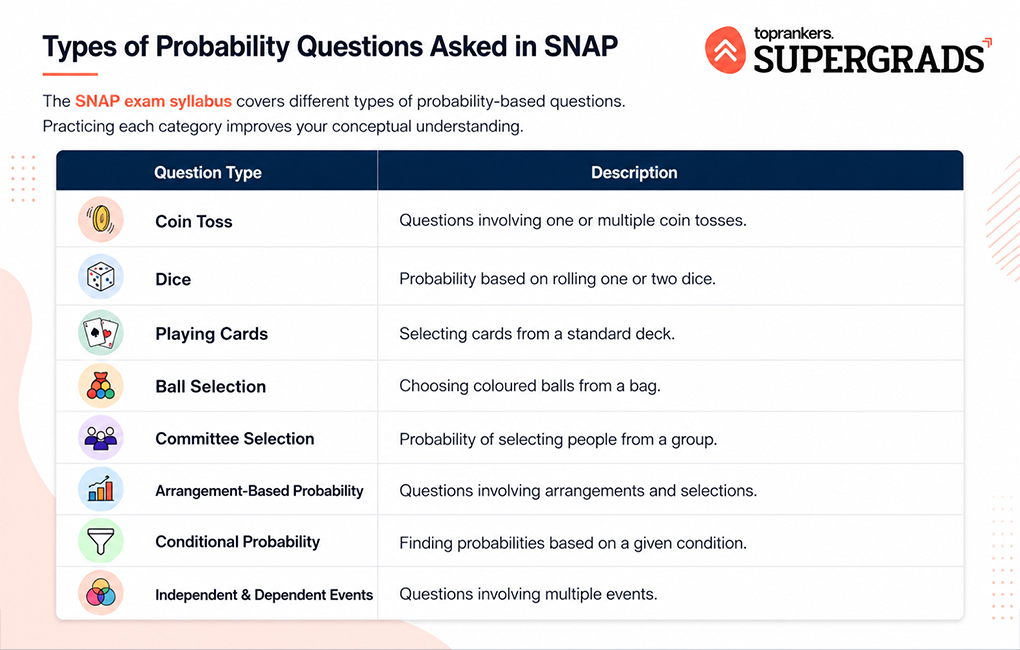
Types of Probability Questions Asked in SNAP
The SNAP exam syllabus covers different types of probability-based questions. Practicing each category improves your conceptual understanding.
Question Type
Description
Coin Toss
Questions involving one or multiple coin tosses.
Dice
Probability based on rolling one or two dice.
Playing Cards
Selecting cards from a standard deck.
Ball Selection
Choosing coloured balls from a bag.
Committee Selection
Probability of selecting people from a group.
Arrangement-Based Probability
Questions involving arrangements and selections.
Conditional Probability
Finding probabilities based on a given condition.
Independent & Dependent Events
Questions involving multiple events.
How to Improve Accuracy in Probability Questions for SNAP
Improving accuracy and SNAP total marks is just as important as improving speed. Follow these strategies while practicing SNAP probability questions.
Preparation Strategy
Benefit
Master the basic formulas
Reduces calculation errors.
Practice questions of different difficulty levels
Builds confidence for actual SNAP questions.
Focus on conceptual understanding
Helps solve unfamiliar questions quickly.
Time yourself during practice
Improves speed and exam temperament.
Review incorrect answers
Identifies weak concepts.
Practice mixed Quantitative Aptitude sets
Enhances overall exam readiness.
Probability Questions vs Other Quant Topics in SNAP
Compared with topics such as Percentages, Time & Work, Profit & Loss, and Geometry, probability questions for SNAP usually involve fewer calculations and rely more on logical reasoning. Candidates with strong conceptual clarity often find SNAP probability questions easier to solve, making probability one of the most scoring topics in the exam. For these it's important to practice the SNAP previous year question papers.
Quant Topic
Difficulty Level
Calculation Requirement
Conceptual Focus
Scoring Potential
Probability
Easy to Moderate
Low
Logical reasoning and probability concepts
High
Percentages
Easy to Moderate
Moderate
Percentage calculations and applications
High
Time & Work
Moderate
High
Work efficiency and equation-based problems
Moderate
Profit & Loss
Easy to Moderate
Moderate
Commercial mathematics and percentage concepts
Moderate to High
Geometry
Moderate to Difficult
Moderate
Theorems, formulas, and visualization
Moderate
Are Probability Questions in SNAP Difficult?
Most probability questions for SNAP are of easy to moderate difficulty. Basic questions involving coins, dice and cards are straightforward, while conditional probability and combined event questions require slightly deeper analysis.
Regular practice of SNAP probability questions enables candidates to recognize common patterns and solve questions confidently during the exam.
Conclusion
Probability remains one of the most scoring topics in the SNAP syllabus because it combines logical reasoning with simple mathematical concepts. Regular practice of probability questions for SNAP improves speed, accuracy and confidence. By solving a wide variety of SNAP probability questions, revising formulas and strengthening your conceptual understanding, you can maximize your Quantitative Aptitude score to get best SNAP colleges..
Are probability questions for SNAP calculation-intensive?
Is probability an important topic for SNAP preparation?
Can I prepare probability in one week?
About the Author
Zubeen Siddiqui
Content Writer | MBA & CAT Preparation
Zubeen Siddiqui is a content writer with 5+ years of professional experience, currently specializing in the MBA and CAT preparation space. She focuses on turning complex concepts into clear, engaging, and easy-to-understand content for students.
Her work involves simplifying preparation strategies, breaking down exam insights, and creating content that is practical and relatable for aspirants.... more

1723534562.png)



SHARE