
1723534562.png)

Series Questions for SNAP 2026: Types, Solved Examples & Preparatio
June 27, 2026
Overview: Series questions for SNAP exam are an important part of the Logical Reasoning section and often test a candidate's ability to identify patterns, relationships, and logical sequences. Since these questions are usually quick to solve with the right approach, mastering SNAP series questions can significantly improve your overall score.
What you will get in this blog?
In this guide, we'll cover the types of series questions, solving techniques, examples, and SNAP preparation tips to help you ace the SNAP exam.
What Are Series Questions for SNAP 2026?
Series questions for SNAP require candidates to identify the logic behind a sequence of numbers, alphabets, symbols, or a combination of these. Based on the SNAP exam pattern, candidates must determine the missing term, next term, or incorrect element in the series.
Solved Series Questions for SNAP with Answers
Q1. 3, 8, 15, 24, 35, ?
A. 46
B. 48
C. 50
D. 52
Answer: A. 46
Q2. 2, 6, 18, 54, 162, ?
A. 324
B. 486
C. 648
D. 972
Answer: B. 486
Q3. 1, 4, 10, 19, 31, ?
A. 42
B. 44
C. 46
D. 47
Answer: D. 47
Q4. 5, 9, 17, 33, 65, ?
A. 96
B. 112
C. 129
D. 130
Answer: C. 129
Q5. 144, 121, 100, 81, 64, ?
A. 36
B. 49
C. 42
D. 45
Answer: B. 49
Q6. 7, 13, 25, 49, 97, ?
A. 191
B. 193
C. 195
D. 197
Answer: B. 193
Q7. 1, 8, 27, 64, 125, ?
A. 180
B. 196
C. 216
D. 225
Answer: C. 216
Q8. 2, 5, 11, 23, 47, ?
A. 94
B. 95
C. 96
D. 97
Answer: B. 95
Q9. 13, 21, 34, 55, 89, ?
A. 122
B. 133
C. 144
D. 145
Answer: D. 145
Q10. 9, 18, 36, 72, ?
A. 108
B. 126
C. 144
D. 162
Answer: C. 144
Q11. A, C, F, J, O, ?
A. T
B. U
C. V
D. W
Answer: B. U
Q12. Z, W, S, N, H, ?
A. A
B. B
C. C
D. D
Answer: A. A
Q13. B, E, J, Q, Z, ?
A. K
B. M
C. L
D. I
Answer: B. M
Q14. A, Z, C, X, E, V, ?
A. G
B. T
C. U
D. H
Answer: A. G
Q15. M, O, R, V, A, ?
A. E
B. F
C. G
D. H
Answer: B. F
Q16. A1, C4, F9, J16, ?
A. O25
B. N25
C. P25
D. Q36
Answer: A. O25
Q17. 2B, 5D, 10G, 17K, ?
A. 26P
B. 28P
C. 26Q
D. 30P
Answer: A. 26P
Q18. C3, F6, J10, O15, ?
A. U21
B. V20
C. U22
D. W21
Answer: A. U21
Q19. 1A, 4C, 9F, 16J, ?
A. 25O
B. 25P
C. 36P
D. 36O
Answer: A. 25O
Q20. AA, BD, CG, DJ, ?
A. EM
B. EL
C. EN
D. EO
Answer: A. EM
Q21. 3, 5, 11, 21, 43, ?
A. 84
B. 85
C. 87
D. 89
Answer: C. 87
Q22. 6, 11, 21, 36, 56, ?
A. 80
B. 81
C. 82
D. 83
Answer: B. 81
Q23. 225, 196, 169, 144, ?
A. 121
B. 122
C. 124
D. 125
Answer: A. 121
Q24. 10, 13, 19, 28, 40, ?
A. 52
B. 54
C. 55
D. 56
Answer: C. 55
Q25. 81, 54, 36, 24, 16, ?
A. 8
B. 10
C. 12
D. 14
Answer: B. 10
Q26. 1, 3, 7, 15, 31, ?
A. 61
B. 62
C. 63
D. 64
Answer: C. 63
Q27. 4, 18, 48, 100, 180, ?
A. 292
B. 294
C. 296
D. 298
Answer: B. 294
Q28. 8, 15, 24, 35, 48, ?
A. 61
B. 63
C. 65
D. 67
Answer: B. 63
Q29. E, H, L, Q, W, ?
A. C
B. D
C. E
D. F
Answer: C. E
Q30. 2, 12, 36, 80, 150, ?
A. 240
B. 252
C. 256
D. 270
Answer: A. 240
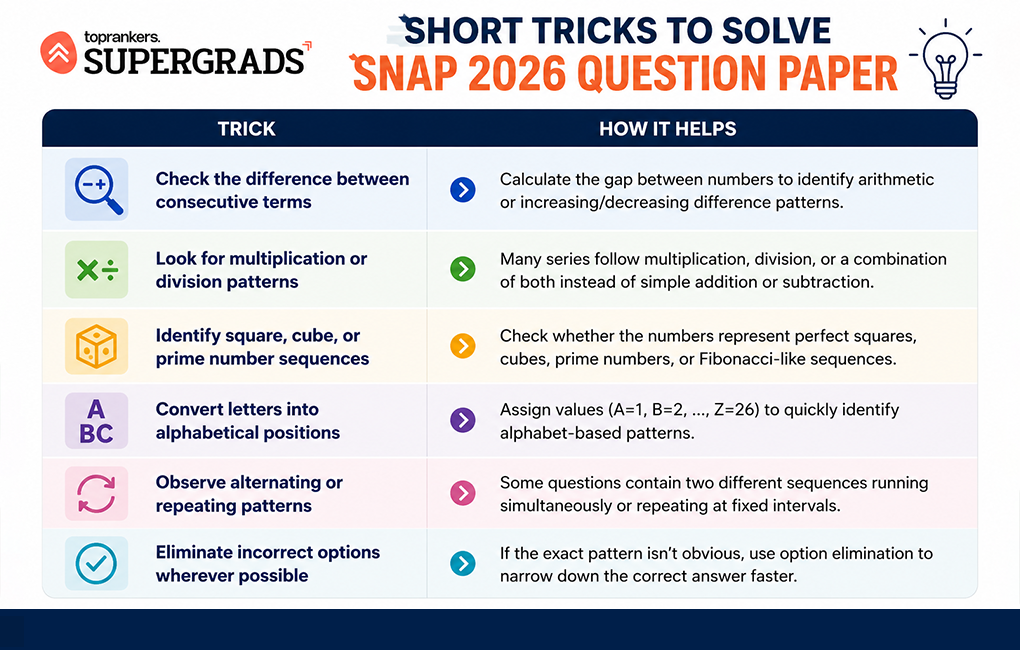
Short Tricks to Solve SNAP Series Questions 2026
Using the right approach can help you solve series questions from the SNAP syllabus in less than a minute. Follow these proven tricks to improve both your speed and accuracy in the SNAP exam.
| Trick | How It Helps |
|---|---|
| Check the difference between consecutive terms | Calculate the gap between numbers to identify arithmetic or increasing/decreasing difference patterns. |
| Look for multiplication or division patterns | Many series follow multiplication, division, or a combination of both instead of simple addition or subtraction. |
| Identify square, cube, or prime number sequences | Check whether the numbers represent perfect squares, cubes, prime numbers, or Fibonacci-like sequences. |
| Convert letters into alphabetical positions | Assign values (A=1, B=2, ..., Z=26) to quickly identify alphabet-based patterns. |
| Observe alternating or repeating patterns | Some questions contain two different sequences running simultaneously or repeating at fixed intervals. |
| Eliminate incorrect options wherever possible | If the exact pattern isn't obvious, use option elimination to narrow down the correct answer faster. |
Why Are SNAP Series Questions Important?
Frequently appear in the Logical Reasoning section
Series questions are a regular feature of the SNAP Logical Reasoning section, making them important topics for SNAP that candidates should practice thoroughly before the exam.
Can be solved quickly with regular practice
Once you understand common patterns and shortcuts, most series questions can be solved in less than a minute, helping you save valuable exam time.
Improve accuracy and overall exam score
Consistent practice of series questions enhances pattern recognition skills, leading to higher accuracy and contributing positively to your overall SNAP percentile.
Require minimal calculations compared to other reasoning topics
Unlike data interpretation or mathematical reasoning, series questions usually involve simple logic and basic calculations, making them one of the quickest scoring topics in the exam.
Types of SNAP Series Questions Asked
The following types of series questions are commonly asked in SNAP:
Number Series Questions for SNAP
These questions involve identifying mathematical patterns using operations like addition, subtraction, multiplication, division, squares, cubes, prime numbers, or Fibonacci sequences.
Example:
2, 6, 12, 20, 30, ?
Answer: 42
Pattern: +4, +6, +8, +10, +12
Alphabet Series Questions for SNAP
Alphabet series questions test your understanding of alphabetical order and letter positions.
Example:
A, D, G, J, ?
Answer: M
Pattern: Every third alphabet.
Alphanumeric Series Questions for SNAP
These combine numbers and letters in a single sequence.
Example:
A1, C3, E5, G7, ?
Answer: I9
Mixed Series Questions for SNAP
These contain symbols, numbers, and alphabets together, requiring careful observation.
Example:
2A, 4C, 6E, 8G, ?
Answer: 10I
Missing Term Series Questions
Candidates must identify the missing value within a sequence.
Example:
5, 10, __, 20, 25
Answer: 15
Common Mistakes to Avoid While Solving Series Questions for SNAP 2026
Avoiding these common errors can help you solve series questions more accurately and prevent unnecessary loss of SNAP total marks in the exam.
| Common Mistake | Why You Should Avoid It |
|---|---|
| Ignoring alternate patterns | Many series follow two alternating sequences. Missing this can lead to incorrect answers. |
| Assuming every series follows arithmetic progression | Not every sequence is based on addition or subtraction; always check for multiplication, division, or other hidden patterns. |
| Missing hidden multiplication or square patterns | Series may involve squares, cubes, prime numbers, or exponential growth instead of simple differences. |
| Spending too much time on one question | If a pattern is difficult to identify, move on and return later to maximize your overall score. |
| Overlooking alphabet positions | In alphabet-based questions, converting letters into their numerical positions often makes the pattern much easier to identify. |
Preparation Tips for SNAP Series Questions 2026
A well-planned SNAP preparation tips, tricks and strategy can help you solve series questions faster while maintaining a high level of accuracy in the SNAP exam.
| Preparation Tip | How It Helps |
|---|---|
| Practice at least 20–30 series questions daily | Daily practice improves pattern recognition and increases solving speed. |
| Revise common number and alphabet patterns | Regular revision helps you quickly identify frequently asked sequence types during the exam. |
| Solve previous year SNAP questions | Practicing past papers familiarizes you with the exam's difficulty level and question trends. |
| Attempt sectional mock tests regularly | Mock tests improve time management and help evaluate your preparation level. |
| Focus on improving speed without compromising accuracy | Developing a balance between speed and precision is essential for maximizing your SNAP score. |
| Analyze mistakes after every practice session | Reviewing your errors helps identify weak areas and prevents repeating the same mistakes. |
Conclusion
Series questions for SNAP can become one of your highest-scoring topics with regular practice of the SNAP previous year papers and the right strategy. Since SNAP emphasizes speed and accuracy, learning common SNAP exam patterns and solving plenty of practice questions will help you answer these questions confidently. Include series questions for SNAP in your daily preparation routine to strengthen your Logical Reasoning section and improve your overall SNAP score.
Frequently Asked Questions
Are series questions asked every year in SNAP?

Which type of series question is most common in SNAP?
How much time should I spend on a series question?
Are SNAP series questions difficult?

Zubeen Siddiqui
Content Writer | MBA & CAT Preparation
SHARE