
1723534562.png)

How to Improve Speed and Accuracy in CAT QA 2026?
May 22, 2026
Overview: If you're searching for how to improve speed and accuracy in CAT QA, the biggest gains come from improving accuracy first and then building speed with structured practice.
Key Takeaways
- Target 80–85% accuracy first, then increase attempts
- Use the 40-20 rule for time management
- Focus on Arithmetic + Algebra (highest weightage)
- Maintain an error log to track mistakes
- Practice daily drills+ understand CAT QA syllabus + practice weekly mocks
What You Will Get in This Blog: A complete step-by-step plan to improve speed and accuracy in CAT QA, including drills, mock strategy, and mistake analysis framework for CAT 2026.
What Makes the CAT QA Section Challenging?
Let’s understand first what exactly makes the CAT QA section challenging. Well, the QA section in CAT features a mix of topics: Arithmetic, Algebra, Geometry, Number Systems, and Modern Maths with about 22 questions to be solved in just 40 minutes.
The real challenge comes not only from the diversity of concepts but from the format: speed, accuracy, and question selection matter far more than school-level math knowledge. Unlike rote learning in school, CAT QA tests real-life problem-solving under pressure.
Other Important Year Wise Question Paper Links
| CAT PYQs | CAT 2025 Question Paper | CAT 2024 Question Paper |
| CAT 2023 Question Paper | CAT 2022 Question Paper | CAT 2020 Question Paper |
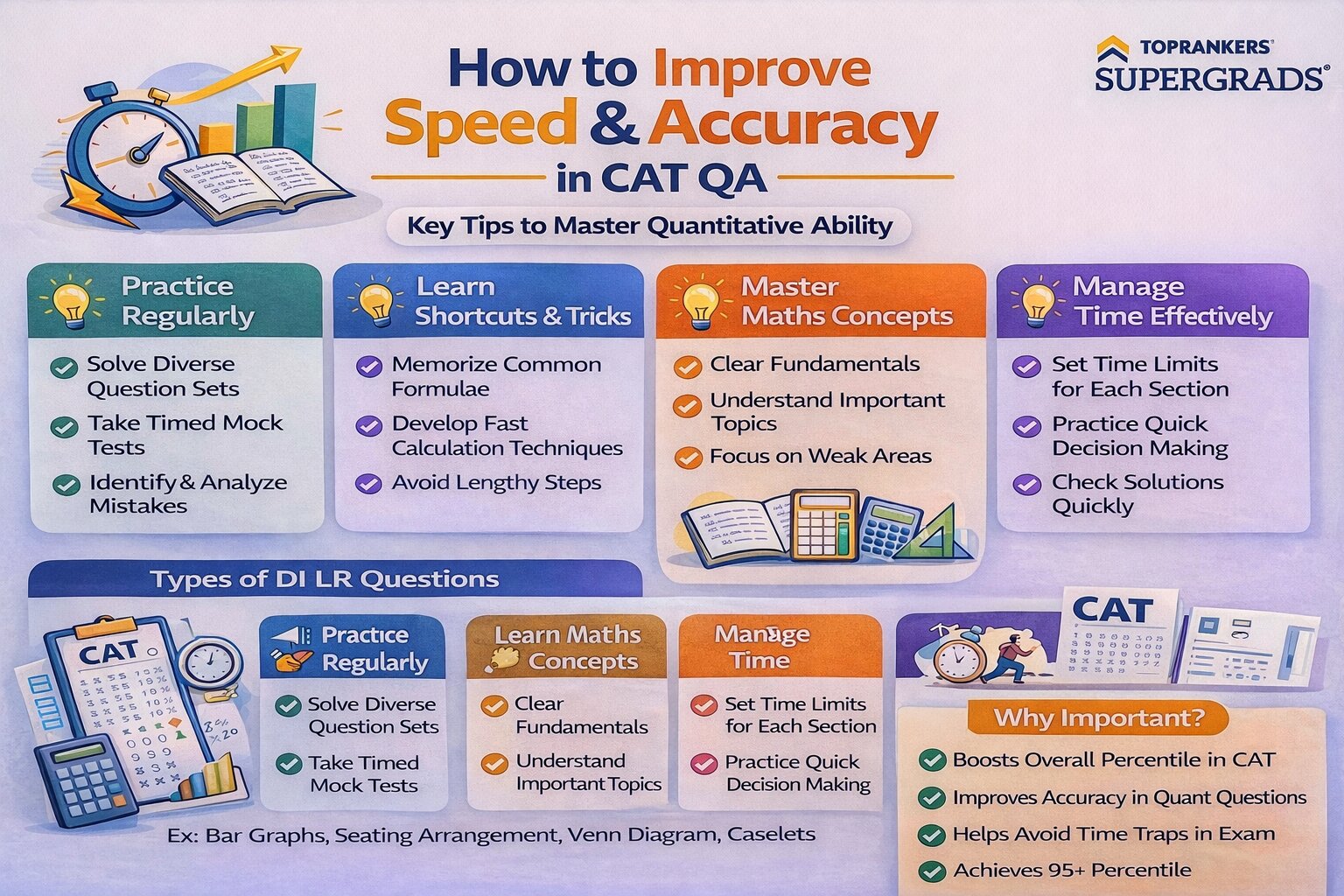
How to Improve Speed and Accuracy in CAT QA Section 2026?
Let’s start one by one with the tips and strategies to improve your speed and accuracy in CAT QA section of the CAT exam:
#Tip 1: Accuracy Comes First: Fix the Machine Before You Speed Up
Before worrying about speed, focus on accuracy this is non-negotiable. Imagine your problem-solving ability as a machine. If it produces errors 30-35% of the time, no amount of speed will help you maximise your score.
Aim for at least 80% accuracy to get a substantial edge.
Increasing your accuracy even by 15-20% is more beneficial than simply attempting more questions with lower accuracy. If you speed up recklessly, errors multiply, and your score suffers.
Check More: Expert Tips to Boost Speed and Accuracy in VARC in CAT Exam
#Tip 2: Understand the Importance of 40-20 Rule
The 40-20 rule is a simple yet powerful time management strategy for CAT QA. It suggests tackling the section in two focused rounds.
- In the first 40 minutes, answer only those questions that you can solve confidently in two minutes or less. This means sticking to topics or question types where you excel and feel most comfortable. Typically, this lets you solve between 15 to 20 questions easily without getting stuck.
- The CAT QA paper deliberately places some tough questions upfront to tempt you into wasting time. Avoid the trap of spending too long on difficult questions early on.
- In the remaining 20 minutes, attempt the trickier or longer questions that you had skipped. Since you already secured 15-20 questions, this time can be used calmly to gain extra points.
By following this, you can easily score around 60 marks in a moderate paper, which translates to a 99+ percentile. It’s about securing the easy wins first before challenging the tougher ones.
Check Now: Most Frequently Asked CAT QA Questions
#Tip 3 Start With What You Know
There’s another approach where all questions are attempted in one go, but with a strict three-minute time limit per question. If you find the first few questions hard, try starting from the end, where the questions are generally easier.
- Many aspirants are unaware of this and spend excessive time staring at the first questions. This wastes valuable time and reduces total attempts.
- Scanning all questions before starting can give you a better sense of which to attempt first.
- The key is discipline: never spend more than three minutes on any question. Move on quickly and come back later if time allows.
Test both this “one-round” method and the 40-20 rule during mocks to find which suits you more naturally. You’ll notice improved scores with consistent practice.
#Tip 4 Cut Down on Solution Time
Improving speed is all about reducing the time for calculations and thinking.
- Master mental math and learn calculation shortcuts.
- Use approximation where exact answers aren’t needed.
- Get comfortable with formulae and revisit shortcut methods.
- Train yourself to identify the easiest way to solve each problem as you practice tests.
With good accuracy, your speed will naturally increase as you get more comfortable with concepts.
Other Important Links
How Many Questions are Expected to be Asked From Each Topic?
Here is the estimated number of questions you can expect in the CAT 2026 exam:
|
Quant Topic |
Number of Questions (Tentative) |
|
10-14 |
|
|
8-10 |
|
|
Algebra |
6-8 |
|
8-10 |
|
|
Modern Maths |
5-6 |
Why Do Speed and Accuracy Matter So Much?
Accuracy is more important than attempting a larger number of questions. Answering questions with high accuracy is the major game-changer in the exam.
For example, improving accuracy from 65% to 80% with a fixed number of attempts can boost your score by double digits.
Conversely, racing to solve more questions while making frequent mistakes can tank percentile ranking due to negative marking. Thus, learning to balance speed and precision is crucial for success.
Check Now: CAT Quantitative Formula Book to Boost Your Score
Quantitative Ability Individual Topics Formula Sheets
| Number System Formula PDF | |
| Arithmetic Formula PDF | |
| Number Theory Formula PDF | |
| Quadratic Equation Formula PDF | |
| Inequalities Formula PDF | |
| Logarithms, Surds & Indices Formula PDF | |
| Time, Speed & Distance Formula PDF | |
| Linear Equations Formula PDF | |
| Ratio, Proportion & Variations Formula PDF | |
| Simple Interest - Compound Interest Formula PDF | |
| Profit & Loss Formula PDF |
What are the Silly Mistakes that Aspirants make in the CAT Exam?
Most errors arise from a few recurring process mistakes:
- Misreading the question: Hurrying through questions leads to missing crucial details or conditions, especially in complex ones.
- Miscalculation: Losing concentration during calculations whether it’s mental math or written steps causes preventable errors.
- Misjudgment of complexity: Underestimating how tricky a problem is, leading to flawed assumptions or oversimplifications.
To improve, review your mocks and identify which of these mistakes you frequently make. Note the patterns and make conscious efforts to eliminate them during practice.
How Do You Overcome “Silly” and Preventable Mistakes?
Here are the tips that you can follow to prevent silly mistakes in the CAT QA section:
- Slow down when reading: Don’t skim; careful reading avoids “pattern matching” mistakes.
- Stay alert: Maintain steady focus throughout calculations, not just at the setup stage.
- Pause before solving: Spend a moment planning an approach before jumping into execution, especially for higher-order problems in topics like permutations & combinations.
- Record process mistakes from each mock and set up checkpoints to avoid repeating them. This “meta-practice” retrains problem-solving habits
What Are the Smartest Tricks to Accelerate Calculations in CAT QA Section?
- Master mental math and calculation shortcuts; this reduces time spent on simple arithmetic and shapes up more time for tricky problems.
- Learn and practice standard approximations (for percentages, square roots, etc.), especially for speed.
- Apply shortcut techniques, but only after you fully understand their logic to minimise errors.
- Use “skip and return”: If a question isn’t cracking within 2-3 minutes, move on and come back later.
- Learn efficient approaches to commonly tested QA problems like alligation for mixtures or ratios in time-speed-distance by practising different methods and picking what works fastest for you.
Conclusion
So, there you have it improving your speed and accuracy in the CAT QA section is totally doable when you focus on fixing the basics first, choose your questions wisely, and practice with purpose.
It’s not about rushing blindly but about being smart and steady like a pro athlete in a decathlon, who trains for each event carefully.
Keep reviewing your mistakes, stay patient with yourself, and keep pushing a little every day!

Smart Prep for CAT: Join Our Free Demo Class
Fill your details
Frequently Asked Questions
How many questions are there in the CAT QA section, and what is the time limit?

What are the key topics in the CAT QA section to focus on for better speed and accuracy?
How can practicing mock tests improve speed and accuracy in the QA section?
What are some strategies to avoid silly mistakes and improve accuracy in the QA section?
Is it better to attempt easier questions first or try all questions in the QA section for maximizing score?

Lalita Vishwakarma
Content Writer
SHARE