
1723534562.png)

Cubes and Dice Questions for CAT 2026: Rules, Formulas, Practice Questions & PDF
October 8, 2026
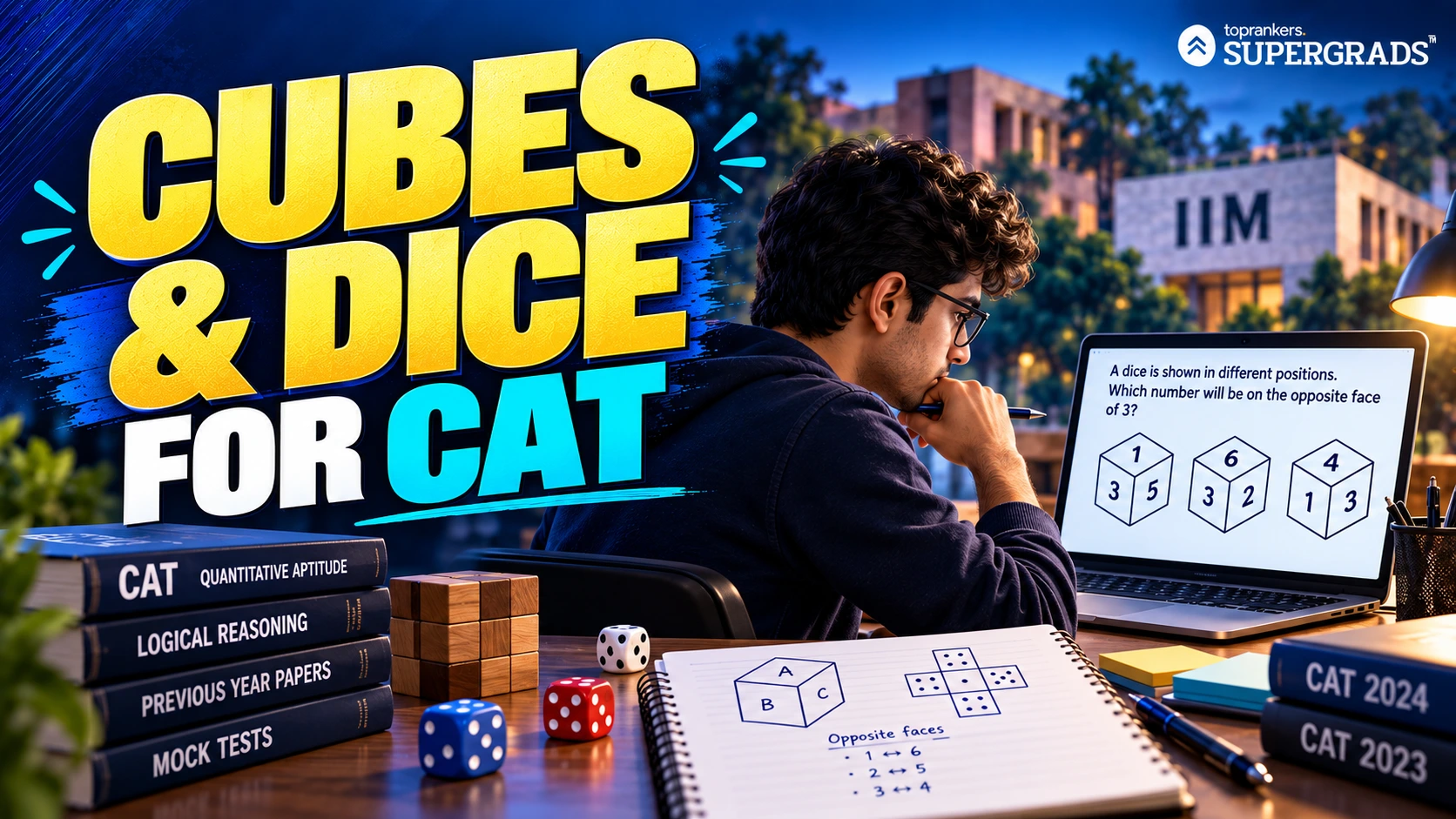
Cubes and Dice Questions for CAT Exam 2026 are an important part of logical reasoning practice. These questions test your visualisation, observation, and ability to identify opposite and adjacent faces. While direct cube and dice questions may not appear every year in CAT, the concept is useful for CAT-level LR sets and other MBA entrance exams.
In this blog, you will find the basics, important rules, formulas, shortcuts, common mistakes, and 30+ practice-based Cubes and Dice Questions for CAT. You will also get guidance on using CAT Previous Year Question Papers (CAT PYQs) for better preparation.
What You Will Get in This Blog
- Basic concepts of cubes and dice
- Golden rules to solve dice questions
- Cube painting formulas
- Types of Cubes and Dice Questions for CAT
- 30+ practice questions with answers
- Shortcut tricks for faster solving
- CAT cubes and dice questions PDF guidance
Key Takeaways
- Cubes and Dice Questions for CAT are easy to score once concepts are clear.
- Dice questions are based on opposite and adjacent face logic.
- Cube painting questions can be solved quickly using formulas.
- Practising CAT PYQs and mock-based questions improves speed.
- A CAT cubes and dice questions PDF can help in quick revision before mocks.
Table of Contents
- What are Cubes and Dice Questions for CAT?
- Understanding the Basics of Cubes and Dice
- Golden Rules to Solve Dice Questions
- Cube Painting Formulas You Must Remember
- Types of Questions in Cubes and Dice Questions
- 30+ Questions on Cubes and Dice with Answers
- CAT Previous Year Questions (PYQs) on Cubes and Dice
- Shortcut Tricks to Solve These Questions Faster
- Common Mistakes Students Make While Solving
- How to Prepare for CAT Cubes and Dice Questions
- Download CAT Cubes and Dice Questions PDF
- Conclusion
What are Cubes and Dice Questions for CAT?
Cubes and Dice Questions for CAT are logical reasoning questions based on the arrangement, rotation, numbering, colouring, and cutting of cubes and dice. In dice questions, you usually need to find the opposite face, adjacent face, or missing number. In cube questions, you may need to calculate how many smaller cubes have 0, 1, 2, or 3 painted faces.
These questions are not just about probability questions formulas. They also test how well you can visualise a 3D object from limited information. That is why regular practice of these Questions for CAT can improve your overall LRDI preparation.
Understanding the Basics of Cubes and Dice
Before solving Cubes and Dice Questions for CAT, you must know a few basic terms:
- Face: A flat surface of the cube or dice.
- Edge: The line where two faces meet.
- Vertex: The corner where three edges meet.
- Adjacent Faces: Faces that touch each other.
- Opposite Faces: Faces that do not touch each other.
- Visible Faces: Faces shown in the given view.
- Hidden Faces: Faces that are not visible in the given view.
In a standard cube, there are 6 faces, 12 edges, and 8 vertices. In dice-based questions, the most important part is identifying which faces are opposite and which faces are adjacent.
Golden Rules to Solve Dice Questions
Rule 1: A Face Cannot Be Opposite to an Adjacent Face
- A cube has one opposite face and four adjacent faces.
- So, if 4, 3, 6 and 1 are next to face 2, none of these can be opposite to 2.
- The only number left is 5, so 5 will be opposite to 2.
Rule 2: Common Face in the Same Position
- Look at two different views of the same dice.
- If one face is common and stays in the same position, compare the other faces.
- The two non-common faces can be used to find the opposite pair.
- This is a useful shortcut in Cubes and Dice Questions for CAT.
Rule 3: Same Common Face, Different Faces
- Sometimes two views have one face in common, but the other faces are different.
- Keep the common face fixed and compare the faces around it.
- This helps you work out which faces can be opposite to each other.
Rule 4: Missing Face
- When two different views of a dice are given, check which face is missing from both views.
- If the common face changes its position in the two views, the missing face can help identify the opposite face.
- This method is especially useful in numbered dice and missing-face questions.
Cube Painting Formulas You Must Remember
Cube painting questions are formula-based. Once you remember the formulas, you can solve these questions within seconds.
| Type of Small Cubes | Formula |
|---|---|
| Cubes with 0 painted faces | (n - 2)3 |
| Cubes with 1 painted face | 6(n - 2)2 |
| Cubes with 2 painted faces | 12(n - 2) |
| Cubes with 3 painted faces | 8 |
Here, n is the number of smaller cubes along one edge of the bigger cube. These formulas are very useful while solving Cubes and Dice Questions for CAT based on painted cubes.
Formula for Cuboid
For a cuboid of dimensions a × b × c, painted on all sides and cut into unit cubes:
- 0 painted faces = (a - 2)(b - 2)(c - 2)
- 1 painted face = 2[(a - 2)(b - 2) + (b - 2)(c - 2) + (a - 2)(c - 2)]
- 2 painted faces = 4(a + b + c - 6)
- 3 painted faces = 8
Types of Cubes and Dice Questions for CAT
Cubes and Dice Questions for CAT can be asked in different ways. The main types include:
- Questions based on opposite faces
- Questions based on adjacent faces
- Dice rotation questions
- Open dice questions
- Numbered dice questions
- Coloured dice questions
- Painted cube questions
- Missing face questions
- Cube cutting questions
Practising these types will help you get familiar with the different patterns used in CAT.
30+ Cubes and Dice Questions for CAT with Answers
Practice the following Cubes and Dice Questions for CAT to improve your speed and accuracy.
Q1. A cube is painted blue on all faces and is then cut into 125 cubes of equal size. How many cubes are not painted on any face?
A. 8
B. 16
C. 27
D. 36
Answer: C. 27
Q2. A cube is cut into 216 smaller identical cubes. How many smaller cubes will have exactly three faces painted?
A. 4
B. 6
C. 8
D. 12
Answer: C. 8
Q3. A cube is cut into 216 smaller cubes. How many cubes will have exactly two faces painted?
A. 24
B. 36
C. 48
D. 60
Answer: C. 48
Q4. A cube is cut into 216 smaller cubes. How many cubes will have only one face painted?
A. 96
B. 108
C. 120
D. 144
Answer: A. 96
Q5. A cube is cut into 216 smaller cubes. How many cubes will have no face painted?
A. 27
B. 48
C. 64
D. 72
Answer: C. 64
Q6. A solid cube of 3 cm side is painted on all faces and cut into small cubes of 1 cm side. How many small cubes will have exactly two painted faces?
A. 12
B. 8
C. 6
D. 4
Answer: A. 12
Q7. A cube has all its faces painted. It is cut into 64 smaller cubes. How many cubes will have no face painted?
A. 4
B. 8
C. 16
D. 27
Answer: B. 8
Q8. A cube is painted on all faces and cut into 27 smaller cubes. How many cubes will have exactly one face painted?
A. 6
B. 8
C. 12
D. 18
Answer: A. 6
Q9. A cube is painted on all faces and cut into 125 smaller cubes. How many cubes will have exactly two painted faces?
A. 24
B. 30
C. 36
D. 40
Answer: C. 36
Q10. A cube is painted on all faces and cut into 125 smaller cubes. How many cubes will have exactly one painted face?
A. 36
B. 54
C. 60
D. 72
Answer: B. 54
Q11. A cube is cut into 343 smaller cubes. How many smaller cubes will have no painted face?
A. 64
B. 100
C. 125
D. 216
Answer: C. 125
Q12. A cube is cut into 343 smaller cubes. How many smaller cubes will have three painted faces?
A. 6
B. 8
C. 10
D. 12
Answer: B. 8
Q13. A cube is painted on all faces and cut into 512 smaller cubes. How many smaller cubes will have exactly two painted faces?
A. 48
B. 60
C. 72
D. 84
Answer: C. 72
Q14. A cube is painted on all faces and cut into 512 smaller cubes. How many smaller cubes will have exactly one painted face?
A. 216
B. 240
C. 252
D. 288
Answer: A. 216
Q15. If a cube is cut into 1000 smaller cubes, how many smaller cubes will have no painted face?
A. 216
B. 343
C. 512
D. 729
Answer: C. 512
Q16. In a dice, face 2 is adjacent to 1, 3, 4, and 6. Which face is opposite to 2?
A. 1
B. 3
C. 5
D. 6
Answer: C. 5
Q17. In a dice, 1 is opposite to 6 and 2 is opposite to 5. Which face is opposite to 3?
A. 1
B. 2
C. 4
D. 5
Answer: C. 4
Q18. If 4 is opposite to 6 and 1 is opposite to 5, then which number is opposite to 2?
A. 3
B. 4
C. 5
D. 6
Answer: A. 3
Q19. A dice shows 1, 2, and 3 in one position. In another position, it shows 1, 4, and 5. Which number can be opposite to 1?
A. 2
B. 3
C. 6
D. 4
Answer: C. 6
Q20. If 2, 3, 4, and 5 are adjacent to 1, which number is opposite to 1?
A. 2
B. 3
C. 4
D. 6
Answer: D. 6
Q21. A cube is painted red on all sides and cut into 64 equal cubes. How many cubes will have at least two painted faces?
A. 24
B. 32
C. 36
D. 40
Answer: B. 32
Q22. A cube is painted black on all faces and cut into 216 equal cubes. How many cubes will have at least two painted faces?
A. 48
B. 56
C. 64
D. 72
Answer: B. 56
Q23. A cube is painted on all faces and cut into 729 smaller cubes. How many cubes will have exactly one face painted?
A. 216
B. 294
C. 384
D. 486
Answer: B. 294
Q24. A cuboid of dimensions 5 × 4 × 3 is painted on all faces and cut into unit cubes. How many cubes will have no painted face?
A. 3
B. 6
C. 9
D. 12
Answer: B. 6
Q25. A cuboid of dimensions 6 × 5 × 4 is painted on all faces and cut into unit cubes. How many cubes will have exactly three painted faces?
A. 4
B. 6
C. 8
D. 12
Answer: C. 8
Q26. A cuboid of dimensions 6 × 5 × 4 is painted on all faces and cut into unit cubes. How many cubes will have exactly two painted faces?
A. 36
B. 40
C. 48
D. 52
Answer: A. 36
Q27. A cube is painted on all faces and cut into smaller cubes. If 27 cubes have no painted face, how many smaller cubes were formed in total?
A. 64
B. 125
C. 216
D. 343
Answer: B. 125
Q28. A cube is painted on all faces and cut into smaller cubes. If 8 cubes have no painted face, how many cubes are present along one edge?
A. 3
B. 4
C. 5
D. 6
Answer: B. 4
Q29. A cube is painted on all faces and cut into 216 smaller cubes. How many cubes will have at least one painted face?
A. 125
B. 152
C. 180
D. 216
Answer: B. 152
Q30. A cube is painted on all faces and cut into 1000 smaller cubes. How many cubes will have at least one painted face?
A. 271
B. 360
C. 488
D. 512
Answer: C. 488
Q31. A cube is painted on all faces and cut into 64 smaller cubes. How many cubes will have exactly one painted face?
A. 12
B. 18
C. 24
D. 36
Answer: C. 24
Q32. A cube is painted on all faces and cut into 27 smaller cubes. How many cubes will have exactly three painted faces?
A. 4
B. 6
C. 8
D. 12
Answer: C. 8
Q33. A cube is painted on all faces and cut into 64 smaller cubes. How many cubes will have no painted face?
A. 4
B. 6
C. 8
D. 12
Answer: C. 8
Q34. A dice has numbers 1 to 6. If 1 is adjacent to 2, 3, 4, and 5, which number is opposite to 1?
A. 2
B. 3
C. 5
D. 6
Answer: D. 6
Q35. A cube is painted on all faces and cut into 125 smaller cubes. How many cubes will have at least two painted faces?
A. 36
B. 44
C. 48
D. 54
Answer: B. 44
CAT Previous Year Questions (PYQs) on Cubes and Dice
Direct Cubes and Dice Questions in CAT Exam Pattern may not appear every year, but the same logical reasoning concepts are useful in LRDI sets. Practising CAT Previous Year Questions helps you understand how visualisation-based reasoning is tested in the exam.
You should also solve CAT PYQs, CAT Mock Test Series, and selected questions from other competitive exams to strengthen your approach. While solving Previous Year Question Papers, focus on logic, arrangement, and visualisation-based sets. These will help you build the thinking pattern required for CAT.
Use CAT Previous Year Question Papers along with a CAT previous year questions PDF for weekly revision and practice.
Shortcut Tricks to Solve Cubes and Dice Questions Faster
Cubes and dice questions can take extra time if you try to figure out every position mentally. A few simple tricks can help you reach the answer faster and avoid unnecessary calculations.
- Use elimination: If some faces are already known to be adjacent, remove them when looking for the opposite face.
- Keep painting formulas handy: For painted cube questions, using the right formula is much quicker than counting each small cube.
- Make a quick sketch: Draw the dice roughly when the positions are difficult to follow.
- Look for common faces: A face that appears in two views can give you useful clues about the other faces.
- Do not keep rotating the dice: Fix one face as a reference and compare the other faces around it.
- Practise regularly: Solve around 10 Cubes and Dice Questions for CAT each week to get comfortable with different patterns.
Common Mistakes Students Make While Solving Cubes and Dice Questions
A few common mistakes can make an easy cubes and dice question look difficult. While practising, watch out for these errors:
- Calling an adjacent face an opposite face: Check whether the two faces actually touch before deciding.
- Not remembering cube painting formulas: Keep the important formulas revised for quick calculations.
- Skipping a visible face: Look at all the faces shown before analysing the arrangement.
- Ignoring the common face: Its position can give you an important clue in dice questions.
- Doing everything mentally: Use a rough diagram whenever you find the positions difficult to track.
- Not solving enough questions: Regular CAT-level practice is important to improve both speed and accuracy.
How to Prepare Cubes and Dice Questions for CAT
To prepare Cubes and Dice Questions for CAT, start with basic concepts and then move to formula-based cube painting questions. Once your basics are clear, practise dice rotation, opposite face, and missing face questions.
- Revise all cube formulas twice a week.
- Solve topic-wise questions before moving to mixed LRDI sets.
- Practise CAT PYQs and similar reasoning questions.
- Use CAT Previous Year Question Papers to understand question difficulty.
- Maintain a notebook of tricky dice rules.
- Revise from a CAT cubes and dice questions PDF before mocks.
Regular practice of Cubes and Dice Questions for CAT will also help you in other exams like SNAP, NMAT, CMAT, XAT, MAH CET, and other MBA entrance exams.
Download CAT Cubes and Dice Questions PDF
CAT questions PDF can help you revise concepts quickly before mock tests. The PDF should ideally include rules, formulas, solved examples, and practice questions with answers.
Students can use the CAT cubes and dice questions PDF for last-minute revision, daily practice, and topic-wise preparation. It is also useful when you want all important topics in CAT for CAT in one place.
Conclusion
Cubes and Dice Questions for CAT are scoring if you understand the basics, remember the formulas, and practise regularly. Dice questions are based on opposite and adjacent face logic, while cube painting questions are mostly formula-based.
To improve your CAT preparation, solve practice questions, mock test questions, CAT Previous Year Questions, and Previous Year Question Papers. Also, keep a CAT cubes and dice questions PDF handy for quick revision before mocks and the final exam.
With consistent practice, Cubes and Dice Questions for CAT can become one of the easiest reasoning topics for you.

Frequently Asked Questions
How many cubes and dice questions are asked in the CAT exam?

What are the most important concepts to learn for cubes and dice questions?
Are cubes and dice questions difficult in CAT?
How can I improve my speed in solving CAT cubes and dice questions?
Should I practice previous year CAT cubes and dice questions?

Jainab Alvi
Content Writer | MBA & CAT Preparation
SHARE