
1723534562.png)

The Brutal Truth Behind Why Students Fail CAT
July 21, 2026
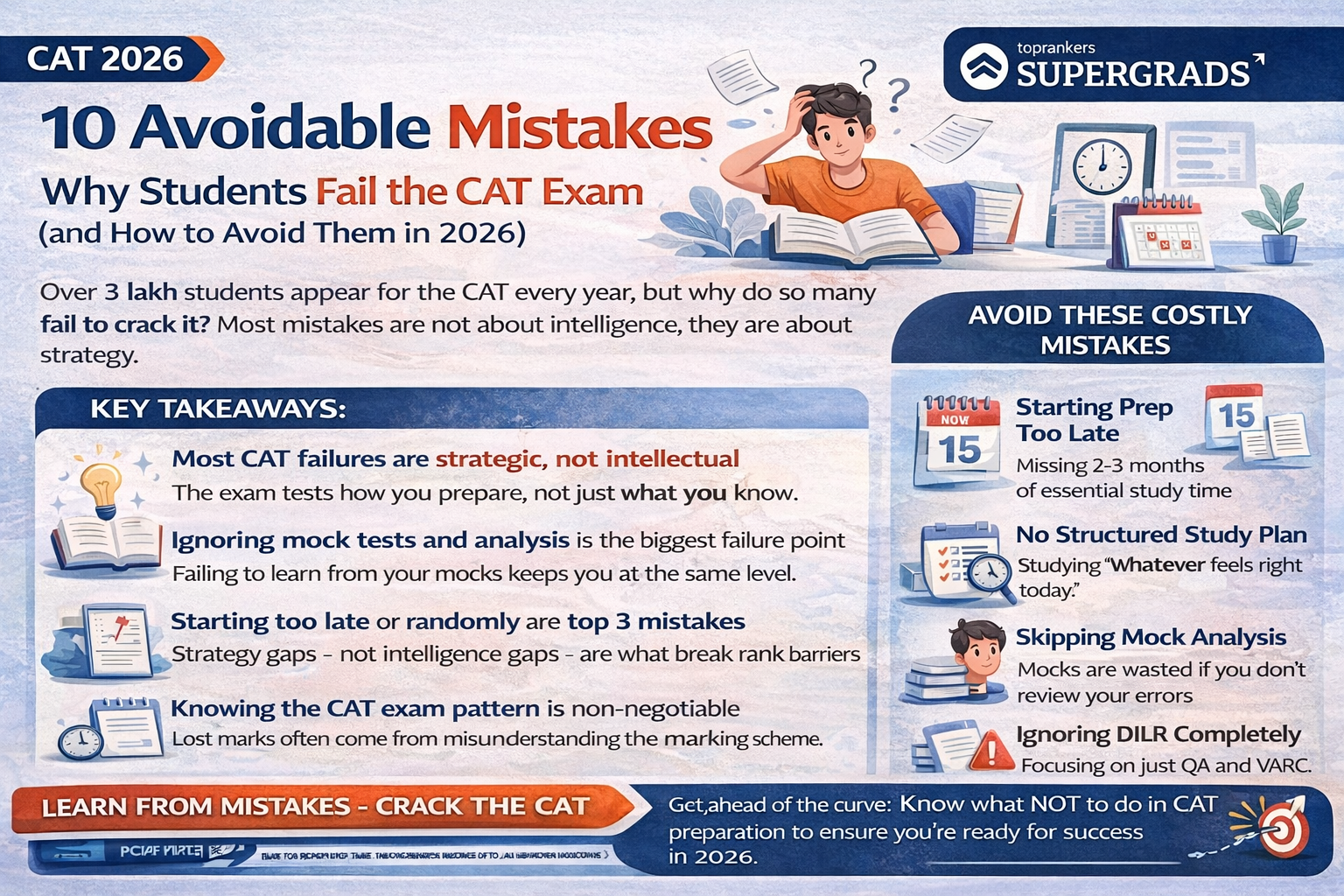
Overview: Every year, over 3 lakh students appear for the CAT exam - but only a handful crack it with a 99 percentile. The majority fail not because they lack intelligence, but because they repeat the same avoidable mistakes. This guide breaks down exactly why students fail CAT, what those mistakes look like in real preparation, and how you can make sure you are not one of them in 2026.
Understanding why students fail CAT is the first step to making sure you don't. Whether it is poor time management, skipping mock analysis, or ignoring the CAT exam pattern - the reasons are surprisingly consistent across thousands of aspirants every year.
Key Takeaways
- Most CAT failures are strategic, not intellectual, the exam tests how you prepare, not just what you know.
- Ignoring mock tests or not analysing them is the single biggest reason aspirants stay stuck at the same percentile.
- Starting too late, studying too randomly, and having no section-wise strategy are the top three avoidable mistakes.
- CAT exam pattern awareness is non-negotiable, many students lose marks simply because they don't know the marking scheme well enough.
- Coaching, especially structured online programs like Supergrads - helps aspirants avoid these mistakes from Day 1.
- Every reason on this list is fixable. The aspirants who crack CAT are not smarter, they are better prepared.
Table of Contents
- A Quick Reality Check
- Top 10 Reasons Why Students Fail CAT
- CAT Exam Pattern Mistakes That Kill Your Score
- Section-Wise Mistakes Students Make
- How CAT Coaching Helps You Avoid These Mistakes
- Preparation Strategy to Make Sure You Don't Fail
- Month-Wise Study Plan to Avoid Common Failures
- Frequently Asked Questions
- Conclusion
A Quick Reality Check about CAT Exam
The CAT (Common Admission Test) is conducted by the IIMs once a year. Over 3 lakh students register, but the number who actually score above 99 percentile is fewer than 3,000. That is less than 1% of all aspirants.
The exam is not designed to test how much you studied. It tests how smartly and consistently you prepared. That distinction is why so many hardworking students still end up failing.
| Parameter | Details |
|---|---|
| Total Registered Aspirants (approx.) | 3 lakh+ per year |
| Aspirants scoring 99+ percentile | Fewer than 3,000 |
| Aspirants scoring 90+ percentile | Approximately 30,000 |
| Sections in CAT | VARC, DILR, Quantitative Aptitude |
| Total Duration | 120 minutes (40 min per section) |
| Marking Scheme | +3 for correct MCQ, -1 for wrong MCQ, 0 for TITA |
| Primary Reason for Failure | Strategy gaps, not intelligence gaps |
Top 10 Reasons Why Students Fail CAT
These are not guesses, these are patterns observed across thousands of CAT aspirants every year. Read each one carefully and ask yourself honestly: am I making this mistake?
1. Starting Preparation Too Late
CAT covers three broad sections with dozens of sub-topics. Most aspirants need a minimum of 6 months of focused preparation. Students who start in September for a November exam almost never have enough time to build the depth and speed that CAT demands.
2. No Structured Study Plan
Studying "whatever feels right today" is not a strategy. Without a clear month-wise plan covering concept building, sectional practice, and full mocks, most aspirants end up over-preparing one section and completely neglecting another.
3. Taking Mocks But Never Analysing Them
This is the single most common reason why students stay stuck at 75–80 percentile no matter how many mocks they give. A mock without analysis is just a wasted 2 hours. The real improvement happens when you sit down after every test and understand why you got each question wrong.
4. Ignoring DILR Completely
DILR is the most unpredictable section in CAT. Students who focus entirely on QA and VARC and leave DILR for "later" almost always struggle on exam day. DILR requires consistent daily practice to build the set-selection instinct that CAT demands.
5. Weak Reading Habit for VARC
Reading Comprehension makes up 67% of the VARC section. Students who don't read regularly - editorials, essays, long-form articles - struggle with dense CAT RC passages. This is a habit that takes months to build, not weeks.
6. Not Understanding the CAT Exam Pattern
Many students lose precious marks because they don't fully understand the marking scheme. For example, attempting uncertain MCQs aggressively leads to unnecessary negative marking. TITA questions have no negative marking - but students often skip them out of habit. Pattern awareness is non-negotiable.
7. Attempting Too Many or Too Few Questions
CAT is not about attempting every question, it is about maximising your score with smart selection. Students who try to attempt all 22 QA questions often end up making silly errors on questions they knew. Accuracy always beats volume in CAT.
8. Neglecting CAT Exam Eligibility and Application Process
Some students spend months preparing but make errors in the application form or miss the registration deadline entirely. Confirming your CAT exam eligibility and completing the form accurately is Step 0, don't overlook it.
9. Comparing Preparation With Peers Constantly
CAT is a percentile-based exam. Your score matters relative to everyone else. But obsessing over what your friends are doing, which batch they joined, or what mock score they got is a massive distraction that derails your own focused preparation.
10. No Coaching or Wrong Coaching
Students who prepare without any guidance often waste 2–3 months on the wrong topics. And students who join the wrong coaching program - one without quality faculty, structured mocks, or proper analysis - often end up worse off than those who self-studied smartly. Choosing the right preparation path is a decision in itself.
CAT Exam Pattern Mistakes That Kill Your Score
One of the most underrated reasons why students fail CAT is a poor understanding of the CAT exam pattern. Here is a breakdown of the pattern and the specific mistakes students make in each area:
| Section | Questions | Time | Common Mistake | Impact |
|---|---|---|---|---|
| VARC | 24 | 40 min | Spending too long on one RC passage | Last 2–3 passages left unattempted |
| DILR | 20 | 40 min | Picking the wrong set and getting stuck | Entire section wasted on 1 set |
| QA | 22 | 40 min | Attempting MCQs without confidence | Negative marking drags down score |
| All Sections | — | — | Skipping CAT TITA questions out of habit | Free marks left on the table |
The fix: Learn the pattern cold. Know exactly how many questions to attempt per section, how much time to allocate per question, and when to move on. This only comes from consistent mock practice with structured post-test analysis.
Section-Wise Mistakes Students Make
Verbal Ability and Reading Comprehension (VARC)
- Not reading regularly - RC speed and comprehension only improve over months of daily reading
- Trying to memorise vocabulary instead of building contextual understanding
- Spending more than 10–12 minutes on a single RC passage - time management within VARC is critical
- Ignoring Para Jumbles and Odd One Out - these are high-accuracy questions if practised regularly
Data Interpretation and Logical Reasoning (DILR)
- Not practising set selection - the 5-minute scan at the start of DILR determines your entire section score
- Attempting only DI sets and avoiding LR or vice versa - CAT combines both in unpredictable ways
- Not timing individual sets during practice - you must know when to abandon a set and move on
- Avoiding difficult set types like Networks, Routes, and Scheduling - these appear regularly in CAT
Quantitative Aptitude (QA)
- Skipping Arithmetic - it carries 40–45% of QA weightage and is the most reliable scoring area
- Over-investing in low-weightage topics like Binomial Theorem while ignoring Ratios and Percentages
- Not practising TITA questions separately - they require a different solving approach with no guesswork safety net
- Learning formulas without solving enough application-based problems - CAT tests application, not recall
| Section | Most Neglected Topic | Actual Weightage | Why It Matters |
|---|---|---|---|
| VARC | Reading Comprehension | 67% of VARC | Single largest scoring area in the exam |
| DILR | Logical Reasoning sets | 40–50% of DILR | LR sets are often easier but students avoid them |
| QA | Arithmetic | 40–45% of QA | Most reliable scoring area; highest question frequency |
How CAT Coaching Helps You Avoid These Mistakes
Most of the mistakes listed above are not about intelligence, they are about direction. This is exactly where structured CAT coaching makes a measurable difference.
A good coaching program, whether offline or online - gives you a roadmap from Day 1. You do not waste weeks figuring out what to study. Your faculty tells you the highest-priority topics, the most common mistake patterns, and the attempt strategy that actually works.
| Mistake | How Coaching Fixes It |
|---|---|
| No study plan | Structured week-by-week curriculum from Day 1 |
| Mock tests without analysis | Guided post-mock review sessions with mentors |
| Wrong topic prioritisation | Faculty highlights high-weightage areas based on recent CAT trends |
| No accountability | Peer competition and scheduled deadlines maintain consistency |
| Weak DILR | Dedicated DILR sessions with set-type-wise practice and selection strategy |
| GD-PI not prepared | Post-CAT interview prep included in most coaching programs |
Supergrads by Toprankers specifically addresses all of these failure points - with IIM-alumni faculty, 100+ full-length mocks, AI-powered weak-area tracking, and flexible online access so working professionals and college students can both benefit without disrupting their schedule.
Preparation Strategy to Make Sure You Don't Fail
Avoiding failure in CAT is not about studying harder, it is about studying smarter. Here is the strategy that separates consistent 95+ percentilers from the rest:
Build Concepts First, Speed Later
The first 2 months of preparation should be purely conceptual. Do not touch mocks until your fundamentals in Arithmetic, Algebra, and RC are solid. Rushing to mocks before concepts are clear just reinforces wrong methods.
Follow the 1:1 Mock Rule
For every mock you give, spend equal time reviewing it. Go question by question. Understand why each wrong answer was wrong. Track your error types - silly mistakes, concept gaps, or time mismanagement - and work on each separately.
Read Every Single Day
RC improvement is slow and cumulative. Pick one high-quality article daily from The Hindu editorial, Economic Times, or Aeon. Read actively - summarise the main argument in 2–3 lines after finishing. Do this for 6 months and your CAT VARC score will reflect it.
Practice DILR Sets, Not Isolated Questions
DILR in CAT comes in sets of 4–5 questions. Never practise individual LR or DI questions in isolation. Always practice full sets under timed conditions. Build the habit of scanning 4–5 sets in the first 5 minutes and selecting your best 3.
Know When to Skip in QA
In QA, if a question does not look solvable within 2 minutes, mark it and move on. Spending 8 minutes on one hard question while leaving 5 easier ones untouched is one of the most common reasons students lose 10–15 marks in QA alone.
Month-Wise Study Plan to Avoid Common Failures
Following a structured timeline is one of the most effective ways to avoid the preparation mistakes that cause most CAT failures. Use this roadmap as your baseline and adjust based on your strengths.
| Month | Focus | Common Failure Risk This Month | How to Avoid It |
|---|---|---|---|
| Month 1–2 | Concept building - Arithmetic, Algebra, RC reading habit, DILR basics | Jumping to mocks too early | No full mocks yet - only topic-wise practice sets |
| Month 3 | Advanced topics - Geometry, Number Systems, full DILR sets, RC daily | Ignoring DILR or VARC for QA comfort | Mandatory daily practice in all 3 sections |
| Month 4 | Sectional mocks + full syllabus revision | Taking mocks without analysis | 2-hour review session after every sectional mock |
| Month 5 | Intensive full-length mocks + deep analysis | Score plateau - same percentile across mocks | Identify top 3 error types and do targeted drills |
| Month 6 | Previous year papers + attempt strategy + final revision | Last-minute panic and changing strategy | Freeze your strategy by Week 2 of Month 6; only refine |
Stick to this plan even on days when motivation is low. Consistency over 6 months is what separates students who crack CAT from those who attempt it repeatedly without improvement.
Conclusion
The question is not whether you are smart enough to crack CAT - almost every aspirant who appears for it is. The real question is whether you are prepared the right way.
The top reasons why students fail CAT - starting late, ignoring mock analysis, misunderstanding the exam pattern, neglecting DILR, and having no structured plan - are all completely avoidable. None of them require extra intelligence. They require awareness, discipline, and the right guidance.
If you have read this blog, you are already ahead of most aspirants. You know the mistakes. Now make sure you do not repeat them. Build your plan, take your mocks seriously, analyse every test, and stay consistent for 6 months.
CAT rewards smart exam preparation. Give it that, and the percentile will follow. To know more about Supergrads by Toprankers and get started with your preparation today, visit us now.

Smart Prep for CAT: Join Our Free Demo Class
Fill your details
Frequently Asked Questions
Why do most students fail CAT even after studying hard?

Is DILR the main reason students fail CAT?
Is DILR the main reason students fail CAT?
How many mock tests are enough to avoid failure in CAT?
Does joining CAT coaching guarantee you won't fail?

Zubeen Siddiqui
Content Writer | MBA & CAT Preparation
SHARE