
1723534562.png)

TG LAWCET Exam Pattern 2027 — Complete Guide to Format, Marking & Sectional Strategy
July 13, 2026
Overview: The PG LAWCET exam pattern is designed to assess a candidate’s aptitude for postgraduate legal studies through objective-type questions. It primarily tests legal aptitude, general knowledge, and current affairs within a time-bound online examination format.
What TG LAWCET Exam Pattern?
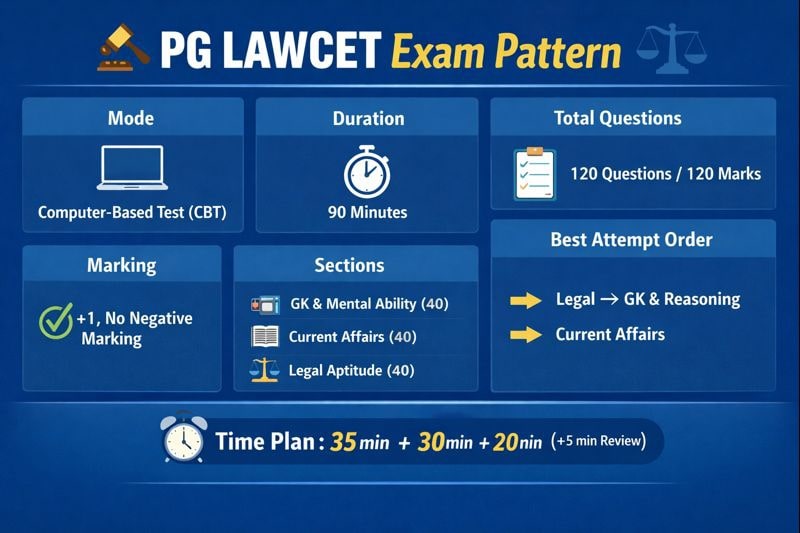
120 questions. 90 minutes. One mark each. That’s the TG LAWCET Exam Pattern in a nutshell—and it decides everything from your daily practice plan to your final rank.
If you’re tracking TG LAWCET 2027 Exam Date and TG LAWCET 2027 Syllabus, here’s the interesting part: understanding the pattern translates directly into smarter attempts and fewer errors.
Why pattern matters for selection and preparation
- It helps you allocate time per section and per question.
- It shows exactly where speed matters and where reasoning matters.
- It informs your mock‑test routine and revision order.
What this guide covers — scope: format, sections, timing, marking, strategy
You’ll get a complete view of TG LAWCET Exam Pattern 2027: mode, question formats, total questions, timing, marking scheme, section‑wise time management, chapter‑wise weightage, mock‑test blueprint, common pitfalls, and quick reference sheets. Let’s dive deeper.
TG LAWCET Exam Pattern 2027 Overview
|
Item |
Details |
|
Mode |
Computer‑Based Test (CBT) |
|
Duration |
90 minutes |
|
Total Questions/Marks |
120/120 |
|
Marking |
+1, no negative |
|
Sections |
GK & Mental Ability (≈40), Current Affairs (≈40), Legal Aptitude (≈40) |
|
Best Attempt Order |
Legal → GK/Reasoning → CA |
|
Time Plan |
35 + 30 + 20 (+5 review) |
TG LAWCET Exam Pattern: Mode, Question Type and Delivery
Computer‑Based Test (CBT) — what to expect
TG LAWCET 2027 Exam Pattern is expected to continue as a Computer‑Based Test (CBT). You’ll attempt the paper at a designated centre on a computer, with on‑screen questions and options. The interface is straightforward: a question palette, options to mark/visit later, and a timer.
Question formats: MCQs, single‑best answer, passage‑based (if applicable)
- Single‑best answer MCQs form the core.
- Most questions are stand‑alone; a few in Legal Aptitude may be brief fact‑based or principle‑application items.
- No descriptive answers—selection is via radio buttons.
Language medium and accessibility provisions
- English medium is standard; centres may provide regional language support as notified.
- Accessibility provisions (like scribe support) follow official norms—refer to the TG LAWCET & PGLCET Notification 2027 for specifics.
Here’s how a typical CBT flow looks:
- Report to centre with TG LAWCET 2027 Hall Ticket and valid ID; complete biometric verification.
- Read the on‑screen instructions and attempt the demo questions.
- Start the test; use the palette to navigate, mark for review, and submit.
- Confirm final submission before the timer hits zero.
Now comes the crucial part—timing and marks.
Duration, Number of Questions and Total Marks
Official breakdown: total questions, marks and time
According to the official TG LAWCET 2027 notification, the exam will consist of 120 questions, 120 marks, and will be conducted over 90 minutes.
Per‑question mark value and time per question (calculated)
- Marks per question: 1
- Time per question: 90 minutes / 120 ≈ 45 seconds
- No sectional time limits
Quick reference table for at‑a‑glance facts
|
Parameter |
TG LAWCET Exam Pattern (2027 expected) |
|
Total Questions |
120 |
|
Total Marks |
120 |
|
Duration |
90 minutes |
|
Marks per Question |
1 |
|
Question Type |
MCQ, single‑best answer |
|
Mode |
Computer‑Based Test (CBT) |
Verify the above in the TG LAWCET 2027 Official Notification PDF once released.
Marking Scheme & Negative Marking — Scoring Rules Explained
Positive marking rules (marks per correct answer)
- Each correct answer fetches +1 mark.
Negative marking policy (confirm if none)
According to the TG LAWCET 2027 exam pattern, there is no negative marking for incorrect answers.
Tie‑break and answer key/valuations (brief)
- The provisional answer key is typically released soon after the exam, followed by a revised/final key.
- Tie‑break reportedly considers overall score and key section performance; final rules will be in the TG LAWCET 2027 Notification.
- Use the TG LAWCET 2027 Answer Key to calculate raw score; final results will appear in the TG LAWCET 2027 Result portal.
“No negative marking is a gift only if you keep accuracy above 80%. Reckless guessing wrecks rank.” — TopRankers Law Mentor
Section‑wise TG LAWCET Pattern (3 Sections) — Question Distribution
Section A: General Knowledge & Mental Ability — topics and typical question count
- Static GK (history, polity, geography, economy), basic science, art & culture
- Mental ability: series, coding‑decoding, analogies, directions, clocks, calendars, basic arithmetic reasoning
Section B: Current Affairs — topics and typical question count
- National/international events, awards, appointments, government schemes, judicial news, sports, books/authors, environment
Section C: Aptitude for Study of Law / Legal Reasoning — topics and typical question count
- Legal terms, legal maxims, constitutional basics, fundamental rights, landmark cases (conceptual), principle‑fact reasoning, contracts/torts basics (aptitude, not deep law)
According to the TG LAWCET 2027 exam pattern, the question paper consists of 120 MCQs divided into three sections: 30 from General Knowledge & Mental Ability, 30 from Current Affairs, and 60 from Legal Aptitude.
|
Section |
Topics (indicative) |
Typical Qs (derived) |
|
A: GK & Mental Ability |
Static GK + reasoning |
30 |
|
B: Current Affairs |
National/international current events |
30 |
|
C: Aptitude for Study of Law |
Legal aptitude and reasoning |
60 |
|
Total |
3 sections |
120 |
If you’re comparing “TG LAWCET exam pattern 2027 number of questions and marks,” remember: 120 questions, 120 marks, with equal weighting across sections in most years.
Section‑wise Time Management & Attempt Strategy (90‑minute plan)
You asked for a pragmatic 90‑minute plan. Here’s a proven flow that aligns with the TG LAWCET Exam Pattern and minimises switching costs.
- Minutes 0–5: Setup
- Skim the interface; confirm section labels.
- Attempt 3–5 sitters to warm up.
- Minutes 5–40: Section C (Legal Aptitude) — 35 minutes
- Reason: High‑yield, moderate difficulty, needs fresh mind.
- Target: 35–38 attempts with 85%+ accuracy.
- Micro‑drills: principle → facts → eliminate → select.
- Minutes 40–70: Section A (GK & Mental Ability) — 30 minutes
- Target: 30–34 attempts.
- Strategy: Do mental ability first (quick scorers), then static GK.
- Skip rules: if you can’t solve a reasoning item in 45 seconds, flag it.
- Minutes 70–90: Section B (Current Affairs) — 20 minutes + 5 minutes review
- Target: 32–36 attempts (high accuracy expected).
- Source advantage: monthly CA digests + last 6–10 months.
- Review (last 5 minutes)
- Convert flagged 50/50s to educated guesses (no negative marking).
- Verify marked‑for‑review items in Legal Aptitude first.
Best order to attempt sections (high‑yield first)
- Section C → Section A → Section B works for most aspirants. If CA is your strongest, swap B and A.
When to flag and move on — skip/return rules
- 45‑second rule for reasoning; 20‑second rule for GK/CA recalls.
- If a legal principle feels unfamiliar, flag and return—don’t spiral.
Mentioning TG LAWCET 2027 Preparation Tips: Practice this flow in 8–10 full‑length mocks to automate timing.
“I treated every mock like the real exam—90 minutes, no phone, complete silence. My accuracy rose from 72% to 88% in 5 weeks.” — A TopRankers law aspirant
Chapter‑wise / Topic‑wise Weightage — High‑Yield Topics (Estimated)
These estimates are based on past papers and competitor analysis; use them to prioritise. Always verify with official past papers once TG LAWCET 2027 Syllabus is confirmed.
|
Area |
Estimated Weightage |
High‑Yield Sub‑topics |
|
Legal reasoning & aptitude |
35–40% |
Constitutional basics, fundamental rights, legal maxims, contracts/torts fundamentals, principle‑fact application, legal GK terms |
|
General knowledge & mental ability |
30–35% |
History (modern India), polity (schedules, articles), geography (Indian), economy basics, science in daily life, reasoning (series, coding, clocks/calendars) |
|
Current affairs |
25–30% |
National policies/schemes, top judicial developments, appointments, awards, sports, environment, international organisations |
Use this as your TG LAWCET 2027 chapter‑wise weightage topics list for planning. Prioritise 70% of your weekly study hours on Legal Aptitude + Current Affairs, then consolidate GK & Mental Ability with timed drills.
Question Types & Example Item Formats (with short examples)
Single‑best option MCQs — example and solving tip
Example: In the Indian Constitution, the Right to Equality is covered under Articles:
- A) 12–15 B) 14–18 C) 19–22 D) 23–24
Tip: Eliminate out‑of‑range options quickly; lock answers you’re 80% sure of. With no negative marking (see TG LAWCET 2027 negative marking details above), educated guesses are viable after elimination.
Logical reasoning/comprehension items — approach and time tip
Example: If TRAIN is coded as UTBJO, how is PLANE coded?
Tip: Identify the shift pattern; keep a 45‑second cap. If you don’t see the pattern fast, flag it.
Current affairs/GK style questions — source & prep advice
Example: Who was appointed as the Chief Justice of India in [recent month/year]?
Tip: Maintain a CA notebook with “People, Places, Positions” updated monthly; revise last 6–10 months thoroughly.
Take TG LAWCET Free mock Test By LegalEdge
Mock Test Strategy & Practice Blueprint (for 8–12 week prep)
A structured mock calendar helps you internalise the TG LAWCET Exam Pattern.
Weeks 1–2: Foundation
- 2 full‑length mocks/week + 3 sectional tests (Legal/GK/CA)
- Target: Accuracy 70–75%, time/Q ≈ 55–60 sec
Weeks 3–4: Consolidation
- 3 full‑length mocks/week + 3 sectionals
- Target: Accuracy 78–82%, time/Q ≈ 50 sec
Weeks 5–6: Acceleration
- 3–4 full‑length mocks/week + 2 sectionals
- Target: Accuracy 83–86%, time/Q ≈ 45–48 sec
Weeks 7–8: Peak Performance
- 4 full‑length mocks/week + light drills
- Target: Accuracy 87–90%, time/Q ≈ 40–45 sec
Track these metrics after every mock:
|
Metric |
Week 2 |
Week 4 |
Week 6 |
Week 8 |
|
Accuracy % |
72–75% |
80–82% |
84–86% |
88–90% |
|
Time per Q |
55–60s |
50s |
45–48s |
40–45s |
|
Flagged Qs |
≤20 |
≤15 |
≤12 |
≤8 |
Related resources: Past Papers, Mock Tests & Practice Resources (bookmark this for weekly revision). And guess what? Reviewing mistakes for 30 minutes after every mock yields the fastest gains.
TG LAWCET vs TS LAWCET — Pattern Differences & Why They Matter
If you’re searching “TG LAWCET vs TS LAWCET,” here’s the conservative view: TG stands for Telangana; TS LAWCET has been the known name historically. Pattern‑wise, both indicate the same state law entrance unless officially distinguished. Always check the current year’s notification.
|
Feature |
TG LAWCET (2027 expected) |
TS LAWCET (historical pattern) |
|
Mode |
CBT |
CBT |
|
Number of questions |
120 |
120 |
|
Duration |
90 minutes |
90 minutes |
|
Marking |
+1, no negative |
+1, no negative |
|
Sections |
GK & Mental Ability, Current Affairs, Aptitude for Study of Law |
Same |
|
Syllabus overlap |
Full |
Full |
How to adapt strategy if switching from TS LAWCET prep
- No real change required. Stick to the TG LAWCET exam pattern 2027 number of questions and marks (120/120/90).
- Focus on Legal Aptitude accuracy and CA recency.
Common Pitfalls Specific to the TG Pattern & Quick Remedies
- Spending 2+ minutes on a single reasoning item — cap at 45 seconds; flag and move.
- Over‑attempting low‑confidence GK — eliminate to two options; guess only if you’ve narrowed it.
- Neglecting Legal Aptitude reading — practise 15 principle‑fact questions daily.
- Studying CA without monthly revision — maintain a notebook and revise weekly.
- Ignoring mock analytics — track accuracy per section, not just total score.
- Not practising on CBT interface — simulate at least 8 full mocks in exam‑like conditions.
- Weak last‑mile revision — compile a one‑pager for legal maxims and constitutional articles.
- Starting with GK if it’s a weak area — begin with Legal Aptitude to build momentum.
- No plan for 50/50s — decide in advance: convert 60%+ confidence to attempts (no negative marking).
- Skipping sleep before exam — 7–8 hours is part of TG LAWCET 2027 Preparation Tips you must follow.
Quick Reference Cheat‑Sheets & Printable Pattern Summary
Use this for your exam‑day folder—label it “TG LAWCET Exam Pattern — Quick Reference”.
Two‑column checklist: do's and don'ts during the exam
|
Do’s |
Don’ts |
|
Start with your strongest section |
Chase sunk‑cost questions |
|
Use 45‑sec cap for reasoning items |
Randomly mark without elimination |
|
Flag 50/50s; return in review |
Skip review buffer entirely |
|
Read legal principles twice, then apply |
Overthink sitters |
|
Keep posture calm; breathe every 15 mins |
Panic on 2–3 tough questions |
Conclusion: Key Takeaways on TG LAWCET Exam Pattern
The TG LAWCET Exam Pattern is simple but unforgiving: 120 MCQs, 90 minutes, +1 per correct answer, no negative marking. Prioritise Legal Aptitude accuracy, maintain a disciplined time split (35–30–20+5), and revise CA monthly. Final‑week action items: 4 full‑length mocks, 2 sectional drills, one‑pager revision for legal maxims/articles.
Your next step—attempt a full‑length mock today and measure your time per question.

Download FREE Study Material
Fill your details

Samriddhi Pandey
Content Writer
SHARE