
1723534562.png)

What are Sequences, Series and Progressions?
Sequences, Series, and Progressions form the core of this topic. Understanding the distinction between these three is the first step to mastering the chapter.
| Term | Definition | Example |
|---|---|---|
| Sequence | An ordered list of numbers arranged according to a definite rule. Can be finite or infinite. | {2, 4, 6, 8, 10, ...} |
| Series | The sum of the terms of a sequence. Adding up the elements gives a series. | 1 + 2 + 3 + ... + n = n(n+1)/2 |
| Progression | A special sequence where each term is obtained from the previous one by a fixed operation - addition (AP), multiplication (GP), or reciprocal (HP). | 2, 5, 8, 11 (AP with d = 3) |
Progressions are one of the important topics for CAT. To ensure you are not missing any similarly important topics, checking the CAT Exam Syllabus is advised.
CAT Progressions and Series Topic Weightage Over Past 8 Years
The table below gives the year-wise number of questions from Progressions and Series in CAT QA across all slots. This data confirms that the topic carries consistent and significant weight every year.
| Year | Weightage (No. of Questions) | Difficulty Level | Key Focus Area |
|---|---|---|---|
| CAT 2025 | 5 | Medium–Hard | AP sums, Infinite GP, Odd number series |
| CAT 2024 | 5 | Medium | AP terms, Recurrence sequences, Floor function |
| CAT 2023 | 7 | Medium–Hard | AP with logarithms, Mixed AP+GP, Common terms |
| CAT 2022 | 5 | Medium | AP averages, nth term, Particle growth |
| CAT 2021 | 5 | Medium | AP integers, Recurrence, Alternating series |
| CAT 2020 | 2 | Easy–Medium | GP common ratio, Recursive sequences |
| CAT 2019 | 6 | Medium | AP rationalisation, Alternating series, Population GP |
| CAT 2018 | 5 | Medium | Series sums, AM averages, AP products, GP ratio |
Also Check | CAT Mock Test series
CAT Progressions and Series Formulas PDF
CAT Progressions and Series is one of the most formula-heavy topics in Quantitative Aptitude. A clear understanding of each formula - and knowing when to apply it - is what separates a 90+ scorer from an average performer on this topic. Click on the link below to download the complete Progressions and Series Formulas PDF.
1. Arithmetic Progression (AP) - Formulas and Properties
If the difference between any two consecutive terms is constant, the terms are said to be in AP. This constant is called the common difference (d).
General form: a, a+d, a+2d, a+3d, ...
Properties of Arithmetic Progression: If a, b, c, d, ... are in AP and k is a constant, then:
2. Geometric Progression (GP) - Formulas and Properties
If in a succession of numbers the ratio of any term to the previous term is constant, the numbers are said to be in GP. This constant is called the common ratio (r).
General form: a, ar, ar², ar³, ...
Properties of Geometric Progression: If a, b, c, d, ... are in GP and k is a constant, then:
3. Harmonic Progression (HP) - Formulas and Properties
A sequence is in Harmonic Progression if the reciprocals of its terms form an Arithmetic Progression. If a, b, c are in HP, then 1/a, 1/b, 1/c are in AP.
AM-GM-HM Relationship and Inequality
The relationship between Arithmetic Mean, Geometric Mean, and Harmonic Mean is one of the most important and versatile concepts in CAT Quant. It appears not only in Progressions questions but also in Inequalities and Algebra problems.
Important Sum Formulas
These standard summation results appear directly in CAT questions and are used as intermediate steps in many harder problems. Make sure you can recall each of them instantly.
Types of Questions Asked in CAT
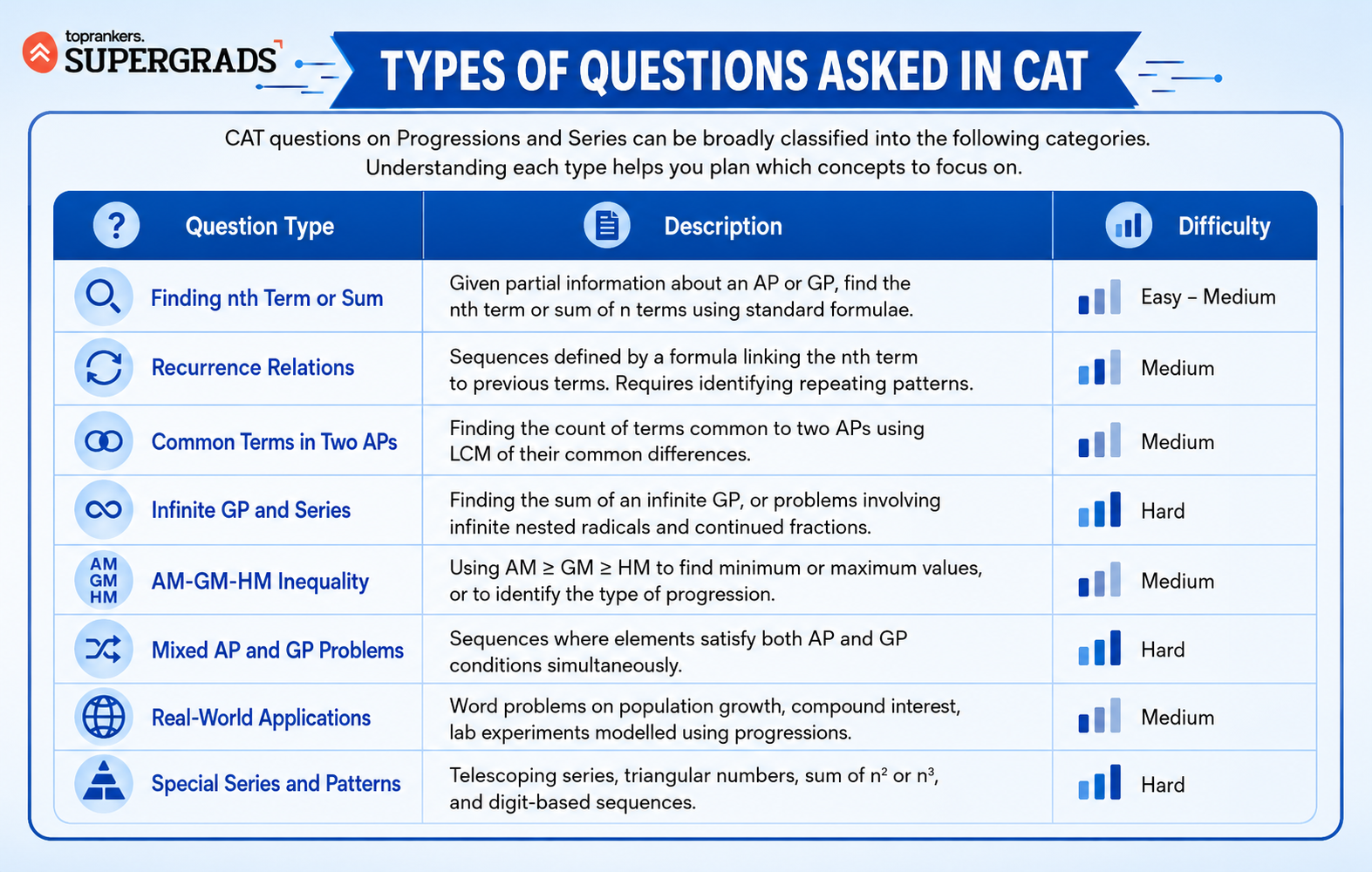
CAT questions on Progressions and Series can be broadly classified into the following categories. Understanding each type helps you plan which concepts to focus on.
| Question Type | Description | Difficulty |
|---|---|---|
| Finding nth Term or Sum | Given partial information about an AP or GP, find the nth term or sum of n terms using standard formulae. | Easy – Medium |
| Recurrence Relations | Sequences defined by a formula linking the nth term to previous terms. Requires identifying repeating patterns. | Medium |
| Common Terms in Two APs | Finding the count of terms common to two APs using LCM of their common differences. | Medium |
| Infinite GP and Series | Finding the sum of an infinite GP, or problems involving infinite nested radicals and continued fractions. | Hard |
| AM-GM-HM Inequality | Using AM ≥ GM ≥ HM to find minimum or maximum values, or to identify the type of progression. | Medium |
| Mixed AP and GP Problems | Sequences where elements satisfy both AP and GP conditions simultaneously. | Hard |
| Real-World Applications | Word problems on population growth, compound interest, lab experiments modelled using progressions. | Medium |
| Special Series and Patterns | Telescoping series, triangular numbers, sum of n² or n³, and digit-based sequences. | Hard |
Q1. A bookstore sells an average of 60 books per day during the first 7 days of a new release, and an average of 63 books per day over the first 8 days. On the 9th day, they sell 11 fewer books than on the 8th day. If the daily average from day 2 to day 9 becomes 66 books, exactly how many copies were sold on the very first day?
A.
B.
C.
D.
Answer:
Tips and Tricks for CAT Progressions and Series
These expert tips from CAT toppers will help you solve questions faster and avoid the most common mistakes in this topic.
-
Assume smart variables for 3-term AP or GP
For 3 terms in AP, take them as (a–d), a, (a+d). For 3 terms in GP, take them as a/r, a, ar. This makes the sum and product conditions far simpler to set up and solve.
-
Common terms in two APs form a new AP with d = LCM(d1, d2)
The first common term is found by inspection. The new common difference of the resulting sequence is the LCM of the two original common differences.
-
For an infinite GP sum to exist, |r| must be strictly less than 1
Always verify the condition |r| < 1 before applying S∞ = a/(1–r). If |r| ≥ 1, the sum does not converge and the formula cannot be used.
-
Use AM ≥ GM to find minimum or maximum values quickly
When a problem involves a sum or product of positive quantities under a constraint, the AM-GM inequality almost always gives the extreme value in 2–3 lines without any calculus.
-
Identify the pattern in recurrence sequences early
For sequences defined by T(n) = f(T(n–1)), compute the first 6–8 terms manually. Most CAT recurrence sequences repeat with a period of 4, 5, or 6. Once you spot the cycle, finding any term is immediate.
-
Telescoping series - look for cancellation patterns
Series of the form 1/(a1 × a2) + 1/(a2 × a3) + ... can be split using partial fractions. Nearly all terms cancel out, leaving only the first and last terms to evaluate.
-
Sum of n terms as a polynomial in n reveals the progression type
If S(n) = an² + bn, the sequence is an AP with first term = a + b and common difference = 2a. This is a frequently tested shortcut for backward engineering the AP.
-
In HP problems, always convert to AP by taking reciprocals
HP questions are rarely solved directly. Take the reciprocal of each term to convert to an AP, solve the standard AP problem, and then convert back. This saves time and avoids errors.
How to Prepare Progressions and Series for CAT
A structured preparation approach for this topic will help you score consistently. Follow the steps below to build strong command over the chapter.
-
Build Your Foundation First
Start with the definitions and standard formulas for AP, GP, and HP. Being able to derive each formula from scratch builds conceptual clarity that pays off in non-standard questions.
-
Master the AM-GM-HM Inequality
This inequality appears across multiple CAT topics including Progressions, Inequalities, and Algebra. Learn to identify when AM-GM applies and practise bounding problems using it.
-
Solve Year-Wise PYQs Strategically
Begin with CAT 2018–2020 questions (relatively accessible), then advance to CAT 2021–2025. Observe recurring patterns - the CAT paper-setter tends to revisit similar ideas in different forms.
-
Practise Time-Bound Sets
Take mini-sectional tests of 5–8 Progressions questions under timed conditions (approximately 12–15 minutes). This builds the habit of prioritising easy vs. hard questions under exam pressure.
-
Integrate with Full-Length Mock Tests
During full-length CAT mocks, tag Progressions questions and track your accuracy and time separately. This data directly informs your section-wise strategy on exam day.
CAT Progressions and Series Questions
Below are CAT Previous Year Questions on Progressions and Series from 2025 to 1990, with detailed video solutions by CAT experts. You can also download them as a PDF or attempt them in test format.
Year-wise CAT Progressions and Series questions (2025 to 1990) with detailed solutions will be placed in this section.
This section will be updated shortly.
Conclusion
CAT Progressions and Series is a high-value topic that rewards consistent preparation. With 5–7 questions appearing every year across all CAT slots, mastering AP, GP, HP, and the AM-GM-HM inequality can significantly boost your Quantitative Aptitude score.
Focus on understanding formulas deeply rather than memorising them, practise year-wise PYQs to recognise question patterns, and integrate this topic into your full-length mock test routine. Candidates who are thorough with this chapter consistently report solving 4–6 questions correctly from this section alone.
Download the free questions PDF and formulas PDF above to get started. For structured coaching, you can also explore the Supergrads CAT Online Course.


SHARE