
1723534562.png)

Judiciary vs APO: Which Career is Better After LLB in 2026?
September 23, 2026
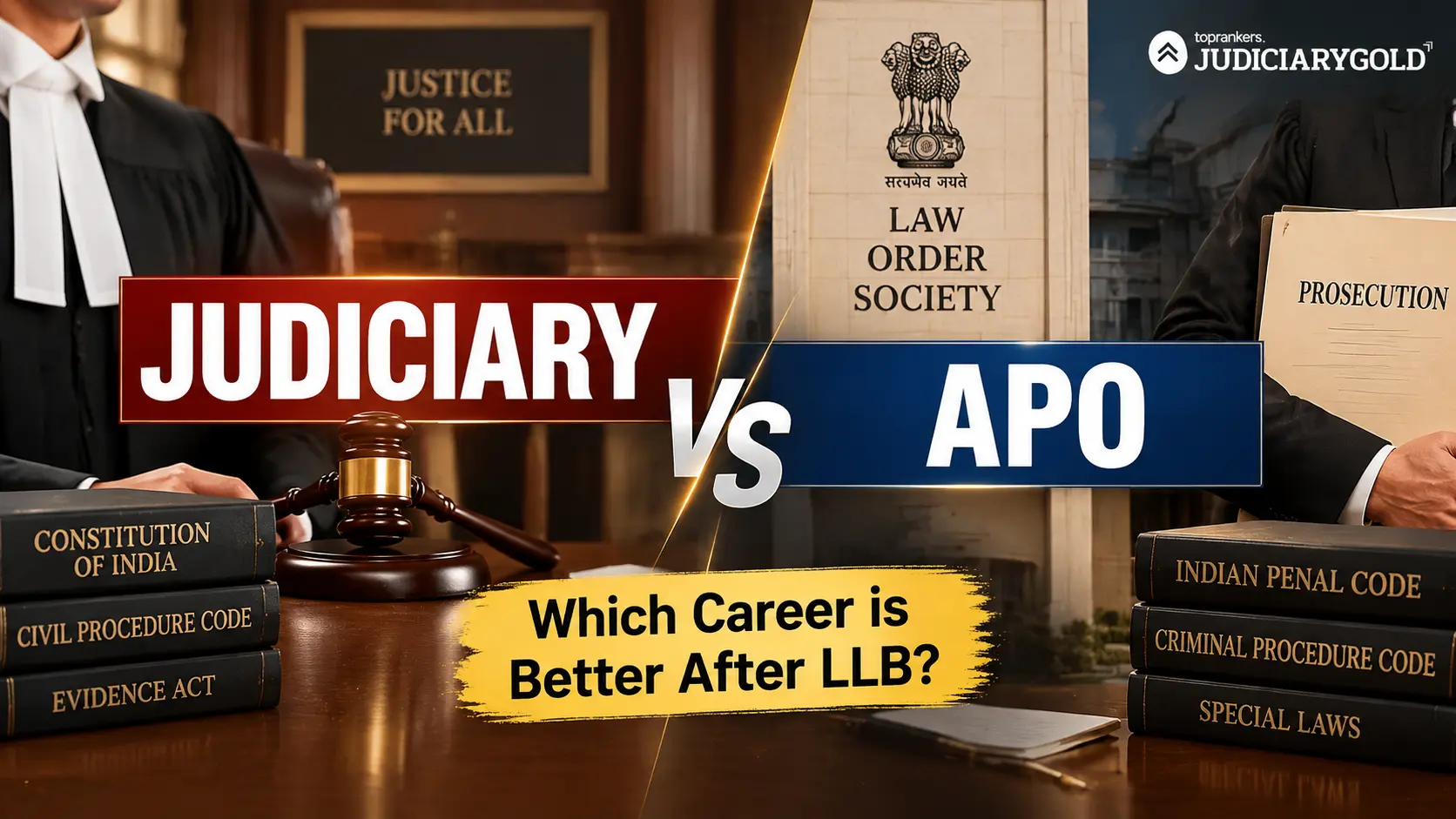
Many law students and fresh LLB graduates feel stuck between two good options — Judiciary (Civil Judge) and APO (Assistant Prosecution Officer). Both are respected government jobs. Both give good salary, security and a chance to work in the justice system. So let us understand what is Judiciary vs APO: Which Career is Better After LLB in 2026?
But which one is better for you?
Here, we will simply provide a detailed comparison of Judiciary vs APO: Which Career is Better After LLB in 2026 on job role, salary, eligibility, exam difficulty, career growth and daily work. By the end, you will clearly know which path suits you more.
What is a Judiciary (Civil Judge)?
In Judicial Services, you become a Civil Judge or Judicial Magistrate.
- Your main work is to sit in court, listen to both sides, and give the final decision.
- You have real power and independence.
- You handle both civil and criminal cases.
Over time, you can become Senior Civil Judge, District Judge, and even reach the High Court.
What is an APO Job?
APO means Assistant Prosecution Officer (also called ADPO or APP in some states).
- You work for the government and represent the State in criminal cases.
- You argue in court, examine witnesses, check charge sheets, and try to get justice for the victims.
- You start in Magistrate courts.
With promotions, you can become District Prosecution Officer or even higher posts in the prosecution department.
Judiciary vs APO
|
Criteria |
Judiciary |
APO |
|
Main Role |
Decide cases as a judge |
Argue and represent the government in criminal cases |
|
Power |
High — delivers judgments and passes judicial orders |
Presents the prosecution's case; the judge makes the final decision |
|
Eligibility |
LLB + 3 years of practice in some states; varies by stat |
LLB; practice requirements vary by state and post |
|
Salary |
Usually higher — approximately ₹90,000–₹1,10,000+ gross |
Approximately ₹55,000–₹80,000+ in-hand, depending on the post and state |
|
Daily Work |
Hearing arguments, examining evidence, writing judgments and orders |
Drafting, examining witnesses, presenting evidence and arguing cases |
|
Career Growth |
District Judge → Higher Judicial Service → High Court Judge (subject to eligibility and selection) |
Senior APO / APP → District Prosecution Officer or other senior prosecution positions |
|
Exam Focus |
Civil Laws + Criminal Laws + Local Laws + Judgment Writing |
Primarily Criminal Laws — BNS, BNSS, BSA, and relevant local laws |
|
Job Nature |
Formal, judicial, and independent |
Advocacy-based, active, and focused on prosecution |
|
Primary Responsibility |
Ensuring fair adjudication and delivering justice |
Conducting prosecution and representing the government's case |
Which One Should You Choose - Judiciary vs APO: Which Career is Better After LLB in 2026?
You may choose Judiciary if:
- You like the idea of giving judgments and having high authority
- You will be trained for longer preparations and the 3-year practice rule
You may choose APO if:
- You want a government job sooner
- You enjoy arguing and active court work
- You have just completed your LLB
Best Option for Students: Choose both exam preparations simultaneously. Many successful candidates do this. The common law subjects make both preparation easy and smart. APO can become your safe option.
Can You Prepare for Judiciary and APO Together?
Yes, and it is highly recommended. Focus first on BNS (new IPC), BNSS (new CrPC) and BSA (new Evidence Act). These are common. Then add civil laws and judgment writing for the Judiciary. Regular practice of answer writing and mocks will help for both.
There is no single “better” career. Judiciary gives more power and prestige. APO gives faster entry, good experience and solid salary. Think about your nature — do you like deciding or arguing? How soon do you need a job? Are you ready for the practice requirement? Both paths let you serve justice and live a respectful life. Choose the one that matches your goals and start preparing seriously.

Nancy Mahavir Sharma
Legal Writer
SHARE