
1723534562.png)

SNAP Reasoning Questions 2026: 40+ Logical Reasoning Questions, Tips & Preparation Strategy
June 24, 2026
Overview: If you are preparing for the SNAP exam, then practicing SNAP reasoning questions should be a major part of your preparation plan. The Logical Reasoning section is one of the most scoring areas in SNAP because the questions are usually concept-based, short, and speed-driven.
In this blog, you will get important topics, the latest SNAP exam pattern, preparation tips, and 40 practice SNAP logical reasoning questions with answers.
What You Will Get in This Blog
This blog covers everything a SNAP aspirant needs to know about logical reasoning questions for SNAP. You will also understand how to use SNAP previous year papers and a good SNAP mock test series for better preparation.
Key Takeaways
- What are SNAP Reasoning Questions?
- 40 Reasoning Questions with Answers
- SNAP Exam Pattern for Logical Reasoning
- Why are SNAP Reasoning Type Questions Important?
- Important Topics Covered in SNAP Logical Reasoning Questions
- Types of Logical Reasoning Questions for SNAP
- Tips to Solve Logical Reasoning Questions for SNAP Quickly
- Common Mistakes Students Make
- How to Prepare for Reasoning Questions?
- Role of SNAP Previous Year Papers and Mock Tests
- SNAP Eligibility
- Conclusion
Table of Contents
- What are SNAP Reasoning Questions?
- SNAP Exam Pattern for Logical Reasoning
- Why are SNAP Reasoning type Questions Important?
- Important Topics Covered in SNAP Logical Reasoning Questions
- Types of Logical Reasoning Questions for SNAP
- 40 Reasoning Questions with Answers
- Tips to Solve Logical Reasoning Questions for SNAP Quickly
- Common Mistakes Students Make
- How to Prepare for Reasoning Questions?
- Role of SNAP Previous Year Papers and Mock Tests
- SNAP Eligibility
- Conclusion
What are SNAP Reasoning Questions?
SNAP reasoning questions are designed to test a candidate’s logical thinking, analytical ability, and problem-solving skills. These questions are part of the Analytical and Logical Reasoning section of the SNAP exam.
Most SNAP logical reasoning questions are short but require quick thinking. Students must identify patterns, relationships, directions, arrangements, conclusions, and assumptions within limited time.
40 Reasoning Questions with Answers
Here are 40 practice SNAP logical reasoning questions to help students prepare better. These questions are designed to match the speed-based nature of the exam.
Number Series
Q1. 2, 6, 12, 20, 30, ?
A) 40
B) 42
C) 44
D) 46
Answer: B
Q2. 5, 10, 20, 40, ?
A) 60
B) 70
C) 80
D) 100
Answer: C
Q3. 1, 4, 9, 16, ?
A) 20
B) 24
C) 25
D) 36
Answer: C
Q4. 3, 7, 15, 31, ?
A) 63
B) 62
C) 61
D) 64
Answer: A
Q5. 8, 16, 32, 64, ?
A) 96
B) 112
C) 128
D) 144
Answer: C
Coding-Decoding
Q6. If CAT = DBU, then DOG = ?
A) EPH
B) EOG
C) FPH
D) EPG
Answer: A
Q7. If PEN = QFO, then BOOK = ?
A) CPPL
B) CPPM
C) DQQL
D) CQQM
Answer: A
Q8. If SKY = TLZ, then STAR = ?
A) TUBS
B) TUBR
C) STBS
D) TUCS
Answer: A
Q9. If GOLD = HPME, then SILVER = ?
A) TJMWFS
B) TKNXFS
C) TJMXFS
D) TJMWGR
Answer: A
Q10. If INDIA = JOEJB, then CHINA = ?
A) DIJOB
B) DIOJB
C) EJOBI
D) EJNIB
Answer: B
Blood Relations
Q11. A is the son of B. B is the daughter of C. How is A related to C?
A) Son
B) Grandson
C) Brother
D) Nephew
Answer: B
Q12. Pointing to a woman, Raj said, “She is my mother’s daughter.” Who is she?
A) Sister
B) Mother
C) Daughter
D) Wife
Answer: A
Q13. If P is Q’s brother and Q is R’s mother, how is P related to R?
A) Uncle
B) Father
C) Brother
D) Grandfather
Answer: A
Q14. A woman introduces a man as her husband’s son. Who is the man?
A) Brother
B) Son
C) Father
D) Uncle
Answer: B
Q15. A is B’s father. C is B’s sister. How is A related to C?
A) Uncle
B) Brother
C) Father
D) Grandfather
Answer: C
Direction Sense
Q16. A person walks 10 m North, then 10 m East. Which direction is he from the starting point?
A) North-East
B) South-East
C) North-West
D) East
Answer: A
Q17. A walks 5 km South and then 5 km East. Which direction is he from the starting point?
A) South-East
B) North-East
C) South-West
D) East
Answer: A
Q18. Facing North, a person turns right and then left. What is the final direction?
A) North
B) East
C) West
D) South
Answer: A
Q19. Facing South, a person turns left. What direction is he facing?
A) East
B) West
C) North
D) South
Answer: A
Q20. Facing East, a person turns right twice. What is the final direction?
A) East
B) South
C) West
D) North
Answer: C
Syllogisms
Q21. Statements: All cats are animals. All animals are living beings. Conclusion: All cats are living beings.
A) True
B) False
Answer: A
Download Free QA Sample Questions for SNAP Exam
Q22. Statement: Some students are athletes. Can we conclude that all athletes are students?
A) Yes
B) No
Answer: B
Q23. Statements: All roses are flowers. Some flowers are red. Conclusion: Some roses are red.
A) Follows
B) Does not follow
Answer: B
Q24. Statements: No pen is pencil. Some pencils are markers. Conclusion: Some markers are not pens.
A) Follows
B) Does not follow
Answer: A
Q25. Statements: All apples are fruits. Some fruits are mangoes. Conclusion: Some apples are mangoes.
A) Follows
B) Does not follow
Answer: B
Seating Arrangement
Q26. Five friends sit in a row. A sits left of B. B sits left of C. Who sits rightmost among A, B, and C?
A) A
B) B
C) C
D) Cannot be determined
Answer: C
Q27. In a circular arrangement, A is opposite B. B is opposite C. Is the arrangement possible for three people?
A) Yes
B) No
Answer: B
Q28. A sits between B and C. D sits left of B. Who is leftmost?
A) A
B) B
C) C
D) D
Answer: D
Q29. If P is second to the left of Q and R is to the right of Q, who sits in the middle?
A) P
B) Q
C) R
D) Cannot be determined
Answer: B
Q30. A, B, and C sit consecutively. B is in the middle. Who are adjacent to B?
A) A and C
B) A only
C) C only
D) None
Answer: A
Critical Reasoning
Q31. Statement: Smoking causes health issues. Which assumption supports this statement?
A) Smoking affects the human body
B) Smoking is cheap
C) Everyone smokes
D) Health issues are unrelated to habits
Answer: A
Q32. Statement: Online learning improves accessibility. What can be inferred?
A) More students can access education
B) Offline classes are useless
C) Teachers are not needed
D) Exams are not important
Answer: A
Q33. The company reduced prices and sales increased. What is the likely cause?
A) Lower prices attracted buyers
B) Buyers stopped purchasing
C) Product quality became poor
D) Market demand disappeared
Answer: A
Q34. The roads were flooded, and traffic slowed down. What can be inferred?
A) Flooding affected transportation
B) Traffic became faster
C) Roads were empty
D) Vehicles were banned
Answer: A
Q35. Students practicing mocks scored better. What is the assumption?
A) Practice improves performance
B) Mocks reduce scores
C) Students do not need revision
D) Scores are based on luck only
Answer: A
Mixed SNAP Reasoning Questions
Q36. Find the odd one out.
A) Circle
B) Square
C) Triangle
D) Pencil
Answer: D
Q37. Find the odd one out.
A) January
B) February
C) Monday
D) March
Answer: C
Q38. A clock shows 3 PM. What is the angle between the hands?
A) 90°
B) 120°
C) 180°
D) 45°
Answer: A
Q39. Which day comes after two days from Monday?
A) Tuesday
B) Wednesday
C) Thursday
D) Friday
Answer: B
Q40. If 1 January is Monday, what day is 8 January?
A) Monday
B) Tuesday
C) Wednesday
D) Sunday
Answer: A
SNAP Exam Pattern for Logical Reasoning
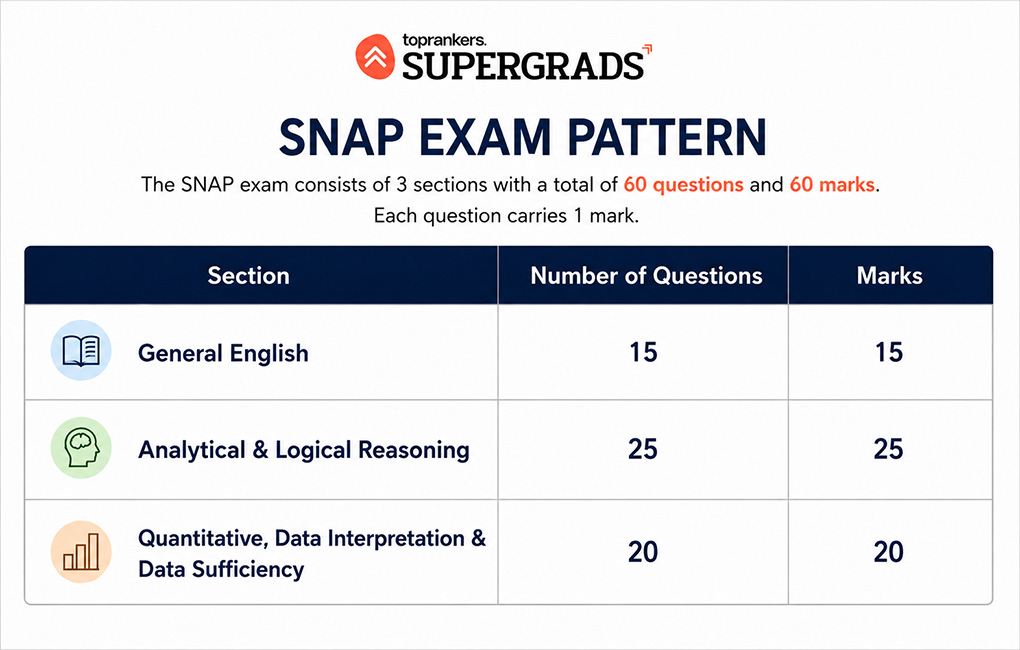
Before solving logical reasoning questions for SNAP, students must understand the latest SNAP exam pattern. This helps in planning time, attempts, and accuracy level.
The table below gives a quick overview of the expected SNAP paper structure.
| Section | Number of Questions | Marks |
|---|---|---|
| General English | 15 | 15 |
| Analytical & Logical Reasoning | 25 | 25 |
| Quantitative, Data Interpretation & Data Sufficiency | 20 | 20 |
In the SNAP exam, Logical Reasoning usually carries strong weightage. This is why practicing SNAP reasoning questions daily can improve your overall score.
SNAP Marking Scheme
- Correct answer: +1 mark
- Incorrect answer: -0.25 mark
- Total questions: 60
- Total duration: 60 minutes
Why are SNAP Reasoning Type Questions Important?
SNAP reasoning questions are important because they can be solved faster than many Quant-based questions. With regular practice, this section can become a strong scoring area.
- They help improve overall SNAP score.
- They test logic more than heavy calculation.
- They can be solved quickly with practice.
- They improve decision-making under time pressure.
- They help students manage the 60-minute paper better.
Students who solve enough snap logical reasoning questions and analyse SNAP previous year papers usually understand the exam better.
Important Topics Covered in SNAP Logical Reasoning Questions
The Logical Reasoning section includes multiple topics. Students should practice topic-wise logical reasoning questions for SNAP to build speed and accuracy.
Analogy
Analogy questions test relationships between words, numbers, or concepts. These are common in SNAP reasoning questions.
Series
Series questions require students to identify missing numbers, letters, or patterns.
Coding-Decoding
Coding-decoding questions check how well students understand hidden patterns and symbol-based logic.
Blood Relations
These questions test family relationship logic and require careful reading.
Direction Sense
Direction-based SNAP logical reasoning questions test movement, distance, and final direction.
Seating Arrangement
These questions include linear, circular, and mixed arrangement-based logic.
Syllogisms
Syllogism questions test conclusions based on given statements.
Input-Output
Input-output questions are pattern-based and require step-by-step arrangement.
Clocks and Calendars
These questions test time, angles, days, dates, and calendar logic.
Critical Reasoning
Critical reasoning questions include assumptions, conclusions, inferences, strengthening, and weakening arguments.
Types of Logical Reasoning Questions for SNAP
While preparing for the SNAP exam, students should practice different types of SNAP reasoning questions instead of focusing on only one topic.
- Coding-Decoding
- Number Series
- Letter Series
- Blood Relations
- Seating Arrangements
- Statement and Assumption
- Statement and Conclusion
- Syllogisms
- Cause and Effect
- Input-Output
- Ranking Questions
- Direction Sense Tests
- Puzzles
- Critical Reasoning
Tips to Solve Logical Reasoning Questions for SNAP Quickly
To solve logical reasoning questions for SNAP quickly, students must focus on practice, shortcuts, and revision. The goal is not just to attempt more questions but to attempt them accurately.
The table below shares practical tips to improve your performance in SNAP reasoning questions.
| Strategy | How It Helps |
|---|---|
| Practice daily | Daily practice improves familiarity with different types of SNAP logical reasoning questions. |
| Solve SNAP previous year papers | Snap previous year papers help students understand actual exam trends and difficulty level. |
| Attempt SNAP mock test series | A good SNAP mock test series builds speed, accuracy, and exam confidence. |
| Learn shortcuts | Shortcuts reduce solving time in series, coding-decoding, and direction-based questions. |
| Focus on accuracy | Since the SNAP exam has negative marking, accuracy is very important. |
| Analyse mistakes | Mistake analysis helps avoid repeated errors in future SNAP reasoning questions. |
Common Mistakes Students Make
- Spending too much time on one puzzle.
- Ignoring easy questions in the beginning.
- Not practicing enough SNAP logical reasoning questions.
- Not taking a proper SNAP mock test series.
- Guessing answers due to time pressure.
- Ignoring the latest SNAP exam pattern.
How to Prepare for Reasoning Questions?
Step 1: Understand the SNAP Exam Pattern
Start by understanding the latest SNAP exam pattern. This helps you know how much time to give to Logical Reasoning during preparation and mocks.
Step 2: Build Your Basics
Begin with easy topics like series, coding-decoding, blood relations, syllogisms, and direction sense. These topics form the foundation of many SNAP reasoning questions.
Step 3: Practice Topic-Wise Questions
Solve topic-wise logical reasoning questions for SNAP before moving to mixed practice. This helps in improving conceptual clarity.
Step 4: Attempt Mock Tests
A good SNAP mock test series gives real exam-like practice. It also helps students improve time management.
Step 5: Analyse Your Performance
After every mock, check your weak topics, silly mistakes, and time-consuming questions.
Step 6: Solve SNAP Previous Year Papers
Previous year papers are useful because they show the actual level and style of the exam. They also help students identify frequently repeated question types.
Role of SNAP Previous Year Papers and Mock Tests
Students preparing for the SNAP exam should not depend only on theory. Practice through SNAP previous year papers and mocks is equally important.
Here is how previous papers and mocks help in preparing SNAP reasoning questions:
-
They help students understand real exam difficulty.
-
They show frequently asked reasoning topics.
-
They improve speed and accuracy.
-
They help students manage exam pressure.
-
They make revision more structured.
Combining SNAP previous year papers with a reliable SNAP mock test series is one of the best ways to prepare for SNAP logical reasoning questions.
Conclusion
Mastering SNAP reasoning questions can significantly improve your overall score in the SNAP exam. Since Logical Reasoning is a high-weightage and scoring section, students should practice consistently and focus on speed with accuracy. Before applying for the SNAP exam, students should check the latest SNAP eligibility criteria.
Use SNAP previous year papers, understand the latest SNAP exam pattern, practice enough SNAP logical reasoning questions, and attempt a quality SNAP mock test series. With the right approach, logical reasoning questions for SNAP can become one of your strongest areas.
Frequently Asked Questions
How many Logical Reasoning questions are asked in the SNAP exam?

Are SNAP reasoning questions difficult?
Which topics are important for SNAP Logical Reasoning?
4. Are SNAP previous year papers enough for preparation?
How much time should I give to Logical Reasoning daily?
Is there negative marking in SNAP?

Zubeen Siddiqui
Content Writer | MBA & CAT Preparation
SHARE