
1723534562.png)

SEBI Grade A Legal Officer Phase 2 – Securities Law Notes & PDFs
February 13, 2026
Overview: Are you looking for high-quality free resources for the SEBI Grade A law officer mains exam scheduled for 21st February,2026? If so, then you are at the right place! Download it right now.
The SEBI Grade A Legal Officer exam is one of the most prestigious opportunities for law graduates in India, offering work stability and the chance to regulate the country's financial markets. As you move into Phase 2, the stakes get higher, and Securities Law emerges as the ultimate "game changer".
In this detailed guide, we will explore the essential topics, exam patterns, and free resources available through Toprankers (LegalEdge After College) to help you ace this segment.
Why is Securities Law the Key to Cracking Phase 2?
Securities Law is not just another subject; it carries a massive 40% weightage in Paper 2 of the Phase 2 examination. While most aspirants are familiar with Criminal or Corporate Law from their graduation, Securities Law is often new and requires a deeper, more specialised understanding.
Phase 2 consists of two papers:
- Paper 1: English Descriptive (100 marks).
- Paper 2: Legal Stream (100 marks), which is a mix of 70 marks for MCQs and 30 marks for Descriptive Questions (3 questions of 10 marks each).
Since Securities Law accounts for a large portion of Paper 2, mastering it is essential to securing a high aggregate score.
What are the Must-Study Topics for Securities Law?
The Securities Law syllabus is comprehensive, covering several acts and regulations. Based on expert analysis from LegalEdge After College, here are the core areas you must focus on:
| Act/Regulation | Key Focus Areas for MCQs & Descriptive Answers |
|---|---|
| SEBI Act, 1992 | Board composition, powers and functions, investigation (Sec 11C-11D), and penalties (Sec 15A-15HB). |
| SCRA, 1956 | Definitions of "Securities" and "Securities Contracts," and recognition/cancellation of Stock Exchanges. |
| Depositories Act, 1996 | D-mat/Re-mat processes, and the rights/obligations of Depositories, Participants, and Beneficial Owners. |
| SEBI (PIT) Regulations, 2015 | Definitions of "Insider," "UPSI," and "Connected Person," plus trading plans and disclosure duties. |
| SEBI (SAST) Regulations, 2011 | Trigger points for open offers, types of offers, and exemptions under Regulation 10. |
| SEBI (PFUTP) Regulations, 2003 | Regulations 3 and 4 regarding manipulative and unfair trade practices. |
How Should You Approach Descriptive Questions?
The descriptive portion of Paper 2 requires you to write approximately 500 to 600 words per answer to ensure comprehensive coverage.
Toprankers' Recommended Strategy:
- Focus on Conceptual Clarity: Unlike MCQs, where you might get by with surface-level knowledge, descriptive answers demand a deep dive into statutory interpretations and procedures.
- Structure Your Answers: Use headings and bullet points to clearly explain functions, powers, or legal procedures.
- Connect with Recent Developments: SEBI often asks application-based questions. Stay updated with recent IPOs or regulatory changes in the market.
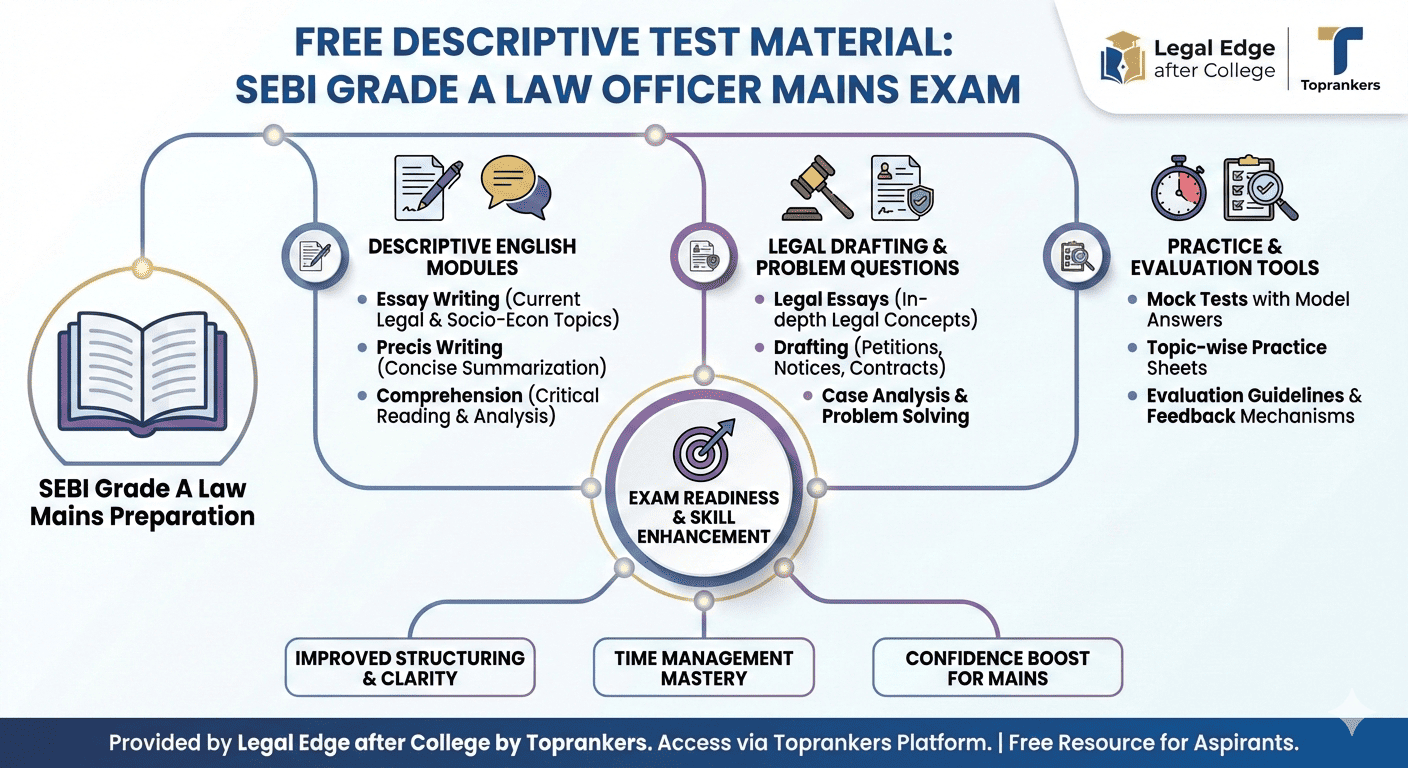
Where Can You Find Free Resources for Your Preparation?
Toprankers provides high-quality free content through its dedicated YouTube channel, LegalEdge After College. These resources are designed to save you time and provide expert-led insights.
- YouTube Strategy & Topic Videos: Access specialised videos that break down complex Securities Law regulations into "doable" segments.
- Important Topic Discussions: Expert faculty, including Raj sir, regularly upload sessions on "What to Expect from Security Laws" and "Important Sections You Cannot Skip".
- Current Affairs & Legal Updates: Follow the channel for updates on official SEBI notifications and circulars, which are crucial for the exam.
- Special Discount: For those looking to transition from free resources to structured practice, use the coupon code LEACYT to avail a 10% discount on all courses, including test series and crash courses.
How to Stay Consistent in Your Revision?
To succeed, you must move beyond simple memorisation. Use the following six-step preparation method recommended by experts:
- Primary Source: Stick to the Bare Acts and official SEBI regulations as your primary reading material.
- Order of Study: Start with the SEBI Act, followed by the SCRA and the Depositories Act, before moving into specific regulations.
- Short Notes: Create one-liners or flowcharts for compliance timelines and penalty sections for quick revision.
- Daily MCQ Practice: Dedicate time every day to solving topic-wise MCQs to build speed.
- Weekly Mock Tests: Attempt at least two full-length mocks per week to acclimatise to the exam environment.
- Writing Practice: Do not ignore descriptive writing; try writing at least one answer daily to maintain your speed and flow.
Check: SEBI Legal Officer Salary 2026
Key Takeaways for SEBI Grade A Aspirants
- Securities Law accounts for 40% of the Legal Paper, and it is the most critical subject for Phase 2.
- Mix of Objective & Subjective: Prepare for both 70 marks of MCQs and 30 marks of descriptive writing.
- Focus on PIT and SAST: These regulations are "SEBI favourites " and frequently appear in exams.
- Use Free YouTube Resources: Leverage LegalEdge After College for strategy and conceptual clarity.
- Avoid memorisation: Focus on understanding how the law applies to solve scenario-based questions.
By following this structured approach and utilising the free resources at Toprankers, you can confidently navigate the complexities of Securities Law and move one step closer to your dream career at SEBI.

Take a Free SEBI Mock Test
Fill your details
Frequently Asked Questions
What is the importance of taking a SEBI Grade A mock test?

Do you offer free mock tests for SEBI Grade A preparation?
How can I access the SEBI Grade A mock test series?
Is there a specific mock test for SEBI Grade A officers?

Shayant Kumar Pathak
Communications Lead - Legal Edge After College
SHARE