


Delhi APP Preparation Tips 2026: Study Plan & Strategy for January 2027 Exam
October 30, 2026
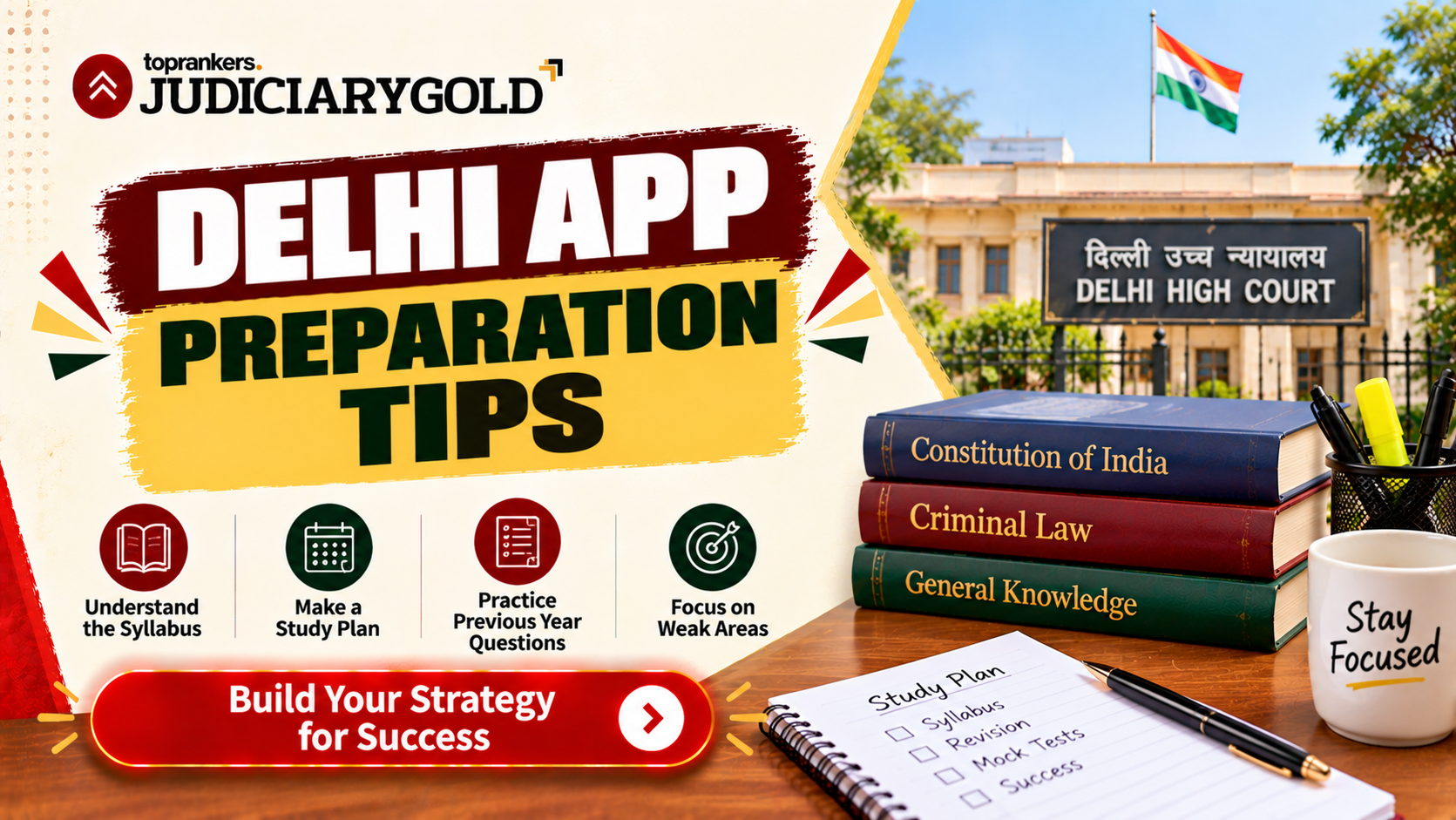
The most useful Delhi APP preparation tips for the 9 January 2027 Recruitment test is to study the 15 Acts in UPSC's official syllabus.
Candidates can study from the bare Acts for Constitution, BNSS, BNS and BSA, practise statement-based MCQs under a two-hour timer, and attempt a doubtful question only when you can eliminate at least one option.
- UPSC will hold the Delhi APP recruitment test on 9 January 2027 (Saturday), 2:00 PM to 4:00 PM, offline, for 140 Assistant Public Prosecutor posts under Advertisement No. 11/2026.
- The test carries 75% of the final merit and the interview 25%, so the written paper decides most of the result.
- Wrong answers cost one-third of a question's marks.
- IPC, CrPC and the Indian Evidence Act are not in the syllabus. Study BNS, BNSS and BSA section numbers, not the old ones.
Delhi APP Exam Pattern 2026 Overview
The Delhi APP recruitment test is a two-hour, offline, objective paper in English, with one-third negative marking, followed by an interview.
Candidates should know the Delhi APP exam pattern with full clarity before starting preparations for the exam.
| Particulars | Details |
|---|---|
| Conducting Body | Union Public Service Commission (UPSC) |
| Posts | 140 Assistant Public Prosecutor posts (Group A, Gazetted, Level 10) |
| Advertisement | No. 11/2026, published on 10 September 2026 |
| Recruitment Test Date | 9 January 2027 (Saturday), 2:00 PM to 4:00 PM |
| Mode | Offline, pen and paper |
| Question Type | Objective multiple-choice questions, with equal marks for each question |
| Medium | English only |
| Negative Marking | One-third of the marks assigned to a question deducted for each wrong answer; no deduction for unanswered questions |
| Final Merit | Recruitment Test: 75%; Interview: 25% |
| Admit Card | Awaited |
Subject-wise Delhi APP preparation tips
The Delhi APP paper does not weigh all 15 Acts equally, so candidate’s' preparation shouldn’t either. The tips below follow the question count from UPSC’s January 2026 law paper, starting with the subjects that carried the most marks.
- Constitution (24 questions) -This was the single largest block, and UPSC's questions test the text, not commentary. One January 2026 question asked which reservation category has a percentage ceiling written into Article 16 itself (the answer is EWS, Article 16(6), up to 10%). Read the bare text of Parts III and V and the Union Territory articles, and make a one-page list of every number the Constitution states.
- BNSS (17 questions) - Criminal practitioners lose easy marks here by answering from CrPC memory. The 2026 paper asked about the new 20-year cap on aggregate consecutive sentences (s. 25), interim ex parte attachment of crime proceeds (s. 107) and seizure during property tracing (ss. 116–117), all areas that changed or are new. Keep a change sheet with three columns: old CrPC section, new BNSS section, what changed.
- BNS and BSA (27 questions together) - Learn section numbers in the new scheme. For BSA, give special time to electronic evidence and the certificate under s. 63, which replaced the old s. 65B. For BNS, list the offences that did not exist under IPC.
- Companies Act (15 questions) - This is the surprise for most court-room advocates. Questions are precise on thresholds: one-tenth of paid-up capital to requisition an EGM, three-fourths in value for a scheme, 2:1 post-buy-back debt ratio, seven years for IEPF transfer. Build a numbers table from Chapters IV, VII, VIII and XV rather than reading the Act cover to cover.
- Anti-corruption and money laundering (PC Act, PMLA, DSPE, CVC: 18 questions) - UPSC likes recent Supreme Court judgments here. The 2026 paper used State v C B Nagaraj (May 2025) on proof of demand and Vijay Madanlal Choudhary (2022) on PMLA. Track Supreme Court corruption and PMLA rulings from 2024 up to December 2026.
- IT Act and Competition Act (15 questions together) - Both reward definition-level precision. Know which section does what (69 interception, 69A blocking, 69B traffic data), and which factors in s. 19 belong to agreements, dominance, geographic market or product market.
- Contract, Trade Marks and GI Acts - Not tested last time, so give them a short, targeted pass in the final month: definitions, the main tests and the offence sections.
Delhi APP 2026 Study Plan
Candidates should spend the first five weeks on the Constitution and the three criminal codes, the next three on special statutes, and the last two almost entirely on timed papers and revision.
| Week | Main Work | Output by the End of the Week |
|---|---|---|
| 1–2 | BNSS and BSA: bare Act reading | CrPC-to-BNSS and IEA-to-BSA change sheets |
| 3 | BNS | List of new offences and renumbered general exceptions |
| 4 | Constitution: Parts III, IV, V and VI | One-page list of numbers and time limits in the text |
| 5 | Constitution: Union Territories, services, emergency provisions and constitutional bodies; first full mock | Error log started |
| 6 | PC Act, DSPE Act, CVC Act and PMLA | Case-law sheet covering 2022 onwards |
| 7 | Companies Act thresholds and IT Act; download the admit card when released | Companies Act numbers table |
| 8 | Competition, Environment, Contract, Trade Marks and GI Acts; two mocks | Section-to-subject map for these five Acts |
| 9 | A full mock every other day at 2:00 PM; revision using the error log | Improving mock scores and fewer wrong answers |
| 10 | Revise change sheets and numbers tables only; complete the last mock by 6 January | Rest on 8 January |
How should you revise in the last 15 days?
Revise from three notes you built yourself, not from fresh books: your change sheets (old law to new law), your numbers tables (percentages, days, years) and your error log from mocks.
- Write each wrong mock answer as one line: the section, the trap and the correct rule.
- By the final week that log is the most valuable thing you own, because it is a list of the exact mistakes you are likely to repeat.
Which books and resources should you use for the Delhi APP exam 2026?
Candidates can start with the bare Acts and then refer to a commentary for clarification. Use previous papers to identify relevant statutory provisions and judgments for revision.
| Resource Type | What to Use |
|---|---|
| Bare Acts | Current text of all 15 Acts from India Code, the Government of India's official repository |
| Constitution | A bare Constitution plus D.D. Basu's Shorter Constitution of India or M.P. Jain's Indian Constitutional Law |
| Criminal Laws | Current BNS, BNSS and BSA editions with comparative tables for the IPC, CrPC and Indian Evidence Act |
| Corporate and Commercial Law | Avtar Singh's Company Law and Law of Contract |
| Previous Papers | UPSC's January 2026 combined law paper, published on the UPSC website |
Candidates can refer for notes and topic-wise MCQ practice, the APO/ADPO study material covers the same criminal-law core as the Delhi APP syllabus.
Common Mistakes in Delhi APP Preparation 2026
The common mistakes that candidates generally do are - studying the old criminal codes, ignoring the corporate and economic statutes, and practising without the negative-marking penalty. Each one shows up directly in the score.
- Answering from CrPC and IPC memory - A question on BNSS Section 25 expects the 20-year aggregate cap, not the old 14-year figure. Habit is the trap, and experienced advocates fall into it more often than fresh readers.
- Treating it as a pure criminal-law exam - The Companies Act, IT Act and Competition Act gave 30 of 120 questions in January 2026. Skipping them gives away a quarter of the paper.
- Reading commentaries before the bare Act - UPSC's options are usually built from the statutory wording, with one word changed: "special resolution" for "special notice", "two-thirds" for "three-fourths", "may" for "shall".
- Guessing blind - With one-third negative marking, a pure guess gains nothing on average. Leave it unless you can rule out at least one option.
- Practising untimed - A mock without the two-hour limit and the penalty tells you what you know, not what you will score.
How does negative marking change your attempt strategy?
A wrong answer costs one-third of a question's marks, so three wrong answers cancel one right answer. Candidates can check that on a four-option question, the arithmetic looks like this:
| Your Position on the Question | Chance of Being Right | Expected Marks per Question |
|---|---|---|
| Pure guess (no option eliminated) | 1 in 4 | 0 (no gain or loss on average) |
| One option ruled out | 1 in 3 | +1/9 of full marks |
| Two options ruled out | 1 in 2 | +1/3 of full marks |
| Sure of the answer | Certain | Full marks |
How should you prepare for the Delhi APP interview 2026?
The interview carries 25% of the final merit, and UPSC sets a minimum standard of suitability: 50 for General and EWS, 45 for OBC, and 40 for SC, ST and PwBD candidates,, as mentioned in the Delhi APP Exam dates details.
Candidates can start interview preparation only after the written test. Also you can expect questions on your own practice, recent Delhi High Court and Supreme Court criminal rulings, the shift to BNS/BNSS/BSA, and how a prosecutor balances fairness to the accused with the duty to the State.
Key Takeaways
Here is a quick summary of the Delhi APP preparation tips 2026 and how the exam works:
- UPSC conducts the Delhi APP recruitment test on 9 January 2027 for 140 Assistant Public Prosecutor posts. The test counts for 75% of the final merit and the interview for 25%.
- A two-hour objective paper in English with one-third negative marking. The January 2026 UPSC law paper had 120 questions for 300 marks, so plan for about one minute per question.
- 15 Acts, led by the Constitution and the three 2023 criminal laws (BNS, BNSS, BSA). IPC, CrPC and the Indian Evidence Act are not tested.
- The Constitution (24), BNSS (17), Companies Act (15), BNS (14) and BSA (13) led the January 2026 paper. The Constitution and the criminal codes alone gave 68 of 120 questions.
- The Companies Act, IT Act and Competition Act together gave 30 questions, a quarter of the paper.
- Weeks 1–5 for BNSS, BSA, BNS and the Constitution; weeks 6–8 for anti-corruption, economic and commercial statutes; weeks 9–10 for full mocks at 2:00 PM and revision.
- UPSC builds options from statutory wording with one word changed, so read the current text before any commentary.
- In the last 15 days, use your change sheets, numbers tables and mock error log rather than new books.
If you want a structured guidance, take a free demo online class or talk to a Judiciary Gold counsellor about the Judiciary APO Coaching 2026.
Frequently Asked Questions
Is the Delhi APP exam the same as the CBI APP exam?

Is 10 weeks enough to prepare for the Delhi APP exam?
Can I prepare for Delhi APP 2026 while practising full-time?
How many hours a day should I study for Delhi APP 2026?
Are case laws asked in the Delhi APP exam?
Where can I find Delhi APP study material and previous papers?
Nancy Mahavir Sharma
Legal Writer
SHARE