
1723534562.png)

What are CAT Functions Questions, Graphs and Statistics in CAT?
CAT Functions, Graphs and Statistics questions are one of the important topics within the Algebra section of CAT Quantitative Aptitude. It tests a range of skills - from abstract manipulation of functional equations to visual reasoning about graphs and the ability to compute and interpret statistical measures.
The three sub-areas are closely linked. Function problems often require graph interpretation to determine the number of roots or to find areas. Statistical problems frequently involve functions of a dataset, such as computing the mean of a transformed set. Understanding how these three areas interact is key to solving harder CAT questions efficiently.
| Sub-Topic | What It Covers | Example CAT Question Type |
|---|---|---|
| Functions | Domain, range, composite functions, functional equations, max/min functions, modulus, floor/ceiling | Find f(g(x)), find domain of h(x), solve f(x) = f(f(x)) |
| Graphs | Plotting curves, intersections, area under curves, graph transformations, absolute value graphs | Find area bounded by |x| + |y| = 2, count intersections of two curves |
| Statistics | Mean, median, mode, range, standard deviation, interpretation of data sets | Find max minus min of group mean, analyse score distributions |
To ensure you are not missing any similarly important topics, checking the CAT Exam Syllabus 2026 is advised.
CAT Functions, Graphs and Statistics Topic Weightage Over Past 8 Years
The table below gives the year-wise number of questions from Functions, Graphs and Statistics in the CAT QA section. The weightage varies significantly year to year, making it important to prepare the topic thoroughly rather than guess whether it will be heavy or light.
| Year | Weightage (No. of Questions) | Difficulty Level | Key Focus Area |
|---|---|---|---|
| CAT 2025 | 3 | Medium-Hard | Range of rational function, Composite function domain, Max-Min equation |
| CAT 2024 | 5 | Medium-Hard | Surjective functions (counting), Multiplicative functions, Max-Min, Floor function |
| CAT 2023 | 2 | Medium | Area bounded by modulus lines, Two-variable function |
| CAT 2022 | 5 | Medium-Hard | Modulus max function, Quadratic function, Recurrence function, Piecewise function, Floor function |
| CAT 2021 | 1 | Medium | Composite function minimum value |
| CAT 2020 | 8 | Medium–Hard | Quadratic function, Real roots, Area under inequalities, Statistics (mean), Exponential function, Symmetry of roots, Integer pairs, Trapezium area |
| CAT 2019 | 5 | Medium | Exponential function, Piecewise function, Cosine equation, Area with modulus, Multiplicative function |
| CAT 2018 | 3 | Medium | Max/Min functions, Recurrence function |
Student Tip: CAT 2020 had 8 questions from this topic - the highest in recent history. Even in lighter years like 2021 and 2023, the questions that did appear were conceptually demanding and required strong foundational understanding of functions.
CAT Functions, Graphs and Statistics Formulas PDF
A strong command of formulas is essential for solving Functions, Graphs and Statistics problems efficiently. The formulas below cover three areas: Algebra Identities (used in functional equations), standard Function formulas, and Statistics formulas.
Functions - Key Concepts and Formulas
1. Algebra Identity Formulas
These identities are foundational for simplifying expressions in functional equation problems. Memorise them and recognise which identity to apply quickly under exam conditions.
2. Types of Functions
Understanding the classification of functions is essential for domain, range, and composition problems.
| Type | Definition | Example |
|---|---|---|
| One-One (Injective) | Every element in the domain maps to a unique element in the codomain. f(x1) = f(x2) implies x1 = x2. | f(x) = 2x + 3 |
| Onto (Surjective) | Every element in the codomain has at least one pre-image in the domain. | f: R → R, f(x) = x³ |
| Bijective | Both one-one and onto. The function has a perfect inverse. | f(x) = x (identity function) |
| Even Function | f(–x) = f(x) for all x. Graph is symmetric about the y-axis. | f(x) = x², f(x) = cos(x) |
| Odd Function | f(–x) = –f(x) for all x. Graph has rotational symmetry about the origin. | f(x) = x³, f(x) = sin(x) |
3. Composite and Inverse Functions
4. Modulus, Floor, and Ceiling Functions
5. Multiplicative and Additive Functional Equations
These are a class of functional equations directly tested in CAT where a function satisfies a specific rule for all inputs. The most common types are:
Also Check | IIM Waitlist Movement 2026
Graphs - Key Concepts and Area Formulas
Graph-based questions in CAT typically involve plotting modulus or absolute value functions and finding the area of the enclosed region. These questions are often classified as medium-to-hard but are highly scorable once you know the standard approach.
Standard Graph Transformations
Area Under Modulus Graphs
Questions involving the area of regions defined by inequalities like |x| + |y| ≤ k or |x - y| ≤ k are standard CAT questions. The key approach is to remove the modulus by considering cases and identifying the resulting geometric shape.
Statistics - Key Concepts and Formulas
Statistics questions in CAT are fewer in number but can be highly scoring. They typically involve finding or comparing measures of central tendency (mean, median, mode) and occasionally standard deviation, for a group or sub-groups of data.
Arithmetic Mean
Sum of all values / Number of values
Median
Middle value when data is arranged in order
Mode
Value that appears most frequently in the data set
Statistics Formulas for CAT
Mean of n Values Mean = (x1 + x2 + ... + xn) / n
Median (odd n) Value at position (n+1)/2 when sorted in ascending order
Median (even n) Average of values at positions n/2 and (n/2)+1
Range Range = Maximum value - Minimum value
Weighted Mean Weighted Mean = (w1x1 + w2x2 + ... + wnxn) / (w1 + w2 + ... + wn)
Combined Mean If group 1 has n1 elements with mean m1 and group 2 has n2 with mean m2: Combined Mean = (n1*m1 + n2*m2) / (n1 + n2)
Variance σ² = [Σ(xi - mean)²] / n
Standard Deviation σ = sqrt(Variance)
Types of Questions Asked in CAT
CAT questions from this topic can be broadly grouped into the following types. The difficulty level and approach differ significantly across types.
| Question Type | Description | Difficulty |
|---|---|---|
| Functional Equations | Given a rule like f(xy) = f(x)f(y) or f(x+y) = f(x) + f(y), find f at a specific value or determine the function. | Medium–Hard |
| Composite Functions | Find f(g(x)), determine domain of h(x) = f(g(x)) + g(f(x)), or evaluate f(f(f(x))) at a specific point. | Medium |
| Max and Min Functions | Problems of the form f(x) = max{expression1, expression2}. Find the minimum of the max or maximum of the min. | Medium |
| Modulus Function Problems | Solve equations or find the minimum of expressions involving |x|, |x-a|, |x-b|. Often requires case analysis. | Medium |
| Floor / Ceiling Functions | Problems involving [x] (greatest integer function). Find the sum of a series involving floor values or solve floor equations. | Medium–Hard |
| Area Under Graphs | Find the area of regions bounded by modulus-based lines, inequalities, and curves. Uses geometry after plotting. | Medium |
| Curve Intersections | Determine how many times two curves intersect, or find the number of real roots of an equation by graphical analysis. | Medium–Hard |
| Statistical Measures | Find mean, median, or range for a dataset or sub-group. Often involves comparing sub-group means or finding extreme values. | Easy–Medium |
| Piecewise Functions | Evaluate or analyse functions defined differently in different intervals. Check continuity and solve equations within each interval. | Hard |
| Surjective Function Counting | Count the number of onto functions from set A to set B using the inclusion-exclusion principle. | Hard |
Also Read | CAT Arithmetic Syllabus 2026
Tips and Tricks for CAT Functions, Graphs and Statistics
Below are expert tips compiled from CAT toppers and coaching faculty. These shortcuts will help you solve questions faster and avoid the most common errors in this topic.
-
For max{f, g}: minimum occurs where f(x) = g(x)
The minimum value of max{f(x), g(x)} is found at the intersection of f and g. This avoids calculus entirely and can be solved in under 30 seconds once you set up the equation correctly.
-
For modulus sum f(x) = |x-a| + |x-b| + |x-c|, the minimum is at the median
When you have an odd number of absolute value terms, the function is minimised when x equals the median of a, b, c, ... This is a direct result of the triangle inequality and saves significant time.
-
Identify the functional equation type before solving
Check whether f satisfies f(xy) = f(x)f(y) (power/constant), f(x+y) = f(x)f(y) (exponential), or f(x+y) = f(x)+f(y) (linear). Each type has a known general solution, so recognition saves you from deriving it from scratch.
-
For symmetry questions: if f(a+x) = f(a-x), then x = a is the axis of symmetry
This means every root r is paired with a root (2a - r). If there are four distinct roots r1, r2, r3, r4, then r1 + r2 + r3 + r4 = 4a. This shortcut appears almost every two to three years in CAT.
-
Substitute x = y = 0 or x = y = 1 as the first step in functional equations
In any functional equation, the first substitution to try is always x = y = 0 (to find f(0)) and then x = y = 1 (to find f(1)). These two values frequently unlock the rest of the solution.
-
For floor function series, group terms by integer value
When evaluating a sum like sum of [n/k] from n = 1 to N, group the values of n for which [n/k] equals the same integer. The number of terms in each group is easy to count and avoids term-by-term calculation.
-
For area problems: remove modulus first, then identify the shape
When given |x| + |y| = k or |x - y| = k, open the modulus case-by-case (four cases for two modulus terms), find the boundary lines, and identify the geometric shape — usually a square, triangle, or trapezium — before applying the area formula.
-
For statistics questions involving sub-groups, use total sum as the bridge
If the mean of the lowest 9 scores in a group of 10 is given, and the mean of the highest 9 is also given, find the total sum of each group of 9 and use the difference to relate the highest and lowest scores. This appears almost every year in one form or another.
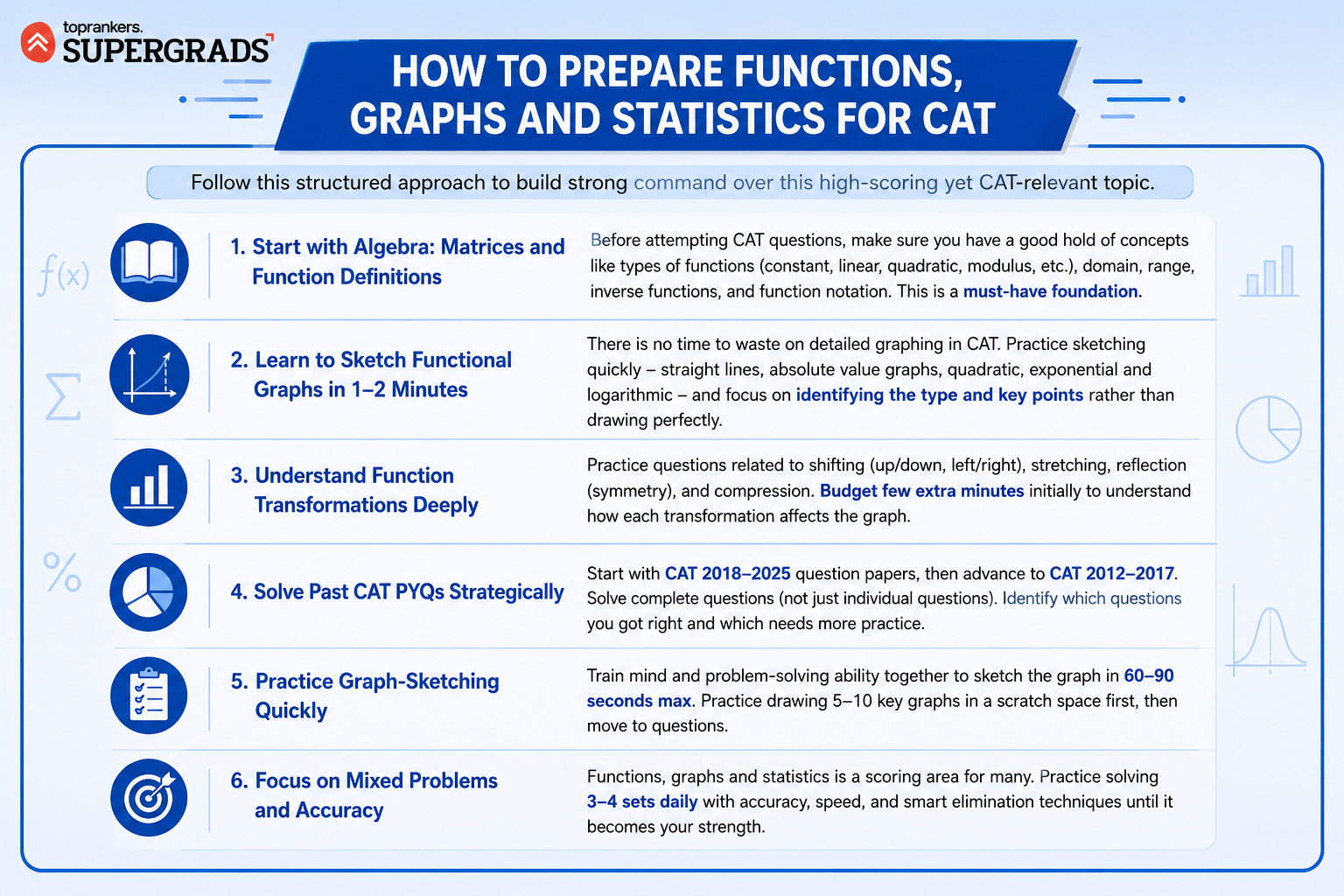
How to Prepare Functions, Graphs and Statistics for CAT
Follow this structured approach to build strong command over this topic before your CAT attempt.
-
Start with Algebra Identities and Function Definitions
Before attempting any CAT question, make sure you have all the algebra identity formulas memorised and understand the definitions of domain, range, injective, surjective, and bijective functions. This is the non-negotiable foundation.
-
Learn the Standard Functional Equation Types
There are four or five recurring functional equation templates in CAT. Practise each type - multiplicative, additive, exponential, and recurrence-based - until you can identify the type and write the general solution immediately.
-
Master Modulus Function Case Analysis
Modulus questions require you to split into cases based on sign conditions. Practise this systematically: identify the critical points where the expression inside the modulus changes sign, then solve each interval separately. Speed comes with repetition.
-
Solve Year-Wise PYQs Strategically
Start with CAT 2018–2021 questions (more standard question types), then advance to CAT 2022–2025 (more complex piecewise and surjective function questions). Identify which question types you find difficult and prioritise those in your revision.
-
Practise Graph Sketching Quickly
For area-based problems, the ability to quickly sketch an accurate graph is the skill that separates fast solvers from slow ones. Practise sketching |x| + |y| = k, y = |x - a|, and piecewise functions until it becomes automatic.
-
Integrate with Full-Length Mock Tests
During full-length CAT mocks, flag Functions and Graphs questions separately and track your accuracy and time per question. This helps you decide - based on real data - which question types you should attempt first in the actual exam.
CAT Functions, Graphs and Statistics Questions (Year-wise)
Below are CAT Previous Year Questions on Functions, Graphs and Statistics from 2025 to 1991, with detailed video solutions by CAT experts. These questions cover all sub-types tested in the paper and are arranged year-wise for targeted practice.
Questions Will Be Added Here
Year-wise CAT Functions, Graphs and Statistics questions (2025 to 1991) with detailed solutions will be placed in this section.
This section will be updated shortly.
Conclusion
CAT Functions Questions, Graphs and Statistics is a topic that rewards candidates who invest time in understanding concepts rather than just memorising formulas. With weightage ranging from 1 to 8 questions across different years, it can be a significant contributor to your QA score - or a deciding factor in a tough paper.
Focus on the core functional equation types of CAT Functions Questions, master modulus case analysis, and build the habit of quickly sketching graphs for area-based problems. Practise the year-wise PYQs systematically, starting from older and more standard questions before moving to recent complex ones.
For a complete and structured preparation approach, you can also explore the Supergrads CAT Online Course which covers all QA topics with dedicated video lectures, formula sheets, and question banks.


SHARE