
1723534562.png)

AILET Marks vs Rank 2026: Good Score for NLU Delhi
December 15, 2025
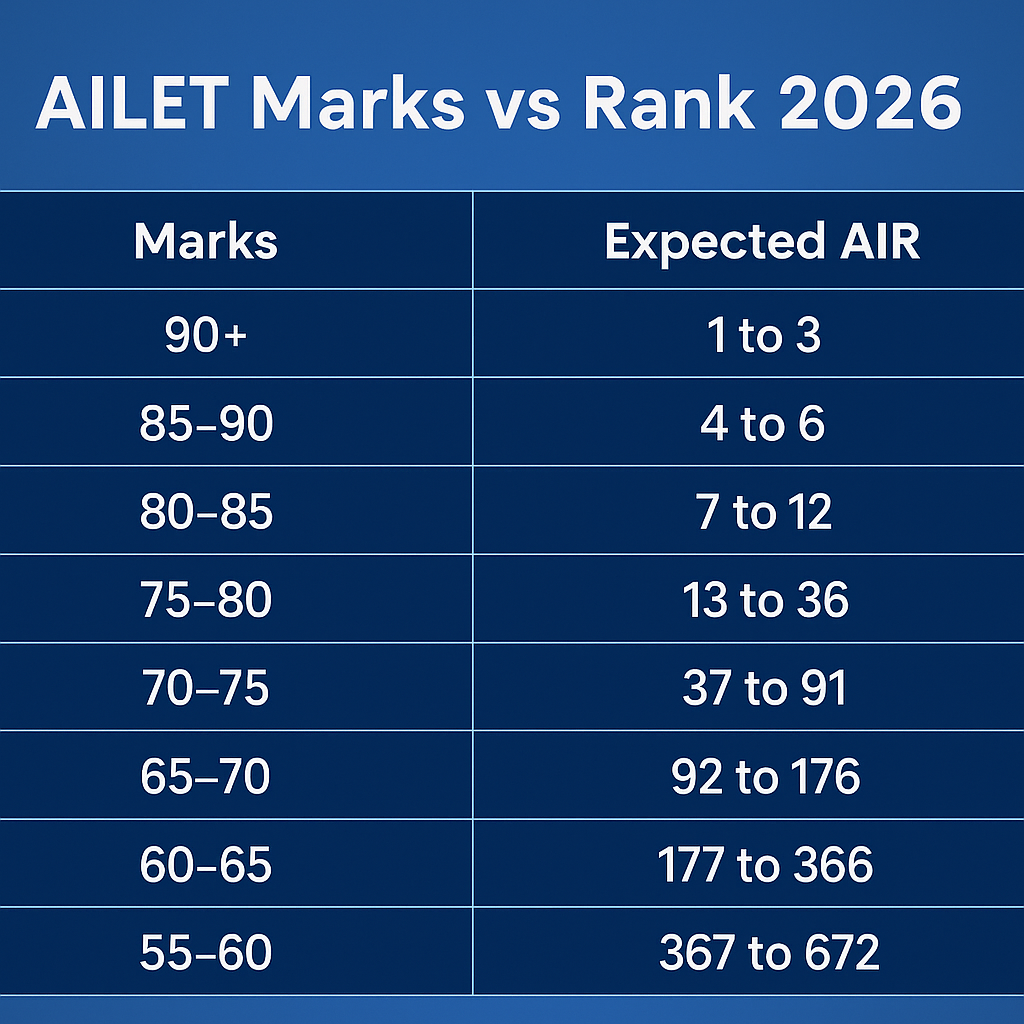
AILET marks vs rank is a trend-based estimate that helps you predict your expected All India Rank (AIR) from your AILET score. In general, 90+ marks can place you around AIR 1–3, 80–85 marks around AIR 7–12, 70–75 marks around AIR 37–91, and 60–65 marks around AIR 177–366, though the final rank can shift each year based on paper difficulty, score distribution, and tie-breakers.
If you’re searching AILET Marks vs Rank, you’re basically asking one thing: “My score = what AIR (All India Rank) can I expect?”
This page gives you a trend-based AILET marks vs rank table, a reverse planner (rank goal → marks you should target), a quick score calculator using negative marking, and the tie-breaker logic that usually decides ranks when marks are the same.
One important thing to keep in mind: AILET 2026 Marks vs Rank is never 100% fixed in AILET. Every year, ranks shift based on the paper’s difficulty, overall accuracy levels, and how the candidate pool performs. So the most practical way to use “marks vs rank” is to treat it as a range, not as a single exact number.
Quick Answer: AILET Marks vs Rank (Most Searched)
Here are the most searched score bands and the expected rank range they usually translate to:
-
90+ marks → Expected AIR ~1 to 3
-
85–90 marks → Expected AIR ~4 to 6
-
80–85 marks → Expected AIR ~7 to 12
-
75–80 marks → Expected AIR ~13 to 36
-
70–75 marks → Expected AIR ~37 to 91
-
65–70 marks → Expected AIR ~92 to 176
-
60–65 marks → Expected AIR ~177 to 366
Tip: If your score is near a boundary (like 79.75 vs 80.25), consider the wider band. Near AILET cut-offs, even one mark can shift rank sharply.
AILET UG Basics (BA LL.B.) You Must Know Before Predicting Rank
AILET UG is typically structured like this:
-
Total Questions: 150 MCQs
-
Total Marks: 150
-
Duration: 120 minutes
-
Sections:
-
English: 50
-
Current Affairs & GK: 30
-
Logical Reasoning: 70
-
-
Negative Marking: -0.25 per wrong answer
This negative marking is what makes AILET ranking so sensitive. 4 wrong answers = -1 mark, and that single mark can move you dozens of ranks in competitive zones.
AILET Score Calculator (+1 / -0.25)
To calculate your expected score from the AILET 2026 answer key, use:
Expected Score = (Correct × 1) − (Wrong × 0.25)
Example
If you attempted 120 questions and got 92 correct and 28 wrong:
Score = 92 − (28 × 0.25)
Score = 92 − 7
Score = 85
This final score is what you should match with the marks vs rank table—not the number of attempts.
AILET Marks vs Rank 2026 (Expected Table)
Use this as your practical AILET rank predictor after you calculate your final marks.
AILET Score to Expected AIR Mapping
-
90+ → 1 to 3 (Topmost bracket, strongest zone)
-
85–90 → 4 to 6 (Very high probability zone)
-
80–85 → 7 to 12 (Top 15-ish territory)
-
75–80 → 13 to 36 (Top 50-ish territory)
-
70–75 → 37 to 91 (Competitive zone)
-
65–70 → 92 to 176 (Borderline-to-possible depending on category/list movement)
-
60–65 → 177 to 366 (Mostly category-dependent / later lists)
-
55–60 → 367 to 672 (Low probability unless category advantage)
-
50–55 → 673 to 1116 (Generally outside typical admission band)
-
45–50 → 1117 to 1790
-
40–45 → 1791 to 2671
-
35–40 → 2672 to 4023
-
30–35 → 4024 to 5692
-
Below 30 → 5693 and below
Rank Goal → Marks Target (Reverse Table)
Many students think in outcomes first: “Top 10”, “Top 50”, “Top 100”. Use this reverse planning guide.
-
Target AIR Top 3 → Aim 90+ (Safe buffer: try 92–95)
-
Target AIR Top 10 → Aim 80–85+ (Safe buffer: try 86+)
-
Target AIR Top 25 → Aim 75–80+ (Safe buffer: try 80+)
-
Target AIR Top 50 → Aim 72–78 (Safe buffer: try 78+)
-
Target AIR Top 100 → Aim 70–75 (Safe buffer: try 75+)
-
Target AIR Top 200 → Aim 65–70 (Safe buffer: try 70+)
This section usually helps a page outrank competitors because most pages only give a table, but don’t help users plan targets.
What is a “Good Score” in AILET?
“Good score” isn’t an official term—it’s a practical benchmark for real admission chances.
Use these simple bands:
-
90+ marks: Elite zone (top ranks)
-
80–89 marks: Strong zone (high probability band)
-
70–79 marks: Competitive zone (category + list movement matters)
-
60–69 marks: Borderline zone (often category dependent)
If your goal is to secure a strong rank, treat Logical Reasoning as your rank-protection section—because it impacts score heavily and also influences tie-breakers.
AILET Tie-Breaker Rule (When Marks Are Same)
AILET often has score clusters. When two candidates score the same marks, ranks are decided using tie-breakers. Commonly used order:
-
Higher marks in Logical Reasoning
-
The candidate is a senior in age
-
Computerised draw of lots (if still tied)
That’s why LR matters even beyond marks—it can decide your rank when the total score is identical.
How to Use This Like a Real AILET Rank Predictor
Here’s the best way to predict rank without confusion:
-
Calculate your score accurately using +1 and -0.25
-
Match your score with a band in the marks vs rank table
-
Use a safety buffer if you’re near a boundary (70/75/80 are common cut zones)
-
Account for tie-break sensitivity (LR marks matter in ties)
-
After the AILET results, compare with the official closing ranks and update expectations
Common Mistakes While Predicting AILET Rank
Avoid these, and your estimate becomes instantly more reliable:
-
Comparing attempts instead of the final score
-
Ignoring negative marking impact (a few wrong answers can drop multiple ranks)
-
Treating expected rank as an “exact” number
-
Not considering tie-breakers near cut-offs
-
Assuming one-year trend tables are permanent
Final Note
The AILET Marks vs Rank data above is an expected trend-based mapping meant for smart estimation and planning. The final ranks depend on official score distribution and tie-breaker application.
Frequently Asked Questions
What does AILET Marks Vs Rank mean?

Is the score-to-rank mapping always accurate?
Does negative marking change my expected rank a lot?
Why do two candidates with the same marks get different ranks?
If my score is close to a boundary (like 79–80), what should I assume?
How should I use the AILET Marks Vs Rank table properly?

Samriddhi Pandey
Content Writer
SHARE